
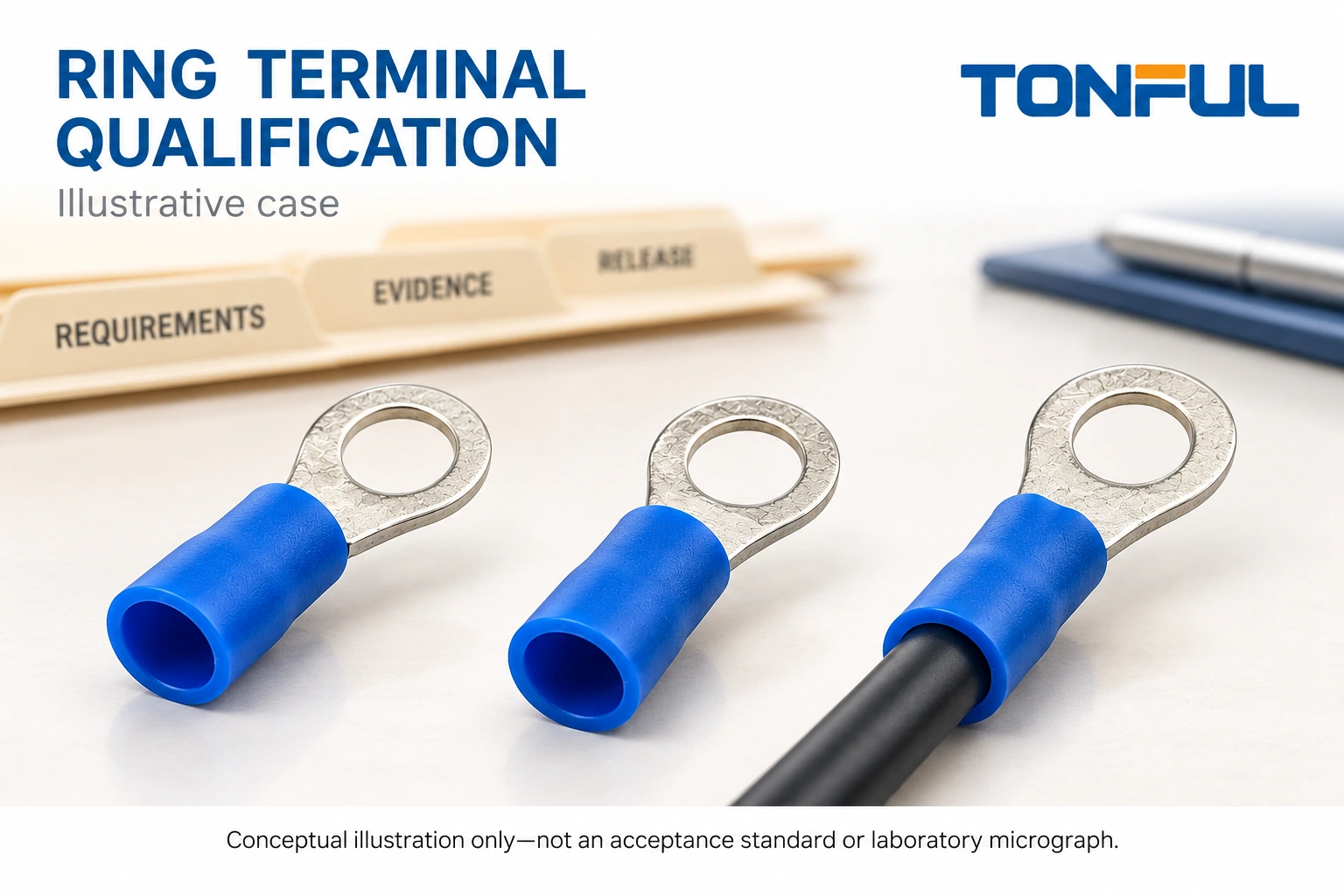
A terminal sample can fit a wire, survive a pull check and still be unsuitable for production. The missing evidence may concern the actual wire construction, stud interface, tooling, electrical load, environment or a supplier change. Electrical terminal qualification connects those details to a defined purchasing decision instead of treating one attractive sample as approval.
The following case is illustrative, not a report of a TONFUL customer project. No actual sample measurements, customer names, certification results or approval outcomes are claimed. It follows a hypothetical equipment builder selecting crimped ring terminals for stranded copper panel leads. The example shows what changes a decision from incomplete to reviewable; numerical limits remain fields for the responsible engineer to approve.
Contents
- Define the Application and Qualification Boundary
- Resolve the First Sample Review
- Build the Evidence Plan
- Follow the Case Through Approval Gates
- Control Production and Later Changes
- Work With TONFUL
Define the Application and Qualification Boundary
The Starting Request
The hypothetical buyer initially asks for an insulated ring terminal that matches an existing lead. That request describes a product family, not an approved termination system. The engineering review first identifies the wire specification, conductor material and stranding, insulation diameter, landing stud, contact surface, available space and maintenance access. It also establishes whether an existing approved design is being replaced or a new assembly is being developed.
TONFUL’s wire terminal product scope provides a starting point for enquiry. A category listing does not establish that a specific terminal meets the hypothetical application. The selected SKU, drawing revision, construction and supporting documentation must be identified before assigning evidence to it.
The qualification boundary includes the crimp, ring-to-stud connection and installed lead support. Approval does not extend to other constructions such as cord-end ferrules, whose receiving terminal and preparation requirements differ. Panel loading, enclosure temperature and equipment safety remain responsibilities of the equipment design team.
The Requirements Record
| Requirement field | Entry required before test approval | Responsible reviewer |
|---|---|---|
| Wire identity | Specification, supplier, size, stranding and insulation diameter | Harness engineer |
| Terminal identity | SKU, drawing revision, material, plating and insulation construction | Component engineer |
| Landing interface | Stud, palm envelope, hardware stack and approved tightening procedure | Equipment engineer |
| Electrical duty | Load profile, protection and temperature conditions | Electrical engineer |
| Environment | Heat, moisture, chemicals, vibration and service exposure | Application owner |
| Process | Tool, die, cavity, settings and preparation instruction | Manufacturing engineer |
| Acceptance | Each characteristic, limit, method and source revision | Quality and design authority |
Missing entries are open requirements, not permission to use a familiar workshop value. The buyer records which omissions prevent sampling and which can be resolved during drawing review. This prevents a purchase order from silently becoming the technical specification.
Resolve the First Sample Review
An Apparently Equivalent Terminal
In the illustrative first review, the candidate has the expected ring appearance and an insulation color similar to the existing part. Neither observation proves equivalence. The reviewer compares the full stud-hole tolerance, palm width, barrel construction and insulation clearance against the installed assembly. A nominal stud label alone does not show that the washer stack seats correctly or that adjacent hardware remains accessible.
Material alternatives are reviewed separately. The nylon-insulated terminal range can inform a construction discussion, but the material name does not establish heat, flame, vibration or sealing performance for an unspecified SKU. A change from one insulation system to another requires its own rationale and evidence.
The hypothetical candidate is placed on hold because its drawing and tool compatibility record are incomplete. This is an example of a decision rule, not a statement that an actual TONFUL sample failed. The corrective action is to obtain the missing controlled documents, not to repeat informal pulls until a convincing result appears.

Match the Process Before Testing
The manufacturing engineer requests the terminal-to-tool compatibility record, die identification and preparation instructions. Molex’s application-tooling guidance explains where its product-specific tooling specifications provide strip length, crimp height and pull-force information. This is an example of the evidence type to request, not authority to apply Molex limits or tools to a different manufacturer’s terminal.
For the proposed TONFUL combination, review the exact crimping tool and die profile rather than selecting by handle color or wire-size marking alone. A self-adjusting ferrule tool, open-barrel die and insulated-terminal die perform different jobs. The tool’s advertised range does not validate every terminal within that conductor range.
Build the Evidence Plan
Allocate Samples Before Results Exist
The approved plan names sample quantity, selection basis, production lots and responsible approver. It states which specimens receive sequential conditioning, which undergo independent tests and which remain unaged controls. Destructive pull tests and sectioning receive dedicated allocations unless a justified sequence specifically permits otherwise.
Replacement samples cannot quietly erase failures. The plan defines invalid tests, equipment interruptions, specimen damage during handling and conditions for authorized retesting. A genuine product failure remains in the report even if later samples pass. The investigator preserves the failed assembly and records its relation to the terminal lot, wire lot and tool setup.
Separate Mechanical and Electrical Questions
Visual and dimensional inspection checks stripping, strand inclusion, insertion, barrel formation, insulation damage and ring deformation against the applicable drawing. Crimp height is measured only where the terminal construction and controlled method define a meaningful location. A tidy photograph cannot replace a dimensional result.
The pull procedure identifies grip arrangement, alignment, speed, conditioning, instrument range, accuracy and failure-mode classification. It also defines whether insulation support is included or excluded. Limits come from the approved terminal application requirement; no universal minimum is inferred from wire size. Cross-sections are required only when the qualification plan, product specification or customer requirement calls for them.
Electrical work separates the crimp path from the bolted interface. A four-wire arrangement minimizes current-lead effects, but everything between the Sense points remains included. Record Force and Sense positions, test current, polarity or offset-compensation method, ambient temperature, stabilization and reference-wire length. State whether matched wire resistance is subtracted. Keep initial values, aged values and changes traceable to the same measurement boundary.
Powered testing belongs in a controlled setup operated by competent personnel with suitable instruments, protection and guarding. Never use resistance or continuity mode on an energized circuit. Installed checks must follow the equipment’s isolation and restoration procedure; a blog does not authorize live-panel work.
A Compact Test Record
| Record field | Required entry |
|---|---|
| Sample identity | Terminal and wire lots, sample ID, drawing revision |
| Preparation | Strip length requirement/result, insertion evidence, operator |
| Tool setup | Tool serial, die/cavity, settings, verification record |
| Mechanical result | Measurement, applicable limit, pull mode and raw-file reference |
| Electrical boundary | Force/Sense positions, current, compensation and wire correction |
| Conditioning | Sequence, exposure requirement and deviations |
| Decision | Source document, result, reviewer and date |
Follow the Case Through Approval Gates
Document Readiness Is Not Sample Approval
Once the missing documents are supplied in the hypothetical case, the reviewer can authorize testing. That decision means the proposed configuration is sufficiently defined to evaluate. It does not imply that the sample has passed, that a certificate covers it or that production quantities can be ordered without restriction.
The evidence review compares each result with its named requirement. If a crimp satisfies mechanical criteria but the installed hardware interferes with neighboring terminals, the assembly remains unresolved. If a thermal result exceeds the approved limit, examine the load, measurement boundary, contact interface and lead support before deciding whether to change the terminal or the installation.
Alternative constructions should not be substituted mid-test. A move to non-insulated terminals changes insulation provision and installation controls. A move to a different ring or barrel can require new tooling and a revised evidence plan. Retain the original configuration and document the reason for each proposed change.
Make the Disposition Explicit
| Approval state | Meaning in this illustrative workflow | Purchasing consequence |
|---|---|---|
| Rejected | Mandatory requirement failed or identity cannot be established | No release |
| Conditional | A defined deviation has authorized scope, owner and expiry | Only the explicitly permitted quantity/use |
| Sample approved | Named specimens satisfy the agreed sample review | Not automatic production approval |
| Production approved | Production-intent process and required evidence are accepted | Purchase within the documented scope |
These are proposed project controls, not standard-mandated universal labels. The actual approval authority decides the terminology and permissions. An unresolved safety requirement cannot be converted into a routine purchasing deviation merely because delivery is urgent.

Control Production and Later Changes
Transfer the Approved Configuration
Production release should preserve the bill of materials, terminal and wire sources, drawing revisions, tool setup, work instruction and inspection plan. Define first-piece verification after setup and appropriate checks after die changes, material changes, maintenance or restart. The reaction plan states who stops production and how potentially affected output is contained.
Receiving inspection confirms lot identity and agreed critical characteristics, not just package count. Store certificates, raw results and approval records so an installed assembly can be traced back to its components. Keep accepted reference samples identified and protected; do not let an unlabeled workshop example become the only definition of acceptable workmanship.
Reopen Approval When the Evidence Boundary Changes
A plating supplier change, altered barrel geometry, different wire construction or new die can affect the original rationale. The change review identifies which characteristics are impacted and whether documentary review, focused revalidation or full qualification is appropriate. The responsible engineer approves that assessment before changed material ships under the original release.
Field feedback is another input, not proof that all installed assemblies are reliable. Define the installation population, observation period, fault attribution and returned-part examination. Compare failures with the original sample configuration and process records before assigning a cause. The useful output of this illustrative case is therefore a controlled decision trail, not a claimed success rate.
Work With TONFUL
Send TONFUL the wire specification, terminal drawing, landing interface, installation environment and intended validation plan. Identify which evidence is already approved and which fields remain open. Request the exact proposed terminal, compatible tooling information and sample-document package so your engineering team can evaluate the complete termination system before purchasing approval.