
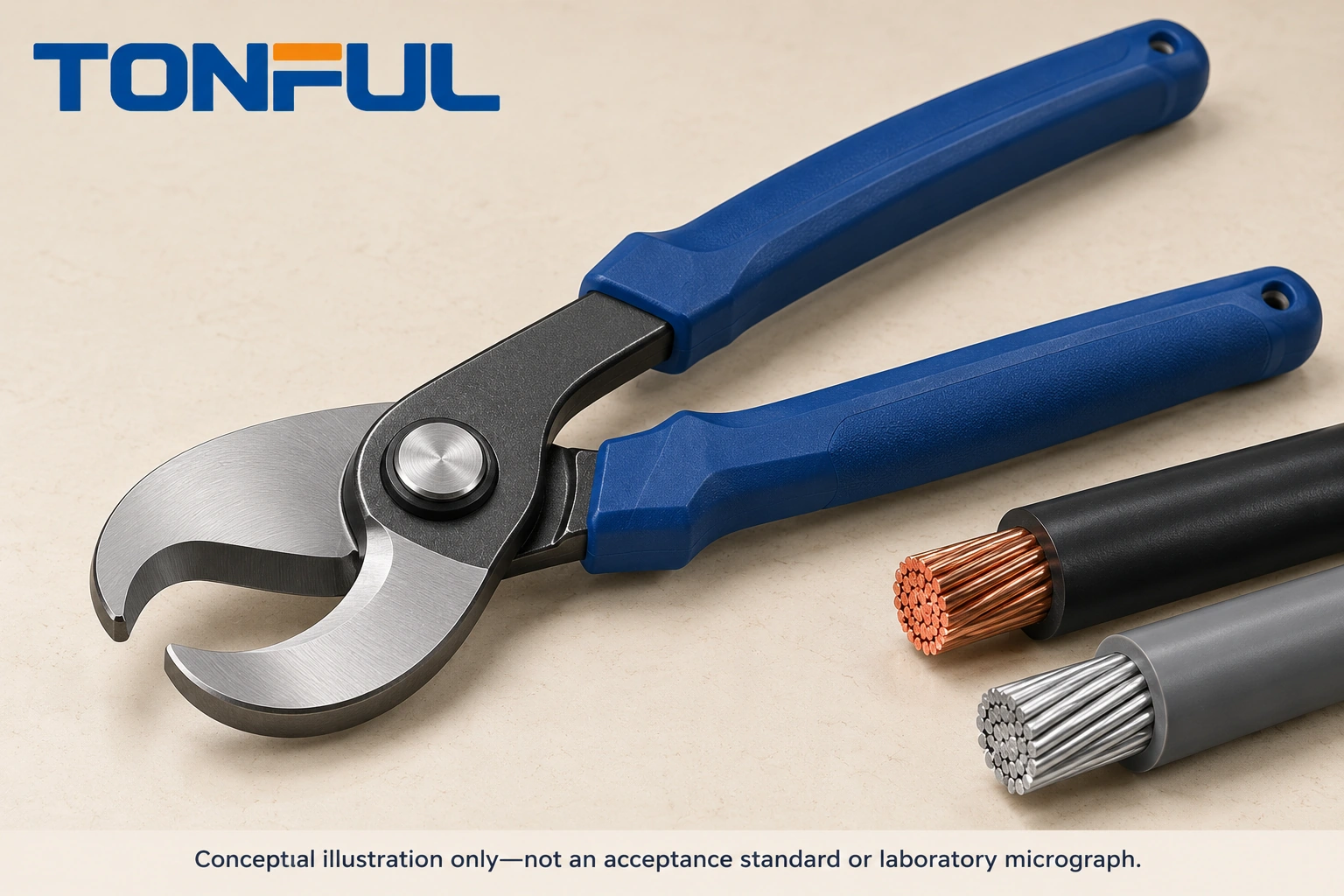
Choose cable cutters for copper and aluminum conductors by matching the exact material, conductor construction, cable dimensions, and cutting task to a documented tool model. Then verify the result on representative cable. A large jaw opening is not a cutting-capacity statement, and a copper capacity must never be assumed to equal an aluminum capacity.
The practical buying decision is whether a selected cutter can repeatedly prepare the specified cable without unacceptable deformation, escaped strands, or unsafe handling. Manual shears, ratchet cutters, and hydraulic cutters can each fit that job, but their drive mechanisms do not remove material restrictions. This guide provides a selection matrix and a sample-evaluation record for procurement and engineering teams.
Contents:
- Identify the cable construction
- Read capacity correctly
- Compare cutting mechanisms
- Evaluate representative samples
- Control safety and maintenance
- Prepare the sourcing request
Identify the Cable Before Comparing Tools
Start with the cable manufacturer’s designation and drawing, not a photograph of its exposed end. Record copper or aluminum, alloy or temper where specified, solid or stranded construction, conductor area, overall diameter, insulation, sheath, and any screen, armor, or reinforcement. Confirm whether the task is cutting an entire cable or only an already separated conductor.
Construction Changes the Cutting Task
Solid conductors present one metal section. Conventional stranded conductors contain multiple wires that can move as the blade closes. Fine-stranded flexible conductors contain more, smaller filaments and may need a cutting edge and support arrangement specifically suited to them. Compacted, sector-shaped, and multicore constructions introduce additional geometry that a simple round single-conductor description misses.
Do not decide suitability by nominal area alone. Two cables with the same conductor area can differ in outside diameter, strand arrangement, sheath thickness, and cutting behavior. A tool approved for one construction may exclude another. For a documented example, the manufacturer’s archived KNIPEX electrical-range catalog separates Cu/Al ratchet cutters with steel-wire and wire-rope exclusions from dedicated reinforced-cable cutters. This historical example illustrates application boundaries, not current purchasing approval. Obtain the selected model’s current instructions, including fine-strand compatibility; no catalog rating transfers to TONFUL.
Screened and Reinforced Cables Need Separate Review
An aluminum conductor is not necessarily an all-aluminum cable. ACSR includes steel reinforcement, while armored cable may add a metallic layer outside insulated cores. Steel wire rope is another distinct cutting task. A Cu/Al cable-cutter statement does not authorize any of these applications. Require explicit model-specific approval for the complete construction before proposing a tool.
TONFUL’s cutting tools catalog page separates compact, ratchet, long-handle, and material-specific models. Treat those as different product choices, not interchangeable versions of one universal cutter. If the cable identity is uncertain, resolve it from traceable documents or a supplier-reviewed sample before trial cutting.

Read Copper and Aluminum Capacity as Separate Claims
A capacity statement needs material, construction, size unit, and model identity. Ask whether the stated limit describes conductor cross-sectional area, cable outside diameter, or another designation. Square millimeters describe area; millimeters describe diameter. Do not turn a diameter into area by treating an insulated stranded cable as a solid metal cylinder.
AWG and circular-mil designations also require care. Use the cable’s controlled designation and the manufacturer’s supported conversion or selection chart. A rough unit conversion cannot establish construction compatibility. Where a table gives a combined Cu/Al statement, ask the supplier to confirm its intended scope rather than creating two identical limits yourself.
Do Not Transfer Copper Capacity to Aluminum
Aluminum and copper are not interchangeable entries in an approval record. Record the supported size for each material separately, together with construction and any exclusions. If only copper is documented, aluminum remains unconfirmed until the manufacturer supplies applicable evidence. Do not assume that softer-looking material makes a larger conductor acceptable.
Likewise, jaw fit establishes only that a cable enters the opening. It does not establish available cutting force, acceptable blade loading, strand containment, or the ability to finish the cut. Added handle length, a ratchet drive, or a hydraulic actuator cannot override a material restriction. Do not improvise extension pipes or strike handles to complete a stalled cut.
| Selection field | Evidence needed before approval | What it does not establish |
|---|---|---|
| Copper capacity | Named model, supported construction and size | Equal aluminum capacity |
| Aluminum capacity | Named model, supported alloy/construction and size | Steel-core or ACSR suitability |
| Diameter limit | Cable outside diameter and stated construction | Equivalent metal area |
| Area limit | Conductor area and applicable cable type | Every sheath or multicore arrangement |
| Jaw opening | Entry clearance under instructions | Successful cutting capacity |
| Blade material | Model specification and approved application | Universal hard-material capability |
Keep the approved cable list with the tool specification. A catalog update or a visually similar replacement model should trigger review rather than silent substitution. Purchasers need the exact model code on the quotation, sample, packing list, and spare-blade request so that all four refer to the same cutting system.
Compare Manual, Ratchet, and Hydraulic Cutters
Choose the mechanism after establishing material compatibility. The relevant tradeoffs are operator effort, available working space, cut frequency, tool mass, maintenance, and recovery from an incomplete cut. There is no universal conductor size at which every buyer should move from manual to ratchet or hydraulic operation.
Manual Shears and Hardened Cutting Edges
Direct-action shears can suit accessible, intermittent work within their documented range. Their simplicity can make inspection and transport straightforward, but repeated high-effort cuts may be unsuitable for the operator or workstation. Evaluate actual handle travel and cable support; a compact head may still need substantial clearance behind it.
“Hardened blade” describes an edge property, not permission to cut steel. Edge profile, toughness, alignment, and supported material all matter. A blade designed for Cu/Al can still be damaged by reinforcement or unsuitable hard-drawn material. Do not choose solely by a hardness number, steel name, or the apparent thickness of the jaws.
Ratchet Cable Cutters
Ratchet drives advance the blade through successive strokes. They may help where a direct-action tool requires excessive force, subject to model approval. They also introduce gears, pawls, release features, and pinch points that require instruction and maintenance. Verify the permitted release procedure rather than assuming the blade can always be safely backed out under load.
A completed ratchet stroke is not proof of a clean cable end. Inspect strand separation, flattening, and downstream preparation after a cut. Fine-strand suitability must be explicit; neither the word “ratchet” nor a large diameter claim establishes it. Do not confuse a ratchet cable cutter with a ratchet terminal crimper, whose purpose and approval criteria are different.
Hydraulic Cutting Systems
Hydraulic actuation can supply cutting force through a dedicated cutter head, using manual or powered pumping depending on the system. It adds head compatibility, hose or battery considerations where applicable, stored energy, service requirements, and equipment mass. A hydraulic crimper is not a cutter merely because its actuator develops substantial force.
Review TONFUL’s hydraulic tools range by exact function and model. Request confirmation that the offered system is a cutting system with a supported head and cable construction. Do not substitute cutting parts into a crimping tool or infer cutting capability from its crimping range. Select hydraulic operation only when its documented application and site handling make sense.
| Mechanism | Decision advantage to evaluate | Boundary to confirm |
|---|---|---|
| Direct manual | Simplicity and access for intermittent cuts | Operator effort and permitted material |
| Ratchet | Progressive blade travel with repeated strokes | Construction exclusions and safe release |
| Hydraulic | Dedicated powered or pumped cutting head | Head/system compatibility and stored energy |
Verify Cut Quality With Representative Samples
Agree on a sample plan before evaluating tools. Include each proposed material and construction and the relevant size extremes from the intended workload. Identify cable supplier, lot, insulation, sheath, and condition. The quantity and sampling rationale belong in an approved plan; this article does not invent a universal number of cuts.
Use trained operators, representative access, and the prescribed tool motion. Record whether the work requires one or two hands, how cable is supported, and whether the tool can finish without improvised leverage. Observe cut quality and operating difficulty separately. A visually neat end does not excuse an unsafe stance or excessive handling burden.
Inspect the cut face for flattening, burrs, projecting filaments, incomplete separation, and sheath damage. Use applicable drawing or process requirements to decide acceptance. Check that the end can proceed to the specified stripping and termination process without forcing insertion or trimming away unplanned length. Do not invent a universal ovality, burr-height, or surface-finish limit.
TONFUL’s stripping tools page is relevant to that next operation, but a stripper’s cutting function and its stripping range remain separate claims. Confirm both when proposing a multifunction replacement. A cutter approval must not silently approve the later terminal, lug, die, or crimp process.

| Evaluation record | Entry to complete |
|---|---|
| Cable identity | Supplier, lot, material, construction, area, outside diameter |
| Tool identity | Model, serial or asset ID, blade/head identity, manual revision |
| Trial scope | Specimen IDs, quantity rationale, operating conditions |
| Observations | Completion, deformation, strand containment, handling, photos |
| Acceptance source | Drawing or approved process document and revision |
| Disposition | Approved scope, excluded constructions, reviewer and date |
Preserve failed cuts and explain any retest. A valid failure cannot be removed by discarding its specimen and reporting only later successes. If a blade is replaced or the method changes, document the new condition and determine whether the original approval scope must be repeated. Keep the approved sample and its record distinguishable from sales demonstrations.
Control Safety, Access, and Maintenance
This guide covers disconnected samples and de-energized work only. Have qualified personnel isolate all relevant supplies and verify safe state under the applicable site procedure before cutting installed conductors. A Cu/Al capacity, colored grip, insulated-looking handle, battery drive, or hydraulic pump does not establish approval for cutting energized cable.
Assess pinch points, blade exposure, falling offcuts, cable restraint, and working posture. Keep hands outside the cutting zone and do not reach into jaws to clear strands. Follow the manufacturer’s instructions for stalled cuts. Stop if cable identity, hidden reinforcement, or tool condition differs from the approved task.
Before blade or head access, isolate the tool as instructed: remove the battery and relieve hydraulic stored energy where the manufacturer’s maintenance procedure requires those steps. Do not loosen a hose connection as a shortcut to depressurization. Use the prescribed service process and approved replacement parts; inspect alignment and function before return to work.
Prepare a Model-Specific TONFUL Sourcing Request
Use the TONFUL electrical tools overview to identify the relevant family, then request current documentation for the selected model. Avoid a purchase description such as “large copper cutter” that leaves aluminum compatibility, strand construction, and replacement-blade identity unresolved.
Provide a cable list, drawings, disconnected representative samples, required daily workload, working-space restrictions, and the downstream preparation requirements. Ask the supplier to state Cu and Al capacities separately where different, identify excluded constructions, and confirm maintenance instructions, release procedure, and available spare parts. Record unavailable information as unresolved rather than interpreting silence as approval.
Send that package through TONFUL product enquiries and agree on a documented sample evaluation before ordering. Approve the exact tool-and-cable scope that the evidence supports, not a universal cutter category. That approach makes the quotation comparable, the sample decision auditable, and later replacement purchases less dependent on assumptions about size, material, or drive force.