
When an automotive harness fails at 80,000 miles, the root cause is rarely the copper or the insulation—it is the termination. For decades, engineers have debated whether to crimp or solder wire connections, and in B2B electrical manufacturing that debate now has a clear consensus. This guide from TONFUL Electric compares the cold press terminal against traditional soldering across mechanical strength, vibration endurance, electrical performance, cost, and compliance, so procurement teams and design engineers can specify with confidence.
What Is a Cold Press Terminal?
A cold press terminal—also called a cold-weld or crimp terminal—is an electrical connector that joins a conductor to a mating component through compression at room temperature, with no heat or filler metal. When a calibrated die compresses the terminal barrel around stranded copper wire, three things happen at once: wire strands interlock mechanically, the terminal and conductor deform elastically to create spring-back force, and oxide layers fracture under pressure to form metal-to-metal contact points. The result is a gas-tight cold weld—a solid-state bond comparable in strength to the wire itself.
Cold press terminals are now standard across automotive, marine, industrial automation, EV battery packs, and appliance manufacturing. For a deeper category overview, see TONFUL’s cold press terminal product resource and the guide to choosing cold pressed terminals.
What Is Soldering?
Soldering joins metals by melting a filler alloy—typically tin-lead or lead-free SAC—into the capillary gap between wire and terminal. The solder wets both surfaces and solidifies into a metallurgical bond. Done well, a solder joint offers excellent conductivity and a permanent seal, which is why it remains the standard for PCB assembly and precision electronics. The trouble begins when soldering is applied to stranded wire in dynamic, high-vibration environments.

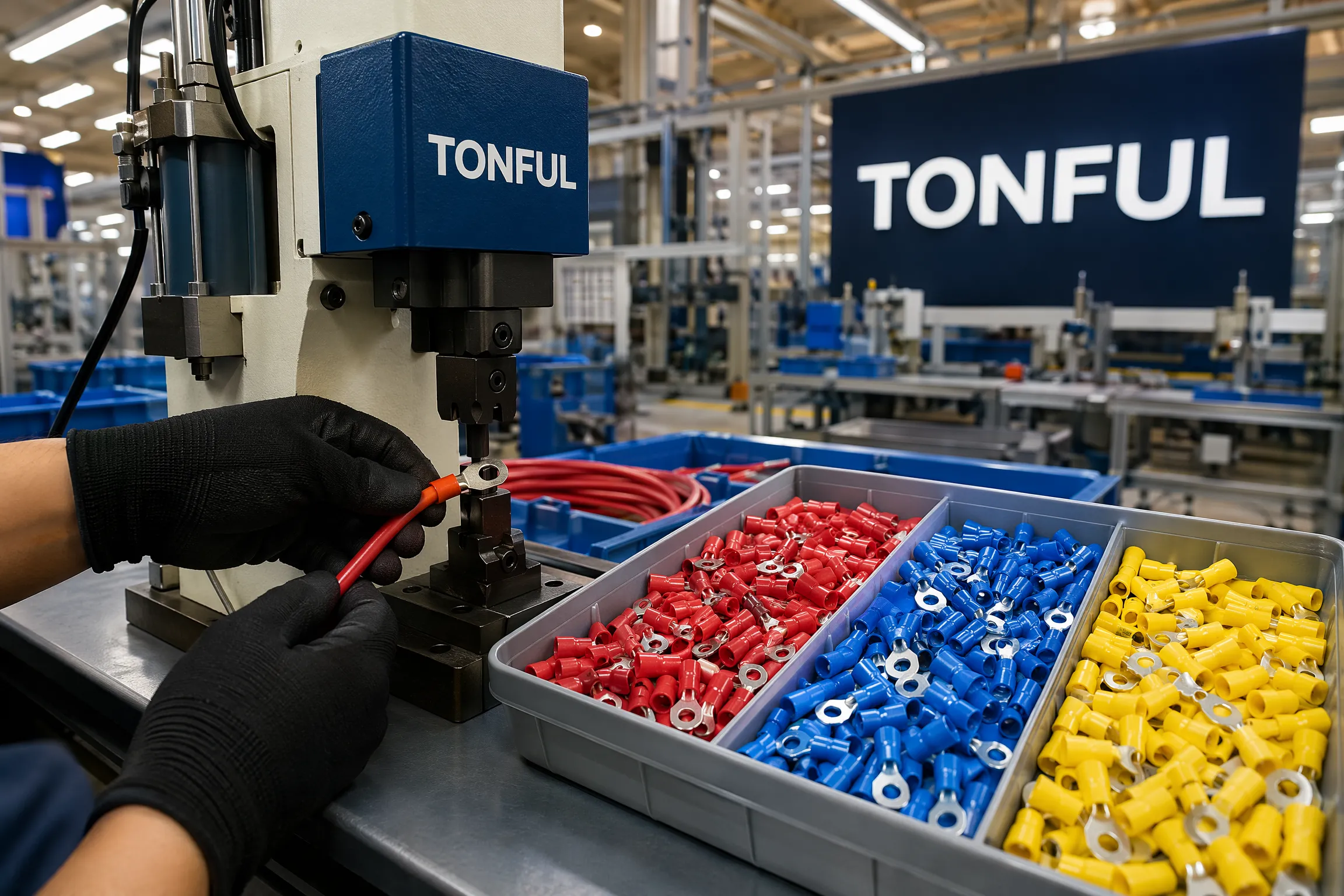
Image 1 — Photorealistic (Industrial Photography). Wide shot of a TONFUL Electric wire harness production line. A technician wearing ESD-safe gloves operates a pneumatic benchtop crimper, terminating tin-plated copper ring terminals onto 12 AWG red wire. A sorted tray of color-coded cold press terminals (red, blue, yellow insulation) sits in the foreground. The TONFUL logo—bold white sans-serif letters on a deep navy background—is clearly visible on the equipment housing and on a wall-mounted brand panel behind the station. Warm industrial lighting, shallow depth of field, photorealistic, 35 mm lens look. No text other than the TONFUL logo.
The Core Difference: Cold Weld vs. Fused Joint
The fundamental distinction is not “mechanical versus metallurgical”—both methods produce a metallurgical bond. The difference lies in how that bond forms and where stress concentrates afterward.
A cold press terminal distributes stress gradually. The crimp barrel and conductor deform together, so flexibility is preserved at the transition from free wire to terminated wire. A solder joint, by contrast, creates an abrupt stiffness boundary: the solder-filled segment becomes rigid while the wire just beyond it remains flexible. In a vibrating engine bay or on a moving production line, that boundary is where fatigue cracks initiate and propagate. Metallurgical analysis of failed solder joints consistently shows crack initiation at the solder-to-wire interface, progressing through the solder matrix until the joint separates. Properly crimped terminals of identical materials survive roughly 40 times more vibration cycles than their soldered equivalents in ISO 16750-3 testing.

Image 2 — Technical Diagram (Annotated Cutaway). Side-by-side annotated cross-section, engineering schematic style on a white background. Left: a cold press terminal barrel crimped around stranded copper, with labeled zones—wire barrel, conductor crimp, insulation crimp, cold-weld interface, gas-tight seal, and a curved green arrow showing gradual stress transition into the free wire. Right: a soldered terminal with solder fillet filling the barrel, labeled zones—solder fillet, intermetallic layer, rigid transition zone, and a red-highlighted fatigue crack initiation point at the wire-to-solder boundary. Callouts beneath each side compare contact resistance and flexibility. The TONFUL logo sits small in the bottom-right corner. Clean line art, blue and red accents.
Cold Press Terminal vs. Soldering: Comparison Table
| Attribute | Cold Press Terminal | Soldering |
|---|---|---|
| Bonding mechanism | Solid-state cold weld (pressure) | Fused metallurgical bond (heat + filler) |
| Heat required | None (room temperature) | 200–370 °C iron or wave |
| Vibration resistance | Excellent; flexible transition | Poor; rigid transition cracks under fatigue |
| Pull-force consistency | ≥90% of wire tensile strength (calibrated tool) | Variable; depends on operator skill |
| Gas-tight seal | Yes—oxide layers fractured under pressure | Yes, if properly wetted |
| Contact resistance | Very low (<1 mΩ typical) | Very low when wetted; rises if degraded |
| Installation speed | 3–5 seconds per termination | 15–60 seconds plus cooling |
| Skill required | Moderate (tool-dependent) | High (technique-dependent) |
| Rework | Difficult; replace terminal | Possible but weakens wire |
| Consumables | None | Flux, solder, cleaners |
| Standards alignment | IPC/WHMA-A-620, UL 486A-B, USCAR-21, SAE AS7928 | IPC J-STD-001 (PCB-level) |
| Best fit | Automotive, marine, industrial, EV, harnesses | PCB assembly, precision electronics, sensors |
Performance Under Vibration and Thermal Cycling
This is where the cold press terminal pulls decisively ahead. Modern automotive specifications demand connections that survive 15 years or 150,000 miles of service across thermal cycling from −40 °C to +125 °C, multi-band vibration, fluid exposure, and salt spray. The SAE/USCAR-21 standard—developed jointly by Ford, GM, and Stellantis—effectively mandates crimped terminals for production harnesses because solder joints cannot pass these profiles reliably.
The physics is straightforward. Solder alloys are brittle relative to annealed copper. Each thermal cycle expands and contracts the joint, and each vibration cycle flexes the rigid solder-to-wire boundary. After enough cycles, micro-cracks open, contact resistance climbs, and the joint either fails open or overheats. A proper cold press terminal, by preserving conductor flexibility and distributing stress across the crimp barrel, avoids this failure mode entirely. For marine and off-road applications where vibration and corrosion compound, TONFUL’s waterproof cold pressed terminals add an environmental seal on top of the mechanical bond.
Understanding why crimps fail matters as much as understanding why they succeed. The most common causes—wrong tooling, worn dies, mismatched wire gauge, and over- or under-crimping—are all preventable with process control. See TONFUL’s analysis of why your crimp failed and the crimp terminal quality control standards guide for root-cause methodology.
Electrical and Thermal Performance
A properly executed solder joint and a properly executed crimp both deliver low contact resistance—often below one milliohm. The divergence shows up over time and under fault conditions.
Cold press terminals maintain stable resistance because the gas-tight cold weld blocks oxygen and moisture from the contact interface, preventing oxidation. Solder joints can degrade as the filler alloy ages, especially at elevated temperatures where intermetallic compounds grow and the joint becomes brittle. In high-current applications—battery cables, inverter links, EV busbars—the cold press terminal’s larger contact area and superior heat dissipation give it a further edge. For heavy-duty grounding and battery applications, TONFUL covers copper lugs vs. battery terminals and EV battery terminal selection in dedicated guides.

Image 3 — Technical Diagram (Schematic). Electrical schematic-style comparison of current flow through two terminations, clean line art on a grid background. Left: cold press terminal with current arrows flowing through multiple parallel metal-to-metal contact points, resistance values labeled at each zone (in mΩ), and a thermal gradient showing even heat distribution across the barrel. Right: soldered joint with current flowing through the solder fillet, a highlighted high-resistance hotspot at the intermetallic layer, and an annotated line graph showing resistance drift over 1,000 thermal cycles. The TONFUL logo appears in the legend box. Navy and orange accents.
Cost, Speed, and Production Scalability
For B2B manufacturers, the economics are decisive. Cold press termination takes seconds, requires no cooldown, and produces consistent results because quality is determined by the tool and die geometry—not by an operator’s soldering technique. A single calibrated crimper can process thousands of terminations per shift with minimal variance.
Soldering is slower, requires skilled labor, consumes consumables, and introduces a thermal hazard on the production floor. It also resists automation for stranded-wire terminations, whereas automated crimping systems handle high-volume harness production with inline quality monitoring. For an overview of available tooling, see TONFUL’s electrical tools and crimping tool resources.

Image 4 — Photorealistic (Industrial Photography). A TONFUL Electric quality-control laboratory bench. A digital pull-force tester clamps a crimped terminal assembly; its screen displays a tensile-strength curve in green. Beside it, an organized assortment box of cold press terminals—ring, fork, butt splice, and cord-end ferrules—arranged by color code (red, blue, yellow). A stereo microscope for crimp cross-section inspection sits in the background. The TONFUL logo appears on the tester housing and on a technician’s lab coat. Cool, clinical overhead lighting, photorealistic, sharp focus, 50 mm lens. No text other than the TONFUL logo.
Standards and Compliance
Both methods answer to recognized standards, but the standards diverge by application:
- IPC/WHMA-A-620 governs cable and wire harness assemblies and sets acceptance criteria for both crimped and soldered terminations. For crimped terminals it mandates pull-force testing (typically ≥90% of wire tensile strength for Class 3) and crimp-height verification. See TONFUL’s IPC/WHMA-A-620 guide and crimp pull-force testing methodology.
- UL 486A-B covers wire connectors for general wiring; TONFUL compares UL 486 vs. UL 310 standards.
- USCAR-21 and SAE AS7928 define automotive and aerospace crimp-terminal performance, effectively requiring crimping for production harnesses.
- IPC J-STD-001 governs soldered electrical assemblies at the PCB level—soldering’s home territory.
For international sourcing, TONFUL’s CE vs. UL certification comparison clarifies which mark matters for which market.
Decision Guide: When to Use Each
| Use a cold press terminal when… | Use soldering when… |
|---|---|
| The application involves vibration or mechanical movement | The joint lives on a PCB or in precision electronics |
| You need high-volume, repeatable production | You need a permanent fused seal on a delicate, low-power signal |
| The environment sees thermal cycling, moisture, or corrosion | The assembly will not flex or vibrate in service |
| Pull-force and gas-tight integrity are specified | Maximum conductivity and a fused metallurgical seal are the priority |
| Automatable harness manufacturing is required | Hand-built, low-volume, or repair work is acceptable |
For most B2B electrical manufacturing—automotive harnesses, industrial equipment, EV systems, appliances, and marine wiring—the cold press terminal is the engineered choice. Soldering retains its place at the PCB level and in specialized precision work. The broader case is laid out in TONFUL’s solder vs. crimp analysis and the engineering answer to whether crimped connections are as good as soldered.

Image 5 — Technical Diagram (Decision Flowchart + Annotated Illustration). A clean decision-tree flowchart helping engineers choose between a cold press terminal and soldering. Decision nodes: “Does the joint vibrate?” → Yes → Cold Press; “Is it PCB-level?” → Yes → Solder; “High-volume production?” → Yes → Cold Press; “Permanent fused seal required?” → Yes → Solder. Each terminal node carries a one-line rationale. Below the flowchart, a small annotated illustration shows a correct crimp profile—wire brush, bellmouth, conductor crimp, insulation crimp, and crimp-height dimension—with callouts. The TONFUL logo sits in the header bar. Engineering style, white background, navy and green accents.
FAQ
Is a cold press terminal as reliable as a soldered joint? In high-vibration, thermally cycled, or high-current applications, a properly crimped cold press terminal is more reliable than a soldered joint. Crimping preserves wire flexibility and forms a gas-tight cold weld that resists fatigue cracking—the dominant failure mode for soldered wire terminations.
Can I solder a cold press terminal for extra security? Generally, no. Adding solder to a crimped terminal stiffens the wire-to-terminal transition, reintroducing the fatigue-crack risk that crimping was chosen to avoid. A correct crimp does not need solder. If environmental protection is the goal, use a heat shrink terminal or a sealed waterproof variant instead.
What tool do I need for cold press terminals? A matched, calibrated crimping tool with the correct die for the terminal series and wire gauge. Tool selection is critical—see TONFUL’s crimp die selection guide and crimping tool maintenance recommendations.
Why are cold press terminals plated with tin or silver? Plating prevents oxidation of the base copper and improves corrosion resistance and solderability where needed. TONFUL’s cold pressed terminal plating guide and tin-plated copper corrosion standards cover the metallurgy in depth.
Which is faster on a production line? Cold pressing. A calibrated crimper completes a termination in seconds with no cooldown, whereas soldering requires heating, wetting, and cooling—typically 15–60 seconds per joint—plus consumables and skilled labor.
Conclusion
The cold press terminal versus soldering debate is settled by the application. For anything that vibrates, carries significant current, or needs to scale across a production line, cold press terminals deliver superior vibration resistance, consistent pull-force, gas-tight integrity, and lower installed cost. Soldering remains the right tool for PCB-level precision electronics where a fused, permanent seal is the priority and the joint will not flex in service.
As a B2B manufacturer of terminals, connectors, and electrical components, TONFUL Electric engineers cold press terminals to IPC/WHMA-A-620, UL, and USCAR-21 standards—built for the environments where solder joints fail. To specify the right terminal for your application, start with the cold press terminal catalog or explore TONFUL’s full terminals and connectors range.