
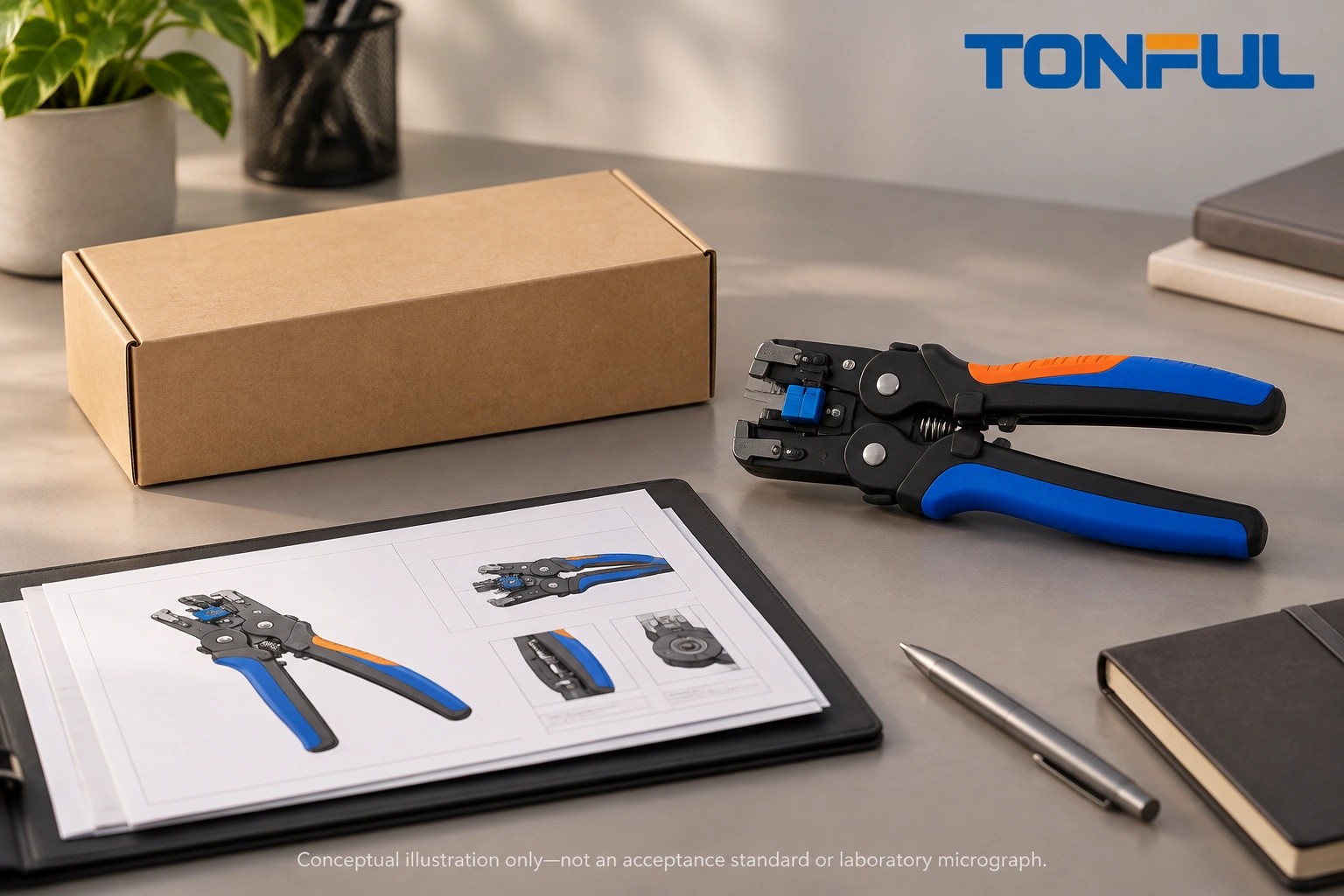
Private label electrical tools need more than a logo file and a target price. The RFQ must define what the tool must do, what may change, who owns the design and which sample approval actually authorizes production. Otherwise, a visually attractive prototype can become the reference for an order whose functional requirements were never agreed.
Use this guide to build a controlled enquiry and approval package for distributors, OEM purchasing teams and tool brands. The templates are proposed buyer controls, not a statement that every supplier offers every customization. MOQ, tooling, marking methods, materials and production timing require written confirmation for the selected model and order.
Contents: Project Boundary | RFQ Matrix | Sample Stages | Verification | Production Release | Enquiry
Project Boundary
Separate branding from engineering changes
Begin with one model schedule linked to the intended application. A catalog tool in a branded carton is different from a changed handle, blade, jaw profile or mechanism. Even a cosmetic change can affect warning visibility, grip behavior or assembly identification. Ask the supplier to identify which requests leave the base design unchanged and which require engineering review.
Use the TONFUL electrical tools catalog to shortlist a family, then confirm exact model identity. Do not combine multiple model photographs into a fictional specification. Record supplier model, buyer SKU and revision in one cross-reference so packaging and inspection teams use the same identity.
For a stripper, define conductor material and construction, insulation type, size range and strip condition. The stripping tools page provides model-specific starting information, but it does not establish successful processing of your particular cable. Send representative cable samples and the governing assembly requirements when compatibility matters.
For a cutter, identify conductor construction, cross-section, outer diameter and permitted materials. Check the cutting tools range for candidate models. A copper or aluminum rating does not imply suitability for steel reinforcement, ACSR or energized cables. State exclusions prominently rather than burying them in artwork notes.
Name the accountable people before quotation
The buyer’s product engineer owns functional requirements and design acceptance. Quality owns the verification plan, evidence review and nonconformity disposition. Procurement owns commercial comparison and the purchase-order baseline. Brand or packaging staff own artwork content and brand authorization. A compliance owner determines destination-market obligations and permitted claims, using qualified advice where needed.
The supplier names one project coordinator and identifies who controls engineering, production and quality responses. Written responsibility prevents a salesperson’s sample email from being mistaken for engineering approval. In a small business one person may hold several roles, but the decisions and their approval authority should still remain distinct.
RFQ Matrix
Send requirements in a response-ready format
Assign a requirement ID to every important input. Ask the supplier to answer Comply, Deviate or Clarify and identify the supporting document. A blank field is unresolved, not agreement. Keep a separate exceptions register and resolve it before comparing prices as if the proposals were equivalent.
| ID | Buyer Input | Required Supplier Response | Buyer Owner | Evidence Before Release |
|---|---|---|---|---|
| R1 | Model, SKU, application and excluded uses | Exact model and differences | Engineering | Approved identity schedule |
| R2 | Materials, conductor construction and operating conditions | Supported scope and restrictions | Engineering | Model documents and application trial |
| R3 | Critical features and acceptance-source revisions | Inspection method and exceptions | Quality | Approved verification plan |
| R4 | Logo file, position, colors and marking boundaries | Feasible method and sample route | Brand | Controlled artwork and physical review |
| R5 | Retail pack, warnings, language, barcode and contents | Pack drawing and bill of contents | Packaging | Approved packed sample |
| R6 | Sample purpose, quantity and traceability | Stage, build method and deviations | Quality | Identified sample and report |
| R7 | Tooling, design rights and change restrictions | Ownership, access and permitted use | Procurement | Written agreed terms |
| R8 | Forecast, order quantity and destination | MOQ, prices, validity and schedule assumptions | Procurement | Accepted quotation and order baseline |
| R9 | Production controls and complaint route | Named contact and change notification | Quality | Control and escalation agreement |
Commercial responses should separate unit price, marking, packaging, engineering, tooling, samples and freight assumptions. Ask whether repeat orders carry setup costs and who owns unused printed packaging. Forecasts are planning inputs unless the agreement explicitly makes them commitments. Do not invent a universal private-label MOQ or apply a competitor’s published schedule to TONFUL.
Record quotation validity, currency, delivery basis and what starts the production clock. The trigger might depend on signed artwork, accepted sample, agreed payment or another contract condition. A launch date is not proof the supplier has committed capacity. Request an achievable schedule with dependencies rather than relying on an informal best-case estimate.
For drawings and files, specify the controlling revision and precedence between the RFQ, supplier drawing, sample and purchase order. Resolve conflicts explicitly. Photographs can explain appearance but should not replace critical dimensions, approved material definitions or measurable acceptance requirements.
Sample Stages
Approve only the purpose demonstrated
An existing catalog sample supports initial product review. An appearance sample supports color, marking position and packaging layout. A functional sample supports the agreed application trial. A production-intent sample must represent the intended materials, tooling, process, site and packing route, with remaining differences declared. The stage names alone prove nothing; record what each actual sample represents.

Assign sample IDs and record shipment date, receiving condition, supplier model, buyer SKU, revision, build location and known deviations. If a sample uses temporary marking, substitute material or hand finishing, state that before evaluation. A polished hand-built sample cannot silently stand in for normal production.
The buyer should approve a sample quantity and distribution plan according to risk. Allocate units to functional work, destructive testing where justified, packaging review and retained references. The quantity must support the approved test plan; there is no universal count that proves a private-label tool is qualified. Keep untested retains separate from tested or damaged specimens.
Record each stage as Approved for stated purpose, Rejected or Held pending evidence. Avoid an ambiguous approved stamp. Appearance approval can authorize artwork progression without authorizing bulk manufacture. A functional pass can be limited to the tested combinations and still leave packaging, destination-market documentation or production equivalence unresolved.
The golden sample is a controlled reference, not a replacement for written specifications. Retain matched references at buyer and supplier where agreed, document storage and condition, and identify which features the sample governs. Wear, fading or accidental use can make a reference unreliable; define replacement and reapproval rules.
Verification
Link every acceptance decision to a source
Create a test plan listing requirement ID, acceptance-source revision, sample IDs, conditioning, equipment, method, results and reviewer. Agree critical defect definitions, invalid-test handling and retest rules in advance. Do not repeat failed tests until a favorable result appears without documenting the failure and disposition.
For stripping trials, inspect the processed conductor and insulation against the governing specification using suitable magnification and measurement. Record cable identity, construction, tool setting and operator. Evaluate the actual intended combinations rather than only an easy mid-range wire. If the source does not define permissible damage, seek engineering disposition instead of inventing an acceptable percentage.
For cutters, assess the intended material and construction under the selected model’s instructions. For crimping tools, identify terminal, conductor, cavity and adjustment as one approved combination. A completed ratchet cycle does not prove an acceptable crimp. Where useful, crimping tool maintenance considerations can guide maintenance questions, while customer or assembly documents determine acceptance.
Treat safety review as part of qualification. OSHA’s hand and power tool overview notes the injury hazards associated with improper tool use or maintenance. Use trained personnel and the applicable safe-work procedure; isolate circuits and verify a safe state before trials. These tools are not automatically insulated or suitable for live electrical work.
Keep hands clear of blades and pinch points. Battery removal and hydraulic depressurization before maintenance must follow the manufacturer’s procedure. Powered equipment needs appropriate guarding, interlocks, training and an approved trial plan; never demonstrate performance by defeating safeguards. Safety acceptance cannot be waived by a good logo sample or favorable price.
Review the packed product, not only artwork on screen
Verify model identity, contents, warnings, language, barcode data and scanning on the actual pack. Check whether packaging exposes a blade or permits damage in the agreed handling route. Approval of a PDF cannot prove print durability, readability on curved surfaces or correct pack assembly. Record the material, artwork revision and pack configuration actually inspected.
Avoid unsupported certification marks, electrical insulation claims or broad suitable-for-all-cables wording. The compliance owner should verify which claims and documentation are appropriate to the destination and exact product. Request evidence that names the relevant model and scope; a generic company certificate does not establish every product claim.
Production Release
Use a signed gate record
| Gate | Required Record | Responsible Approver | Release Consequence |
|---|---|---|---|
| Specification freeze | Approved model schedule, drawing and resolved exceptions | Buyer engineering | Baseline for sample build |
| Sample disposition | Identified samples, results and deviations | Buyer quality with engineering | Accept only demonstrated scope |
| Artwork release | Revision, warnings and brand authorization | Brand and compliance owners | Permit approved printing only |
| Production authorization | Closed critical issues, production equivalence and accepted order | Quality and engineering concurrence; procurement issues order | Permit defined SKU and quantity |
| Shipment disposition | Agreed inspection and traceability evidence | Authorized buyer quality representative | Release or hold shipment |

Complete the release record with project ID, SKU, revisions, sample IDs, linked reports, open issues, permitted scope, approver names and dates. A useful decision sentence is: production authorized only for the listed model, configuration, revision and order quantity. List exceptions individually, including expiry, affected quantities and verification; do not use a blanket acceptance of all deviations.
Procurement should issue the order only after the required technical concurrence. The supplier acknowledges the same baseline and confirms there are no undeclared differences between approved samples and planned production. Payment, silence or receipt of a shipment must not substitute for the agreed approval method.
Define changes requiring prior review: materials, blade or die source, critical geometry, grip construction, production site, subcontractor, process, marking, warnings and packaging. The supplier submits the reason, affected lots, risk assessment and proposed verification before implementation. Buyer engineering and quality decide whether partial testing, new samples or full reapproval is needed.
Also define who owns buyer artwork, pre-existing supplier design, newly funded tooling and later design changes. Agree access, maintenance, permitted reuse, storage and end-of-program disposition in writing. Paying a tooling invoice does not by itself settle all design rights. Use qualified contract review for disputed or commercially important terms.
Enquiry
Before sending an RFQ, confirm that the model schedule, intended application, acceptance documents, artwork scope and approval owners are complete. Keep unresolved capability questions visible in the exception register. Written limits protect both sides from treating a sample or a preliminary quote as a promise that was never made.
Share that package with TONFUL’s product enquiry team and ask which branding, packaging, sample and documentation options are available for the selected models. Request written confirmation before committing to artwork or production. A well-defined enquiry makes the next decision clear without assuming private-label capability that has not been confirmed for your project.