
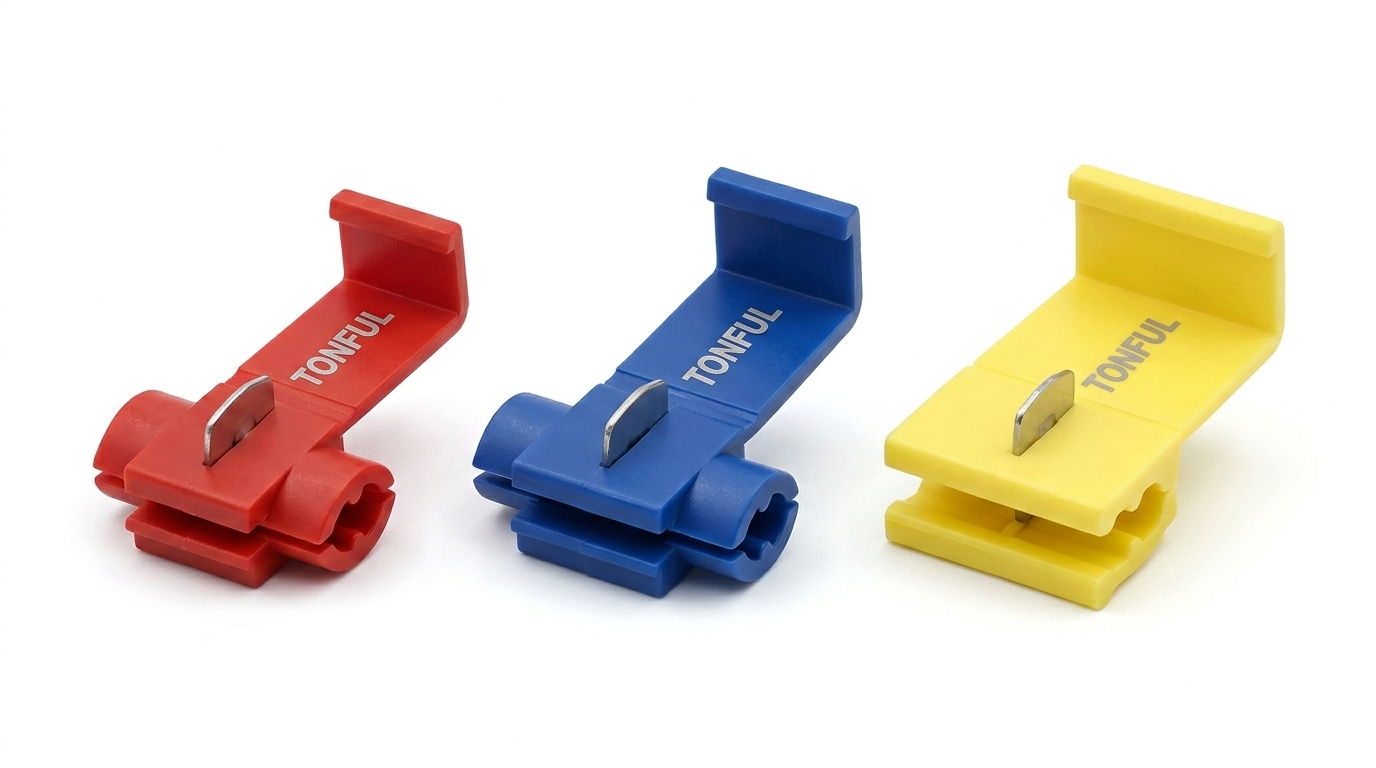
A quick splice connector is an insulation displacement connector (IDC) that taps into an existing wire without cutting, stripping, or soldering. A sharp metal contact inside the plastic body pierces the wire insulation when compressed with pliers, forming a gas-tight junction in seconds. That combination of speed and reliability has made quick splice connectors a staple in automotive wiring, marine circuits, HVAC controls, landscape lighting, and telecom networks—anywhere a branch connection must be added without interrupting the original circuit.
TONFUL Electric manufactures quick splice connectors to OEM-grade standards, alongside a full catalog of automotive electrical connectors, terminals and connectors, and wire accessories. This guide covers how these connectors work, where they perform best, and how they compare to other common wire-joining methods.
How a Quick Splice Connector Works
The core of every quick splice connector is an IDC contact—a tin-plated copper or brass element shaped into a U-channel with sharpened edges. When you press the connector onto a wire and squeeze the fold-over cap with pliers, the U-channel slices through the insulation and cold-welds to the conductor beneath. The plastic housing then locks the contact in place and insulates the joint.
Because the conductor is never fully exposed to air, the connection resists oxidation and corrosion far better than a stripped-and-twisted joint. The cold-weld formed by the IDC contact is also vibration-resistant, which is why quick splices are widely specified in vehicle harnesses and equipment subject to mechanical motion.

Quick Splice Connector Applications
Automotive Wiring
The dominant use case for the quick splice connector is automotive electrical work. When adding accessories—dash cams, LED light bars, auxiliary gauges, reverse lights—a quick splice lets you tap into a fused circuit without cutting the factory harness, preserving the vehicle’s original wiring and warranty coverage. TONFUL’s quick splice connectors are engineered to meet the vibration and temperature demands typical of engine bays and door harnesses, matching the quality expected from a dedicated automotive terminals and connectors supplier.
For technicians adding a circuit to an existing fuse box, a quick splice is often paired with a piggyback terminal or fuse tap to distribute power cleanly. The snap-on installation also makes the connector ideal for field repairs on trailers, where technicians need to splice into tail-light circuits quickly.
Marine and Outdoor Wiring
Moisture is the enemy of any electrical joint. Gel-filled quick splice connectors seal out water at the IDC contact, making them suitable for marine bilge wiring, dock lighting, and irrigation systems. For fully submersible loads, specify an IP68-rated waterproof wire connector or pair the splice with a waterproof wire nut. TONFUL’s waterproof connector line is tested under salt-spray conditions per ASTM B117 to verify long-term corrosion resistance.
HVAC and Building Automation
HVAC contractors use quick splice connectors to tap control wires for thermostats, zone dampers, and sensors without shutting down the unit. The connectors accept the 18–22 AWG solid conductors common in HVAC control cable, and the snap-closed housing provides enough strain relief for permanent installation. Because no stripping is required, a technician can complete a branch tap in under ten seconds.
Landscape and Low-Voltage Lighting
Low-voltage landscape lighting relies on quick splice (tap) connectors to branch feed wires out to each fixture. The connector pierces the SPT-2 lamp cord insulation and contacts the conductor in one squeeze. UV-stabilized housings prevent the plastic from embrittling after years of sun exposure. For direct-burial runs, use a gel-filled variant or a silicone-filled wire nut rated for underground use.
Telecom and Data
Telecom splice connectors use the same IDC principle on a smaller scale, handling 22–26 AWG conductors in telephone and low-speed data drops. Gel-filled IDC splices protect outdoor pedestals and aerial drop wire from moisture ingress, keeping the cold-weld contact stable for decades of service.

Quick Splice Connector vs. Other Wire Connectors
Choosing the right connector starts with understanding the trade-offs. The comparison table below positions the quick splice connector against the most common alternatives.
| Feature | Quick Splice (IDC Tap) | Butt Splice | T-Tap + Male Blade | Wire Nut | Solder Seal |
|---|---|---|---|---|---|
| Installation tool | Pliers | Crimper | Crimper | Hand | Heat gun |
| Stripping required | No | Yes | Yes (tap wire) | Yes | No |
| Cuts original wire? | No | Yes | No | Yes | Yes |
| Reusable | No | No | Blade yes, tap no | Yes | No |
| Vibration resistance | Good | Excellent | Good | Poor | Excellent |
| Moisture resistance | Moderate (gel-filled: high) | Moderate (HS: high) | Moderate | Poor | Excellent |
| Best for | Fast taps on live circuits | End-to-end joins | Quick-disconnect taps | Junction boxes | Wet/permanent joins |
| Typical AWG range | 22–10 AWG | 26–10 AWG | 22–10 AWG | 18–6 AWG | 26–8 AWG |
The quick splice connector wins on speed and on preserving the original circuit; butt splices and solder-seal connectors win on raw durability for permanent end-to-end joins. For a deeper look at the distinctions, see our guide on the difference between crimp and splice, our overview of types of wire connectors, and our companion articles on butt splice connector applications, solder seal butt connectors, and heat shrink butt connectors.
Quick Splice Connector Specifications
TONFUL quick splice connectors are color-coded by wire range, following the same convention used across insulated terminals.
| Color | AWG Range (Run / Tap) | Typical Use | Housing Material |
|---|---|---|---|
| Red | 22–18 AWG | Signal, sensor, telecom | Nylon / PP |
| Blue | 18–14 AWG | Automotive, HVAC control | Nylon / PP |
| Yellow | 14–10 AWG | Power feeds, lighting | Nylon / PP |
| Gel-filled | 22–14 AWG | Outdoor, marine, burial | Nylon + silicone gel |
All variants use tin-plated brass or copper-alloy contacts for conductivity and corrosion resistance. Operating temperature ranges from -40°F to 221°F (-40°C to 105°C), covering most automotive and industrial environments. For a cross-reference of equivalent IDC options, see our guide on 3M Scotchlok alternatives.

Installation Guide
Installing a quick splice connector takes four steps and a pair of standard pliers.
- Position the connector. Place the quick splice over the run wire so the wire sits in the U-channel slot. The tap wire goes into the side port.
- Fold the cap. Press the plastic cap down over the wire until the metal contact begins to bite into the insulation.
- Compress with pliers. Squeeze firmly with flat-jaw pliers until the cap snaps fully closed. You will feel the contact pierce the insulation.
- Verify the tap. Pull the tap wire gently to confirm it is locked. Use a multimeter to check continuity between the run wire and the tap wire.
Never install a quick splice on a live circuit without confirming the voltage rating, and never exceed the connector’s listed AWG range. For a full walkthrough, see our how to use a quick splice connector guide.

Advantages and Limitations
Advantages
- No stripping, soldering, or special crimping tool required—standard pliers suffice.
- Original wire stays intact, so the splice can be removed without shortening the run.
- Gas-tight IDC contact resists oxidation and vibration.
- Low per-piece cost, ideal for high-volume harness work.
Limitations
- One-time use; the contact cannot be reliably re-pierced.
- Not rated for continuous current beyond the contact’s ampacity.
- Standard variants are not waterproof; gel-filled or heat-shrink versions are needed for wet locations.
- Performance depends on correct wire gauge match—oversizing the wire prevents a clean pierce.
Choosing the Right Quick Splice Connector
Start with the wire gauge. Match the connector color to the AWG range of the run wire, using the same logic you would when comparing insulated vs. non-insulated wire connectors. For wet environments, choose a gel-filled variant. For applications where the tap wire may need to be disconnected later, a T-tap with a male quick disconnect is a better fit than a fixed quick splice—see our quick disconnect terminals guide for details.
If you are sourcing in volume, TONFUL supplies quick splice connectors alongside its broader wire terminal catalog, with OEM packaging options and quality control to IPC/WHMA-A-620 standards. Our how to choose the right wire connectors guide covers the full selection framework.

FAQ
What is a quick splice connector used for? A quick splice connector is used to tap into an existing wire to add a branch connection—powering an accessory, sensor, or fixture—without cutting or stripping the original wire. It is most common in automotive, marine, HVAC, and landscape lighting circuits.
Do quick splice connectors really work? Yes. When installed correctly on the proper wire gauge, the IDC contact forms a gas-tight cold-weld that resists vibration and oxidation. The connection is widely used in OEM automotive harnesses and telecom networks. The key is matching the connector’s AWG range to the wire and compressing the cap fully.
Are quick splice connectors waterproof? Standard quick splice connectors are not waterproof. For wet or outdoor locations, use gel-filled (silicone-filled) variants, which seal the IDC contact against moisture. For submersible applications, specify an IP68-rated waterproof wire connector.
Can you reuse a quick splice connector? No. Once the IDC contact pierces the insulation, the metal edge is deformed and cannot reliably re-pierce. The connector should be cut off and replaced if the tap needs to be moved. For reusable branch connections, use a T-tap with a male blade disconnect, which allows the tap wire to be unplugged.
What is the difference between a quick splice and a T-tap? A quick splice makes a permanent tap directly onto a run wire. A T-tap is an IDC connector with a female blade on top, which accepts a separate male quick disconnect—so the tap wire can be unplugged. Both pierce the insulation the same way; the difference is whether the branch is fixed or detachable.
What wire sizes do quick splice connectors handle? Most quick splice connectors cover 22–10 AWG. Red handles 22–18 AWG, blue handles 18–14 AWG, and yellow handles 14–10 AWG. Always confirm the connector’s listed range before installation.
Conclusion
The quick splice connector fills a specific niche in electrical work: a fast, permanent branch tap that preserves the original circuit. It is not a replacement for butt splices on end-to-end joins or for waterproof connectors in submersible loads, but for the vast majority of automotive, HVAC, and low-voltage lighting taps, it is the fastest reliable option. TONFUL Electric manufactures quick splice connectors to the same quality bar as the rest of its terminal and connector catalog, giving OEMs, distributors, and technicians a dependable source for volume sourcing. Pair them with the right companion—from piggyback terminals to heat shrink tubing—and a quick splice becomes one of the most efficient tools in any electrical kit.