
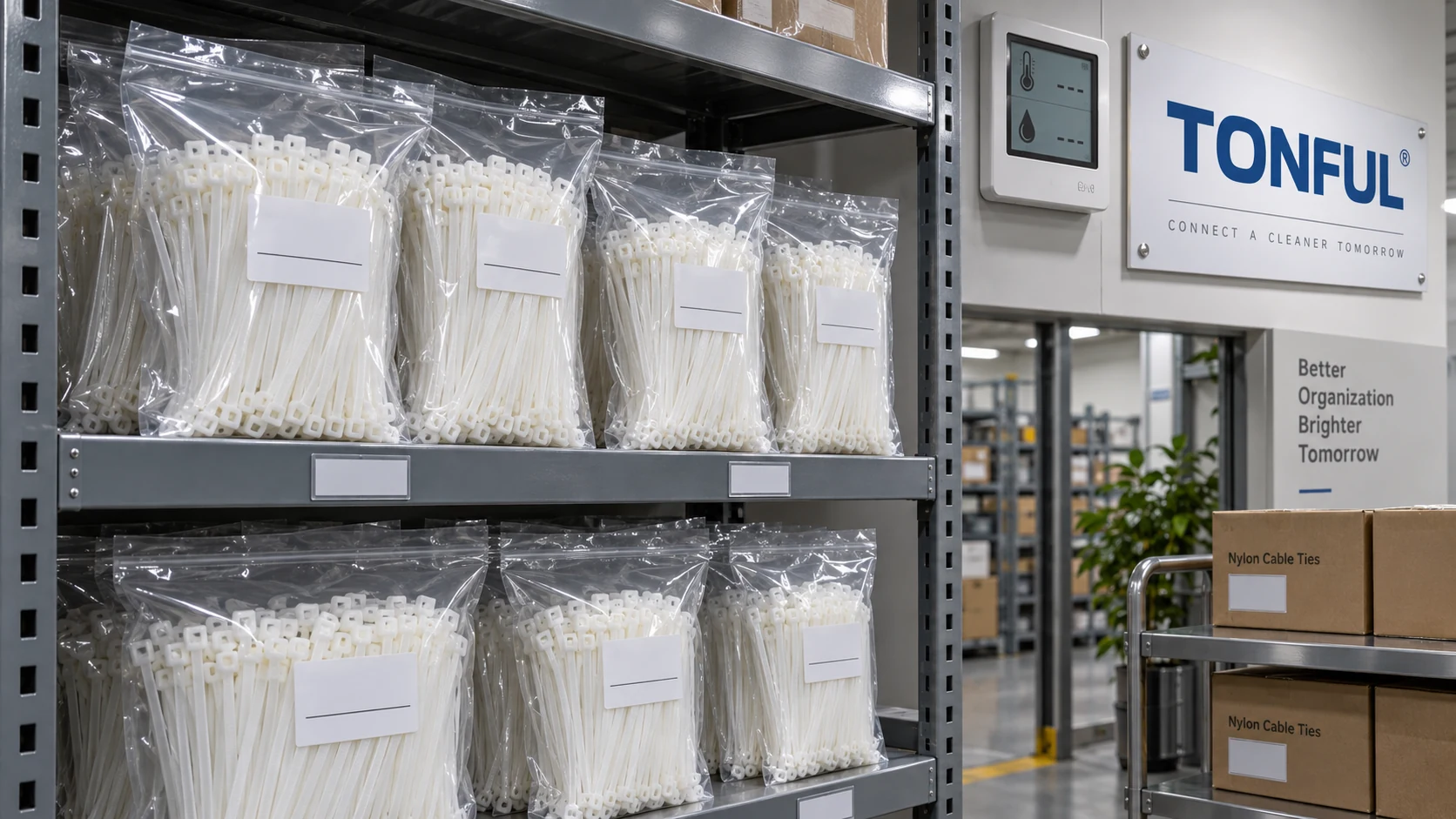
Nylon cable ties are often bought in large quantities and opened only when a production line needs them. A batch that installs smoothly when shipped may become difficult to handle if bags are opened, left in dry air or stored beside heat. Conversely, a damp warehouse does not prove every brittle tie can be repaired by adding water. The right approach is to control product identity, finished-part condition, packaging and release evidence.
This guide focuses on nylon ties, especially PA66. Other materials and special formulations may need different handling. It does not assign TONFUL a universal moisture percentage, conditioning time or shelf life. Those values require an exact part specification and controlled evidence.
Why Moisture State Matters
PA66 is hygroscopic: it exchanges moisture with surrounding air. Moisture can change flexibility, dimensions and mechanical response. Very dry ties may be more prone to cracking during bending or installation, while high moisture exposure can change stiffness and performance in other ways. A tie’s behavior also depends on grade, additives, geometry, head design and temperature. Feel alone is not a moisture measurement.
Panduit’s nylon 6.6 storage guidance recommends sealed packaging and describes the risk of moisture loss in cold or dry conditions for its products. HellermannTyton’s polyamide storage guidance likewise advises keeping its ties in original packaging away from direct sun and heat. Their specific target conditions and stated moisture level are manufacturer instructions, not automatically TONFUL acceptance limits.
Two stages are easily confused. Resin pellets may need drying before injection molding to protect melt processing. Finished nylon ties may be conditioned after molding to achieve a specified handling state. Re-drying finished ties because pellets were dried before molding reverses the purpose of conditioning. The TONFUL manufacturing-process guide explains the separate stages. A receiving team should ask which finished-part condition the declared loop strength and installation tests represent.
| Question | Correct evidence | Unsafe shortcut |
|---|---|---|
| Is the tie too dry to install? | Part-specific condition test plus functional installation | Judging by color or sound alone |
| Is a package protecting the tie? | Approved bag construction, seal and lot record | Assuming any open carton is equivalent |
| Is old stock usable? | Supplier-defined shelf life or controlled reinspection | Universal “two years” rule |
| Can brittle stock be restored? | Supplier-approved conditioning and post-treatment test | Pouring a fixed volume of water into a bag |
| Does the tie still meet its rating? | Test at specified conditioning and temperature | Comparing unmatched dry and conditioned samples |
Conditioning Is a Defined Manufacturing Step
A manufacturer may condition nylon ties after molding, then seal them to maintain an acceptable state until use. The method could involve controlled humidity, time and packaging or another validated process. The correct procedure depends on the actual resin, tie dimensions and quality plan. A thick head and thin strap need not equilibrate at the same rate; that is one reason a calendar rule alone is weak evidence.
Ask the supplier for its conditioning procedure and the tests used to validate it. Useful records include sample identity, molding and conditioning dates, environment, packaging time, measured condition if required, installation behavior and mechanical test results. The declared loop-strength test should identify whether samples were as-molded, conditioned, aged or recovered after exposure. Comparing numbers without sample state can create a false material ranking.
Do not copy a competitor’s stated 2.5% target, 24-hour procedure or 30-day period into TONFUL purchasing documents. Even where those figures appear in an authentic manufacturer guide, they apply to that manufacturer’s materials and process. A supplier may have a different target for PA12, filled PA66, a UV-stabilized formulation or another design. The TONFUL PA66-versus-PA12 guide explains why material family matters; it does not replace finished-part qualification.
Receiving and Warehouse Controls
At receiving, confirm the ordered part number, revision, material/color, package quantity and lot identifier. Inspect bags for punctures, open seals, water intrusion and heat damage. Photograph and quarantine any suspect packaging before it is mixed with good inventory. Record manufacture or packaging date if provided, receipt date, supplier shipment and storage location. A bag with no usable lot identity cannot support a meaningful traceability investigation.
Store sealed packages according to the exact supplier instructions. As a general practice, keep nylon ties away from direct sunlight, radiators, hot process equipment and uncontrolled dry-air flow. Avoid locations with chemical vapors or cleaning agents that could affect packaging or polymer. Warehouse temperature and humidity records help explain excursions, but a room setpoint does not prove the condition inside every bag. Check both environmental history and package integrity.
Apply first-in, first-out or first-expiring, first-out as appropriate to the supplier’s dated specification. Separate materials and revisions so visually similar natural ties are not substituted. An outdoor black tie may differ from an indoor black tie in its formulation and evidence; color is not a lot-control system. Keep release status visible: accepted, held for inspection, expired pending disposition or rejected. Prevent a quarantined bag from returning to stock after a shift change.

Check the package, identity and storage history before staging ties for installation.
Open-Bag Rules for Production and Service
Opening a moisture-barrier bag begins a different exposure period. Mark the opening date and shift, part, lot and responsible station. Stage only what the job needs. Reseal the remainder by the method approved for that product, rather than leaving ties in open bins next to heaters or air-conditioning vents. The allowable open time, if one is specified, should come from the supplier’s instructions or a validated local study.
Panduit’s guidance gives a short open-bin staging limit for its nylon 6.6 products, especially in low humidity. That is useful evidence that exposure time matters, not a universal limit for every brand. If a production line routinely keeps open ties for days, run a controlled comparison across actual warehouse and line conditions. Record installation breakage, lock engagement and test results by opening time. A local rule can then be based on measured performance rather than memory.
Before installation, verify that the selected tie is within its bundle range and that the tool setting does not over-tension it. A tie can break from a sharp cable edge, cold installation or excessive tool force even when its moisture condition is acceptable. If fractures cluster at one work cell, preserve failed parts and compare adjacent lots, tool settings and package histories. The TONFUL cold-weather breakage guide covers a related failure route.
Shelf Life Is a Product Claim, Not a Calendar Myth
“Shelf life” should mean the supplier-defined period during which an unopened, correctly stored package is expected to meet specified properties. It must state when the clock begins: manufacture, conditioning or packaging date. It should name the exact product and storage conditions, and explain whether the period changes after the bag is opened. Without those details, a blanket “two to three years” claim is not reliable.
Manufacturers publish different terms. A 3M cable-tie document states a five-year shelf life for its cable ties under its specified humidity-controlled storage conditions. That is evidence for those 3M products, not a five-year TONFUL guarantee. Conversely, the current TONFUL page’s generic two-to-three-year statement should not be used as an approval without a controlled TONFUL specification and supporting retention data.
Older stock is not necessarily failed stock, and a bag within a declared period is not automatically acceptable after damage or abnormal storage. Use a decision path: check identity and packaging, review storage excursions, apply the supplier’s dated instruction, then sample and test if the quality plan calls for revalidation. For critical installations, agree in advance whether a held lot may be released after a defined reinspection. Do not change the expiration label informally.
| Stock status | Immediate action | Release evidence |
|---|---|---|
| Sealed, identified, within declared period | Normal receiving and package checks | Supplier specification and lot record |
| Seal damaged or packaging wet | Quarantine affected bags | Supplier disposition plus product testing if authorized |
| Opened, time unknown | Hold from automatic issue | Traceable reinspection or rejection |
| Beyond supplier period | Do not auto-extend | Written supplier/customer-approved revalidation |
| Brittle during installation | Stop affected use and preserve samples | Root-cause and functional test before restart |
Do Not Recondition Suspect Ties by Guesswork
The existing page suggests adding a fixed quantity of water to a bag and waiting one or two days. That is not a safe universal instruction. Water distribution, resin, part size, previous aging and packaging differ; rewetting cannot repair molecular degradation, cracked heads, contaminated polymer or a damaged mold feature. Wetting a bag may also destroy its traceability label or expose metal accessories to corrosion.
For suspect ties, quarantine the lot and contact the supplier. If reconditioning is permitted, obtain a controlled procedure covering sample selection, environment, duration, drying or wiping, packaging, functional installation and mechanical retest. Include a comparison with unaffected reference stock. Document who approved the treatment, which lots it covered and whether the customer must approve deviation. A one-time successful hand bend is not evidence of restored rated performance.
Where a tie must meet a declared loop strength, specify fixture, loop size, pull rate, temperature, conditioning, sample count and failure mode. The TONFUL loop-strength guide distinguishes a test result from installed working load. Reconditioned stock that passes a room-temperature pull test may still need low-temperature installation or aged-performance checks for its intended use.
A Practical Storage and Reinspection Record
A short record is more useful than a long warehouse policy nobody completes. Use one entry per part/lot and retain it with the purchase and release documents. The fields below are blank by design; actual limits should come from the supplier and customer-approved plan.
| Record field | Required entry |
|---|---|
| Identity | Part number, material, color, revision, supplier and lot |
| Dates | Manufacture/conditioning/packaging date as supplied, receipt and opening dates |
| Packaging | Bag type, seal status, label condition and any damage photo ID |
| Storage | Location, temperature/humidity excursion reference and sunlight/heat exposure |
| Staging | Opening time, reseal method, work cell and quantity issued |
| Inspection | Visual/head check, installation observation and sample condition |
| Retest | Method, sample count, fixture/tool, measured results and failure modes |
| Decision | Acceptance document, disposition, approver, date and affected shipments |
If the line reports brittle ties, use this record to distinguish a lot-wide issue from one open-bin location. Compare failed and conforming samples from the same lot, then another lot in the same station. Check the tool and bundle edge before blaming humidity. Preserve unopened reference bags where feasible. This evidence helps prevent replacing a manufacturing issue with an ineffective warehouse fix.

A release decision needs part-specific testing and documented storage history, not appearance alone.
Work With TONFUL
For TONFUL’s cable tie range, ask for the exact part’s packaging, storage, conditioning and dated shelf-life statement if required by your purchasing system. Share the expected warehouse climate, open-bag staging time, installation temperature, tool and application consequence. Agree on a reinspection and deviation route before aging or packaging damage occurs.
The goal is not to keep every bag at one borrowed percentage. It is to preserve the approved finished-tie condition and detect when storage or handling has changed the part’s actual function. A controlled lot record and a clear hold/release rule make that goal practical for both factory and distributor.