
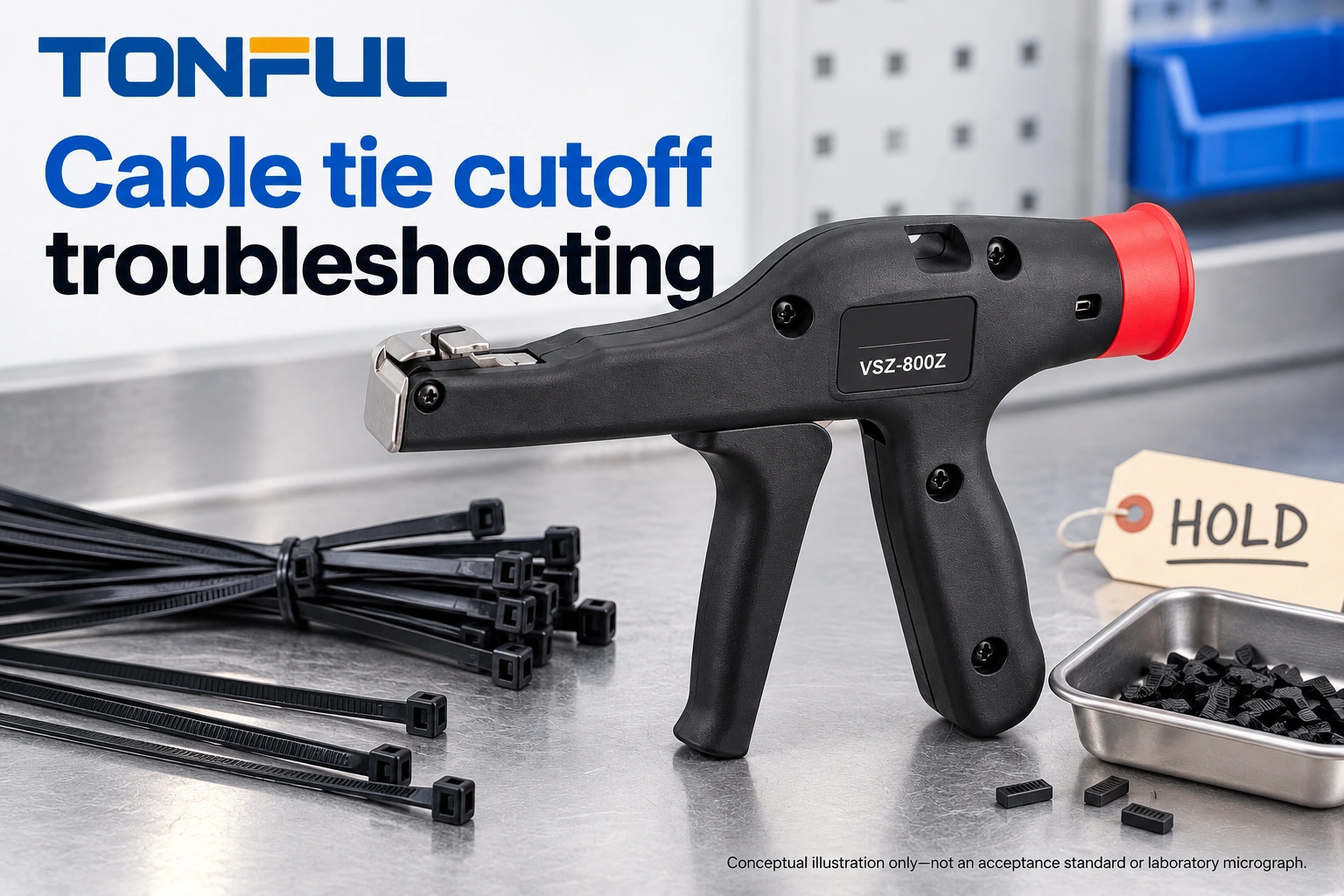
A cable tie gun not cutting cleanly does not automatically need a sharper blade. A partially severed tail can originate in an incompatible tie, poor nose seating, a slipping feed mechanism or an interrupted operating sequence. Replacing parts before recording the evidence can hide the original fault and leave the assembly process uncontrolled.
Stop using a tool that cannot cut properly, contain suspect assemblies, and identify the exact tool and tie before attempting a correction. This guide provides a diagnostic order for nylon tie tensioning and cutoff tools, with separate evidence, containment, root-cause confirmation, corrective action and prevention for blade, feed and setup faults. It is not a service manual or permission to dismantle an unfamiliar gun.
Contents:
- Contain the fault
- Confirm compatibility and setup
- Investigate feed and grip
- Evaluate blade faults
- Verify the root cause
- Control restart
Contain the fault before troubleshooting
Stop the installation operation and identify the last known acceptable check. Hold affected work back to that point, extending containment when traceability cannot establish a reliable boundary. Keep the tool, failed ties, cut tails and packaging lot information available. Do not mix defective examples with loose workshop waste or discard them during an immediate cleanup.
Record the symptom precisely: no cut, incomplete cut, torn tail, variable projection, slipping strap, damaged head or excessive bundle compression. These are not interchangeable defects. Photograph the installed condition before removing a suspect tie under an approved rework method, and retain its relationship to the assembly and tool asset number.
Make the work area safe through qualified site procedures, including circuit isolation and verification where electrical equipment is involved. A cable tie fastening tool is not established as insulated live-work equipment. Keep hands clear of the cutter, feed path and moving handles. Never probe the nose while operating the trigger or defeat a guard, stop or interlock to observe movement.
Before any blade access, remove the applicable energy sources and control stored energy exactly as the selected manufacturer’s maintenance instructions require. Pneumatic, battery and manual tools have different hazards; a manual tool can still retain spring or mechanism energy. Do not invent a common disassembly sequence. If the exact instructions are unavailable, quarantine the tool and obtain authorized service guidance.
The current TONFUL nylon fastening tool page specifically warns against continued use when a worn blade prevents proper cutting. Its VSZ-800K and VSZ-800Z are nylon tensioning/cutting tools, not conductor cutters, terminal crimpers or steel-band tools. Identify the actual model before applying any diagnostic assumption.
Confirm tie compatibility and setup first
Symptom and evidence
Variable tail projection, cuts that worsen in restricted spaces, and damage appearing after a material change all justify a setup review. Record tie part number, supplier lot, width, thickness, material designation and head construction. Compare them with the tool’s permitted application and the released work instruction rather than relying on the label nylon or on width alone.
TONFUL lists VSZ-800K for widths 4.8–12 mm with a listed thickness of 2 mm, and VSZ-800Z for widths 2.8–6 mm with a listed thickness of 1.5 mm. Confirm the actual tie’s dimensional applicability with TONFUL; these entries are not blanket approval for every material or head design inside the width span. Do not use either model’s data for the other.
Check access and nose seating from outside the hazard area. A mounting base, neighboring tie or enclosure wall may prevent the intended head contact. Record whether the symptom occurs only in one installed position. Also verify the adjustment setting, authorized operating sequence and whether an operator has been pulling the tool away during installation.
Containment, confirmation and correction
Hold the unapproved tie or setup combination. Under an approved safe trial plan, compare it with a known approved combination while retaining the original evidence. Change one documented factor at a time. A symptom that disappears when access is restored supports an access hypothesis, but does not prove the original blade was undamaged.
The permanent correction may be a revised approach envelope, approved tie construction, fixture position or operating instruction. Do not compensate for an obstruction with extra tension. Prevent recurrence through a first-piece review after routing, material or workstation changes. Use the TONFUL cable tie range to distinguish standard self-locking ties from releasable, mounting and other head arrangements before proposing substitutions.

Investigate feed and grip before condemning the blade
Symptom and evidence
A strap that slips, advances inconsistently or shows repeated gripping marks may never reach the intended cutoff condition. The uncut tail can therefore be a feed symptom rather than direct evidence of a blunt blade. Compare retained tails and record where the marks occur, which tie lots are involved and whether the problem follows a particular tool.
Document contamination or lodged fragments only through the inspection access permitted by the exact manual. Never insert a finger or improvised pick into the feed path, and never hold a moving mechanism open by hand. Do not apply oil or solvent simply because the strap looks difficult to pull; the selected instructions determine permitted cleaning and lubrication.
Containment, confirmation and correction
Quarantine the affected tool and suspect tie lot as appropriate. Authorized personnel should assess gripper condition, obstructions and mechanism return under the prescribed safe maintenance procedure. Retain service findings and any removed components. A cleaned mechanism that passes one cycle is not enough to establish that contamination was the only cause.
Confirm the hypothesis with a controlled comparison of the approved tie and tool after authorized correction. If the symptom follows a tie lot rather than the serviced tool, investigate its dimensional, surface or conditioning differences against the governing tie documents. Do not label a supplier lot defective solely because a different tool handles it better.
Permanent correction may require an approved gripper replacement, permitted cleaning, tie disposition or supplier corrective action. Prevention should specify housekeeping, permitted service materials, inspection responsibility and a reaction plan for renewed slipping. The electrical tools catalogue helps purchasing maintain the proper tool-family identity when requesting replacement units instead of substituting unrelated equipment.
Evaluate blade faults under the exact service instructions
Symptom and evidence
Repeated partial severing or torn edges on a verified compatible setup can justify blade investigation. Capture the cut surface and installed tail condition using the approved inspection method; do not test sharpness with a fingertip. Record whether deterioration was gradual, followed a jam, or began after a service event. These histories lead to different hypotheses.
An authoritative model-specific example is the Panduit PTS operation manual, which distinguishes cutter faults from other operating causes in its troubleshooting table. Its pneumatic procedures, pressure values, service parts and operating actions apply only to that equipment. They are not VSZ maintenance instructions and must not be copied onto a manual TONFUL gun.
Containment, confirmation and correction
Keep the tool out of production pending authorized inspection. Before blade access, follow the exact manual’s energy-removal and stored-energy controls. Authorized service should check the specified blade, mounting, nose and related components without unauthorized sharpening, bending, shimming or adjustment. If instructions or replacement part identity cannot be confirmed, obtain supplier support rather than improvising.
Root-cause confirmation needs more than installing a new blade. Compare the service findings with the retained fault samples and restart results. A wrong blade, damaged nose or incompatible tie can remain after replacement. Document the installed part number and applicable assembly procedure, and investigate why an unsuitable part or damaging condition reached production.
Permanent action is the approved repair plus correction of the initiating cause. Prevention should combine condition-based stop criteria with the manufacturer’s maintenance requirements. Do not invent a universal blade replacement interval from another brand’s cycle-life claim. Cut quality is specific to the tool, tie, setup and application; a flush-cut description never substitutes for the assembly’s acceptance requirements.
Verify the root cause with controlled trials
Use an approved trial plan after the tool has been returned to a safe operating condition. Identify who may run it, the permitted combinations, sample quantity, acceptance source and stop conditions. Trial work must not bypass guards or place observers near the cutting mechanism. Where inspection requires access, stop and establish the required safe state again.
| Fault path | Evidence | Immediate containment | Confirmation | Permanent action | Prevention |
|---|---|---|---|---|---|
| Setup or compatibility | Wrong tie identity, obstructed nose, position-specific failures | Hold affected combination and assemblies | Approved controlled comparison with correct identity and access | Release corrected tie, fixture or instruction | First-piece checks after relevant changes |
| Feed or grip | Slipping, inconsistent advance, retained strap marks | Stop tool and preserve tie lot evidence | Authorized service findings plus controlled retest | Approved cleaning, part replacement or tie disposition | Defined housekeeping and slipping reaction plan |
| Blade or nose | Persistent partial cut, torn edge, service-change history | Quarantine tool and suspect work | Authorized component inspection plus restart evidence | Approved repair and initiating-cause correction | Wear criteria, parts identification and service records |
Record actual settings, not assumed physical force. A dial position does not establish calibrated installation tension. If force is an acceptance requirement, obtain the exact measurement method, equipment and calibration requirements from the applicable documents. Do not convert tie tensile strength into a gun setting or increase tension until a damaged cutter finally severs the tail.
Inspection must cover head integrity and bundle condition as well as the tail. A clean-looking cut with damaged insulation is not a successful correction. Define tail projection and edge criteria using the customer drawing or approved instruction. The TONFUL cable ties buying guide provides material and application context, but it does not supply universal acceptance limits for every installed assembly.
Control restart and prevent recurrence
Restart requires a documented decision, not simply a repaired tool handed back to an operator. Define the affected-work disposition separately from permission to resume production. Retesting new samples does not automatically release older assemblies, particularly when the last acceptable inspection cannot be traced.

| Restart record | Required entry |
|---|---|
| Fault scope | Symptom, time, last acceptable check and held assemblies |
| Traceability | Tool asset, tie part and lot, assembly revision and operator |
| Evidence | Retained samples, photographs, settings and service findings |
| Correction | Confirmed cause, approved parts and instruction revision |
| Verification | Sample plan, acceptance source, results and unresolved deviations |
| Release | Work disposition, production approver and monitoring responsibility |
Update the workstation instruction and training when the correction changes technique or inspection. Monitor the original symptom after restart, with a defined escalation if it returns. Close the corrective action only after the agreed verification evidence demonstrates the correction is effective within the released scope.
For a TONFUL tool that no longer cuts properly, send the model, tie width and thickness, material, fault photographs and retained-sample details through TONFUL’s product support enquiry. Ask for the applicable instructions and model-specific service guidance. Keep the tool on hold until its safe condition and the fastening process have both been verified.