
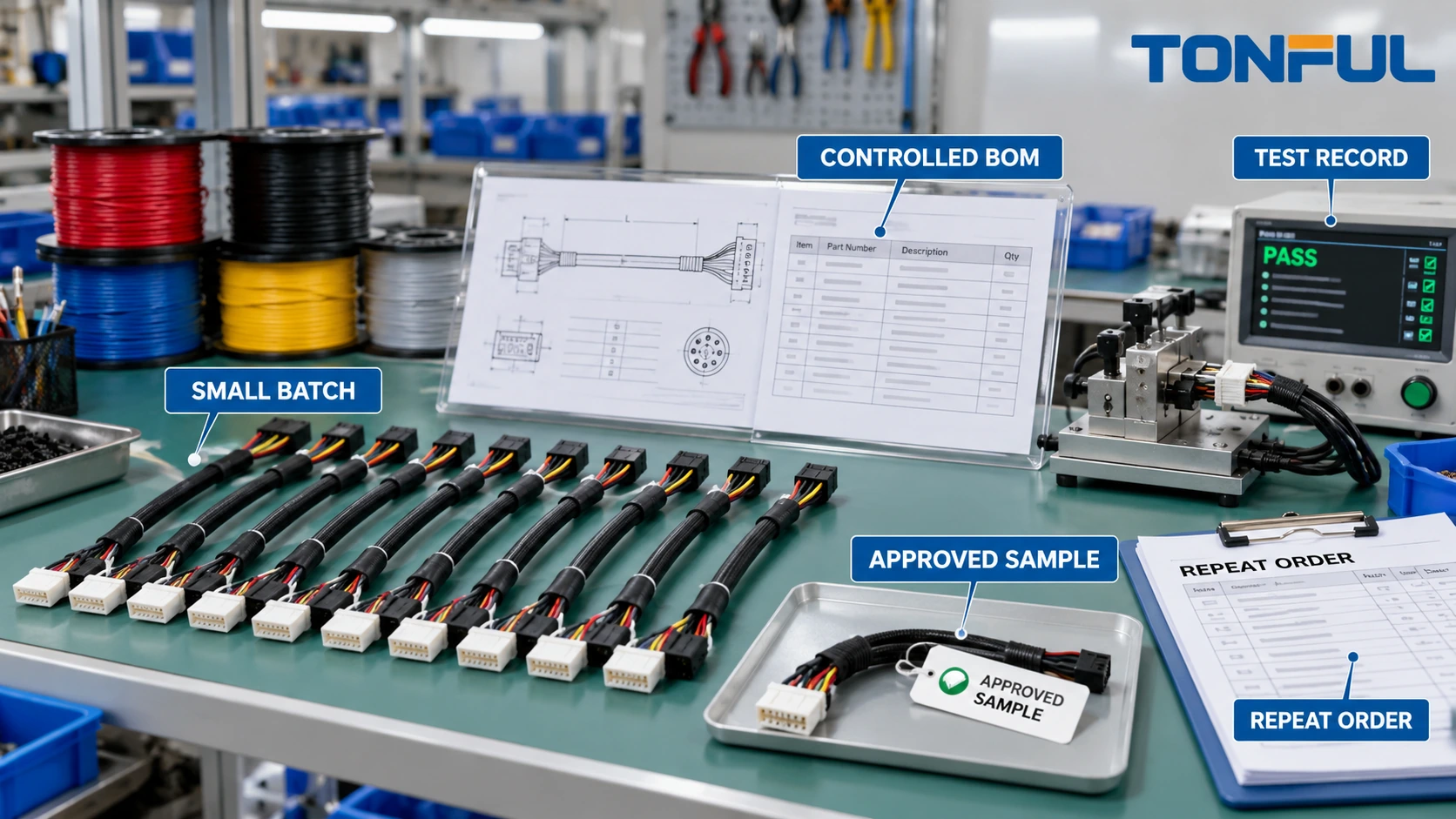
Small-batch cable assemblies are not simply mass-production harnesses ordered in lower quantities. Setup, documentation, material minimums, tooling, programming, inspection and test effort must be spread across fewer units. A low unit price can hide excess inventory, uncontrolled substitutions or a prototype process that cannot be repeated. A higher quotation can include fixtures, records and reserved material that reduce later risk.
The buyer’s task is to separate one-time cost from recurring cost and to define what must remain stable between batches. That requires a clear drawing, bill of material, pinout, acceptance plan, demand profile and ownership agreement before comparing quotes.
This guide covers prototypes, pilot runs, service parts and recurring low-volume orders. It does not promise a universal MOQ, lead time, tooling price or price break. Those figures depend on exact components, processes, demand, supplier capacity and commercial terms.
Why Small Batches Cost Differently
| Cost driver | Why it matters in low volume | Buyer control |
|---|---|---|
| Engineering review | Drawing/BOM questions require similar effort whether quantity is 10 or 10,000 | Submit complete controlled data |
| Material minimums | Wire, cable, terminals, labels and packaging may be sold in reels or packs | Separate required quantity from purchase minimum |
| Setup/changeover | Cutting, stripping, crimping, molding and test fixtures need setup | Group stable configurations where appropriate |
| NRE/tooling | Fixtures, applicators, molds, test adapters and programs may be one-time assets | Define scope, ownership and storage |
| Inspection/testing | First article and test evidence consume time per lot | Agree sample and record depth |
| Procurement risk | Long-lead or obsolete parts can dominate schedule | Approve sources and alternates early |
| Repeat-order control | A second batch can drift if revision and material state are unclear | Freeze approved baseline and effectivity |

<figcaption><em>Separating one-time, lot-level and unit-level costs makes quotations comparable without hiding minimum purchases.</em></figcaption>
Define the Batch Type and Demand Profile
Tell the supplier whether the order is an engineering prototype, design-validation sample, pilot build, bridge production, service part or recurring low-volume product. Each has a different approval boundary. A prototype may allow temporary labels or manual fixtures; a pilot build may need production-intent materials, tooling and records.
Provide expected first quantity, annual usage, order frequency, likely batch range and program duration. Mark uncertain forecasts as estimates rather than commitments. If demand is highly variable, discuss blanket orders, scheduled releases or buyer-owned stock instead of forcing one unrealistic MOQ.
The TONFUL custom cable assembly buying guide explains the construction and performance information needed before sourcing. For branched products, the TONFUL custom wire harness buying guide adds branch geometry, protection and installation context.
Build an RFQ That Supports a Real Quote
At minimum, supply a controlled drawing, BOM, connector pinout, wire/cable requirements, dimensions and tolerances, label content, coverings, applicable workmanship criteria, inspection/test requirements, packaging and requested delivery schedule. Identify customer-supplied components and any approved alternates.
Use manufacturer part numbers where interchangeability matters. “Equivalent connector” is not a complete requirement because keying, plating, seal range, terminal system, retention and mating compatibility can differ. The TONFUL cable assembly RFQ checklist provides reusable technical and commercial fields.
List unresolved assumptions separately. Ask the supplier to respond with compliant, deviating and pending items. A quotation based on silent assumptions may look complete until sample approval reveals a different wire, connector or test scope.
Separate MOQ From Material Minimums
MOQ can describe several different constraints: the supplier’s minimum production run, a component manufacturer’s package quantity, a distributor minimum order, a custom-material minimum, or the commercial value needed to process an order. Ask which constraint creates each minimum.
If 100 assemblies require only part of a wire reel or terminal pack, define who owns the remainder, where it is stored, how long it is retained and whether it is reserved for the project. Excess material can reduce the next order cost, but only if identity, shelf conditions and revision compatibility are maintained.
Avoid automatic substitutions intended solely to reach a lower MOQ. An alternative wire, terminal or housing should have a controlled comparison and approval. If the buyer supplies hard-to-source parts, define incoming inspection, shortage handling, scrap allowance, ownership and liability for unusable material.
Define NRE, Tooling and Ownership
Non-recurring engineering can include design review, manufacturability work, programming, documentation, first article reporting and fixture development. Tooling can include applicators, dies, locator nests, overmold tooling, continuity adapters, test fixtures and gauges. Ask for an itemized list rather than one unexplained fee.
For each item, record owner, physical location, identification number, maintenance responsibility, storage period, replacement condition and transfer rights. Payment does not automatically establish ownership unless the contract says so. A low NRE fee may mean generic tooling is used; a high fee may include dedicated assets that improve repeatability. Evaluate what the cost buys.
Confirm whether revisions are included. A connector or pinout change can require a new test adapter, program or mold insert. Define how modification costs and obsolete tooling are approved before work begins.
Plan Samples and Approval Stages
Separate engineering sample, first article, validation sample and production approval. A sample that fits and powers up may not use production-intent material or tooling. The approval record should name sample IDs, revision, material lots, process route, tests, deviations and disposition.
Use clear statuses: rejected, conditional, sample approved and production approved. Conditional approval needs scope, quantity, owner, due date, expiry and closure evidence. Sample approval does not automatically approve future mass production or a revised configuration.
The TONFUL first article and incoming inspection checklist gives record fields for dimensions, pinout, terminations and electrical tests. For small batches, agree which records accompany every lot and which remain at the supplier for retrieval.
Compare Lead Time by Its Components
Do not accept one total lead-time number without understanding the path. Separate engineering clarification, component procurement, tooling/fixture preparation, sample build, buyer review, validation, production scheduling and transport. Identify which stages can run in parallel and which wait for approval.
Long-lead connectors or custom cable often dominate timing. Ask whether quoted lead time assumes stock that can be allocated, supplier stock that is not reserved, or a new manufacturer order. Record quote validity and recheck availability before release.
Expedite options should identify the actual constraint being changed. Paying for faster assembly does not help if an approved terminal will not arrive. Likewise, purchasing a full component minimum may shorten one order but create obsolete stock if the design changes.
Calculate Total Sourcing Cost
NIST’s Supply Chain Management guidance explains that total cost of ownership extends beyond purchase price and can include freight, lead time, inventory, supplier-management overhead and business risk. Apply that principle to the real project rather than assigning generic percentages.
Use a transparent model:
Total approved-lot cost = recurring assembly cost + allocated material minimums + lot setup + inspection/test + packaging/freight + amortized approved NRE + expected quality and schedule risk
Define each boundary to avoid double counting. If scrap is already included in material cost, do not add it again as a separate failure cost. If tooling is buyer-owned and reusable, amortize it over a realistic approved volume, not an optimistic lifetime forecast.
Compare expected, conservative and stress scenarios. Include incoming inspection, engineering review, diagnostic time, rework, return freight, line interruption and obsolete inventory where relevant. Do not invent failure rates; use verified history or clearly labeled assumptions.

<figcaption><em>A transparent total-cost model shows where minimum material, NRE and schedule risk enter the decision.</em></figcaption>
Protect Repeat Orders From Configuration Drift
Store an approved package: drawing, BOM, pinout, sample record, deviations, component sources, process/test revision, label artwork and packaging. The next purchase order should reference that baseline and identify any changes.
The TONFUL revision-control and traceability guide explains how effectivity and genealogy prevent old and new configurations from mixing. For repeat small batches, verify remaining materials against shelf condition, lot identity and current revision before assuming they can be reused.
Require notification for agreed changes to components, sources, tooling, process, site, test program and sub-tier operations. If a part becomes unavailable, use a controlled alternate-approval process. Do not let commercial urgency turn a proposed substitution into an undocumented permanent change.
Copyable Small-Batch RFQ and Cost Record
| Field | Required entry |
|---|---|
| Project/batch type | Prototype, validation, pilot, service or recurring low volume |
| Demand profile | First quantity, annual estimate, batch range and frequency |
| Baseline | Drawing, BOM, pinout, test and packaging revisions |
| Material minimums | Item, required quantity, purchase minimum, owner and residual stock |
| NRE/tooling | Item, purpose, price, owner, location and revision impact |
| Samples | Quantity, production intent, test scope and approval status |
| Lead time | Engineering, material, tooling, sample, approval, production and freight |
| Recurring price | Quantity break, currency, Incoterm and validity |
| Lot-level cost | Setup, inspection, test, documentation and packaging |
| Change control | Notification scope, approval and effectivity |
| Repeat order | Reserved stock, shelf review and baseline confirmation |
| Open assumptions | Owner, due date and quote impact |
Release Checklist
- Drawing, BOM and pinout revisions agree.
- All quoted assumptions and deviations are visible.
- MOQ and component minimums are separated.
- Residual-material ownership and storage are defined.
- NRE, tooling and fixture ownership are itemized.
- Sample stage and production-approval boundary are documented.
- Lead-time components and availability assumptions are recorded.
- One-time, lot-level and unit-level costs are separated.
- Repeat-order baseline and change-notification rules are agreed.
- Acceptance records, packaging and delivery terms are included.

<figcaption><em>The reusable record keeps commercial terms connected to the technical baseline and approval status.</em></figcaption>
Source Small-Batch Cable Assemblies With TONFUL
For a small-batch cable assembly quotation, send TONFUL the controlled drawing, BOM, pinout, target quantity, forecast range, approved component sources, sample stage, required tests, packaging and delivery need. TONFUL can review manufacturability, material constraints, tooling and record requirements for the defined project. MOQ, price, lead time and capacity remain quotation-specific and should not be inferred from a general article.