
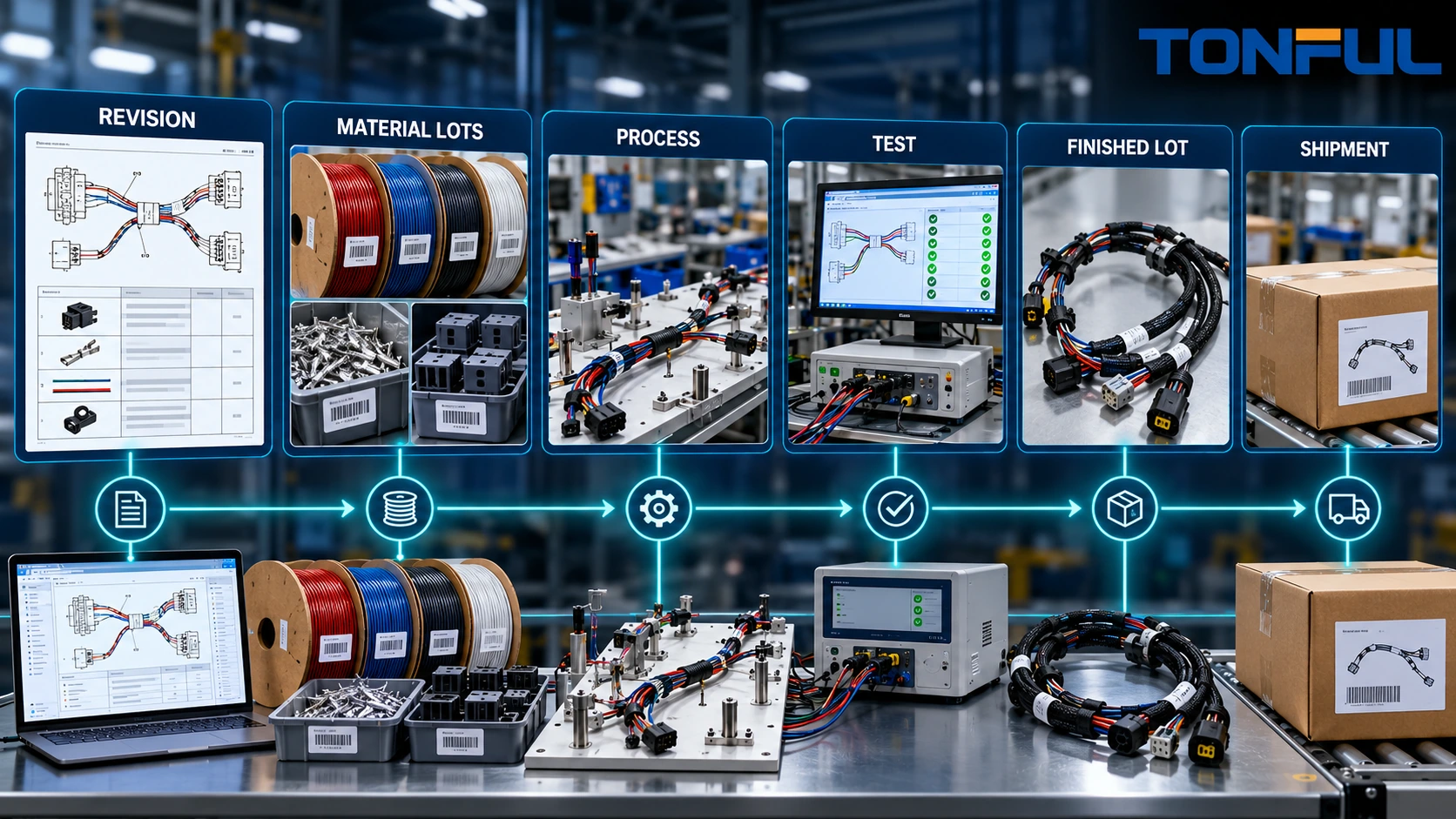
A wire harness can pass continuity testing and still be the wrong product revision. The circuit may be electrically correct while using an obsolete wire, superseded terminal, old label, previous branch length or unapproved test program. Revision control prevents the wrong requirements from reaching production. Lot traceability shows which materials, processes and finished assemblies were actually involved.
These controls must work together. A released drawing without production genealogy cannot identify affected units after a material problem. A detailed lot database cannot prove conformity if operators used an obsolete work instruction. The practical objective is a closed evidence chain from customer requirement to released documents, production inputs, process records, inspection results, shipment and any later correction.
This guide provides a workable structure for OEM and industrial harness programs. It does not prescribe one retention period, serial-number format, lot size or change-notification window. Those requirements must be defined by contract, risk, regulatory obligations, customer-specific requirements and the organization’s quality system.
Revision Control and Traceability Solve Different Problems
| Control | Main question | Typical evidence | Failure if missing |
|---|---|---|---|
| Revision control | Which requirement was authorized at a specific time? | Approved drawing, BOM, change notice, work instruction and effectivity | Obsolete or mixed configuration |
| Material traceability | Which component lots entered the build? | Receiving lot, manufacturer part, supplier lot and issue record | Unknown exposure to defective material |
| Process traceability | How and where was the harness built? | Site, line, machine, tool, program, operator/cell and inspection | Inability to isolate process drift |
| Product genealogy | Which materials and processes belong to each finished unit or batch? | Work order, serial/lot relationship and test record | Recall boundary becomes too broad or too narrow |
| Shipment traceability | Which customer received affected product? | Packing list, shipment lot, quantity and date | Delayed containment and notification |

<figcaption><em>Revision control defines the authorized configuration; genealogy proves what entered each delivered harness lot.</em></figcaption>
Establish a Controlled Requirement Baseline
Start with a configuration index rather than a folder of files. For each harness part number, list the released drawing, BOM, circuit table, connector views, component specifications, label artwork, test specification, packaging instruction, approved deviations and customer documents. Record revision, approval date, effective date and owner.
The TONFUL harness drawing and pinout guide explains why drawing views, circuit tables and connector orientation must agree. If two controlled sources conflict, production should not choose one informally. The issue needs an authorized resolution and a recorded precedence decision.
Control external documents as well as internal ones. A connector application specification, customer standard or wire data sheet may change independently. Record the document number and revision actually approved for the project. A web page viewed today is not automatically the requirement used for a harness built last year.
ISO’s official guidance on documented information for ISO 9001:2015 explains that organizations need objective evidence of effective processes and should determine the documented information necessary for their quality system. It does not define a wire-harness genealogy format or approve a product; the contract and product controls must do that.
Control Engineering Changes and Effectivity
Every change needs a reason, affected items, technical review, validation decision, approval and implementation plan. The change record should identify old and new revisions, impacted finished parts, raw materials, tools, programs, labels, work instructions, inspection plans, packaging and open orders.
Effectivity answers when the new requirement becomes mandatory. Define it by work order, date/time, serial number, finished lot or another unambiguous boundary. “Use new revision next production” is not precise enough. If old and new material can both be used under controlled depletion, state the permitted scope and prevent unintended mixing.
Review work in process, finished stock, supplier stock, service parts and customer shipments before releasing the change. Decide whether each item may be used as is, reworked, relabeled, returned or scrapped. Record who approved the disposition. The TONFUL wire harness DFM checklist helps identify geometry, tooling and installation effects that can make a seemingly small revision significant.
Change scope should be risk based. A spelling correction may need document replacement only. A terminal, wire, seal, splice, routing or test-program change may require first article inspection, destructive testing, environmental validation or customer approval. The TONFUL first article and incoming inspection guide provides the approval boundary for new or changed configurations.
Prevent Obsolete Documents at the Point of Use
Release control fails if the correct revision exists in the system but an old print remains on the harness board. Production access should show only the effective work instruction, drawing, BOM, tester program and label file for the active work order. Printed copies need controlled status or should be replaced by managed digital access.
When a revision changes, withdraw obsolete documents from workstations, shared drives, tool cabinets and offline testers. Archive them so history remains available, but mark them to prevent accidental use. Verify that barcode selection, manufacturing execution systems and tester interfaces point to the approved revision.
Use a line-clearance check at changeover. Confirm removal of old labels, wire kits, terminals, housings, fixtures and sample boards before new material enters the station. If two revisions run concurrently, use physical segregation, distinct work-order identity and controlled storage locations. Color alone is not enough to prevent mixing.
Build Material-to-Product Genealogy
The bill of material states what should be used; genealogy records what was used. Capture component manufacturer, supplier, exact part number, supplier/manufacturer lot, receiving lot and quantity issued. For wire and cable, include reel or spool identity where project risk requires it. For terminals, seals, housings, clips, labels, tubing and overmold material, define the trace depth needed for containment.
Link issued lots to a work order and link the work order to finished serial numbers or production lots. If components are replenished during the run, record the transition. A single work order that consumes multiple terminal lots without timing or quantity information may force the entire order into containment.
For UL AWM or other controlled wire, identity can include manufacturer, style, temperature/voltage marking and production lot as required. The TONFUL UL AWM harness guide explains why a generic “UL wire” description is not enough to maintain construction and authorization evidence.
Sub-tier operations need the same logic. If plating, molding, overmolding or outsourced testing affects the product, link the external processor, lot, certificate/report and date to the production record. A certificate should identify the actual lot and requirement; a generic annual statement does not create genealogy.
Capture Process and Test Traceability
Record the production site, line or cell, date/time, operator or automation identity, machine, applicator, die/cavity, ultrasonic tool/program, tester, fixture and software revision as applicable. The depth should match risk: a simple low-volume pigtail and a safety-related multi-branch harness may require different granularity.
Calibration status alone does not prove that the correct tool was used. Connect tooling identity to the released setup and record first-off, changeover, maintenance and scheduled verification. When a tool is repaired, define whether affected product requires review back to the last accepted verification.
Electrical records should preserve harness identity, test-program revision, adapter/fixture identity, result and retest history. The TONFUL continuity and dielectric test guide explains why continuity, insulation resistance and hi-pot results are not interchangeable. A final pass must not overwrite the original failure without recording investigation, authorization and retest disposition.

<figcaption><em>Useful genealogy connects real material and process transitions to finished lots instead of storing disconnected certificates.</em></figcaption>
Perform Bidirectional Traceability Checks
Forward traceability begins with a material or process record and identifies every affected work order, finished lot, inventory location and shipment. Backward traceability begins with one finished harness and identifies its approved revision, input lots, production route and test evidence. Both directions are required for a credible containment system.
Test the system periodically with a traceability exercise or simulated recall. Select a finished serial/lot and retrieve its complete genealogy. Then select a component lot and identify all affected finished units and customers. Record start time, completion time, missing links, quantity reconciliation and corrective actions. Do not claim a universal completion target unless the contract defines one.
Quantity reconciliation matters. Compare material received, issued, returned, scrapped, remaining and incorporated. Differences may indicate unrecorded replenishment, mixed lots or counting errors. For continuous wire, use the control method appropriate to reel use and scrap rather than pretending every centimeter can be reconstructed if the process does not support it.
Define Recall and Containment Boundaries
When a defect occurs, quarantine the smallest defensible population supported by evidence. Start with the failure mechanism: material lot, tool, setup, operator, time window, program revision or design configuration. Identify the last known conforming and first known conforming boundaries around the suspect interval.
Do not narrow containment based on absence of complaints. Conversely, do not automatically recall every historical harness when accurate genealogy supports a smaller boundary. Preserve failed samples, machine records, inspection data and shipment lists. Record assumptions and escalate unknown periods instead of silently classifying them as conforming.
Corrective action should update the relevant control: supplier requirement, receiving inspection, work instruction, error proofing, monitoring, maintenance, test program or change process. Verify effectiveness on defined later lots. If rework is allowed, control the instruction, authorization, new identity and post-rework test.
Copyable Revision and Traceability Matrix
| Record field | Required entry |
|---|---|
| Finished product | Harness part, revision, serial/lot and quantity |
| Requirement baseline | Drawing, BOM, pinout, test and packaging revisions |
| Change effectivity | Change ID, old/new revision, effective boundary and approval |
| Material identity | Manufacturer/supplier part, lot, receiving lot and issue record |
| Production route | Site, line/cell, work order, date/time and operator/automation |
| Tool/program | Machine, applicator/die/tool and controlled program revision |
| Inspection/test | Record ID, fixture, software, result and retest disposition |
| Nonconformance | NCR/deviation, affected scope and disposition |
| Shipment | Customer/order, packing list, quantity and ship date |
| Retention | Storage system, retention period source and access authority |
Copyable Simulated Recall Record
| Exercise field | Required entry |
|---|---|
| Trigger | Selected finished lot, material lot or process event |
| Forward result | Affected work orders, inventory, shipments and customers |
| Backward result | Revision, materials, route, tools and tests recovered |
| Reconciliation | Received, issued, scrap, stock and finished quantities |
| Missing evidence | Unlinked records, assumptions and containment expansion |
| Timing | Start, checkpoints and completion time |
| Decision | Scope, authority and communication status |
| Follow-up | Corrective action, owner, due date and effectiveness check |

<figcaption><em>A repeatable record makes traceability testable and exposes missing links before a real field event.</em></figcaption>
Specify Traceability With TONFUL
For a custom harness project, provide TONFUL with the drawing and BOM revision structure, change-notification rules, required material and process trace depth, label/serial format, test-record fields, retention requirements and shipment genealogy expectations. TONFUL can align quotation, sampling and production records with the agreed scope. Customer-specific identifiers, retention periods and release authority must be confirmed in controlled project documents.