
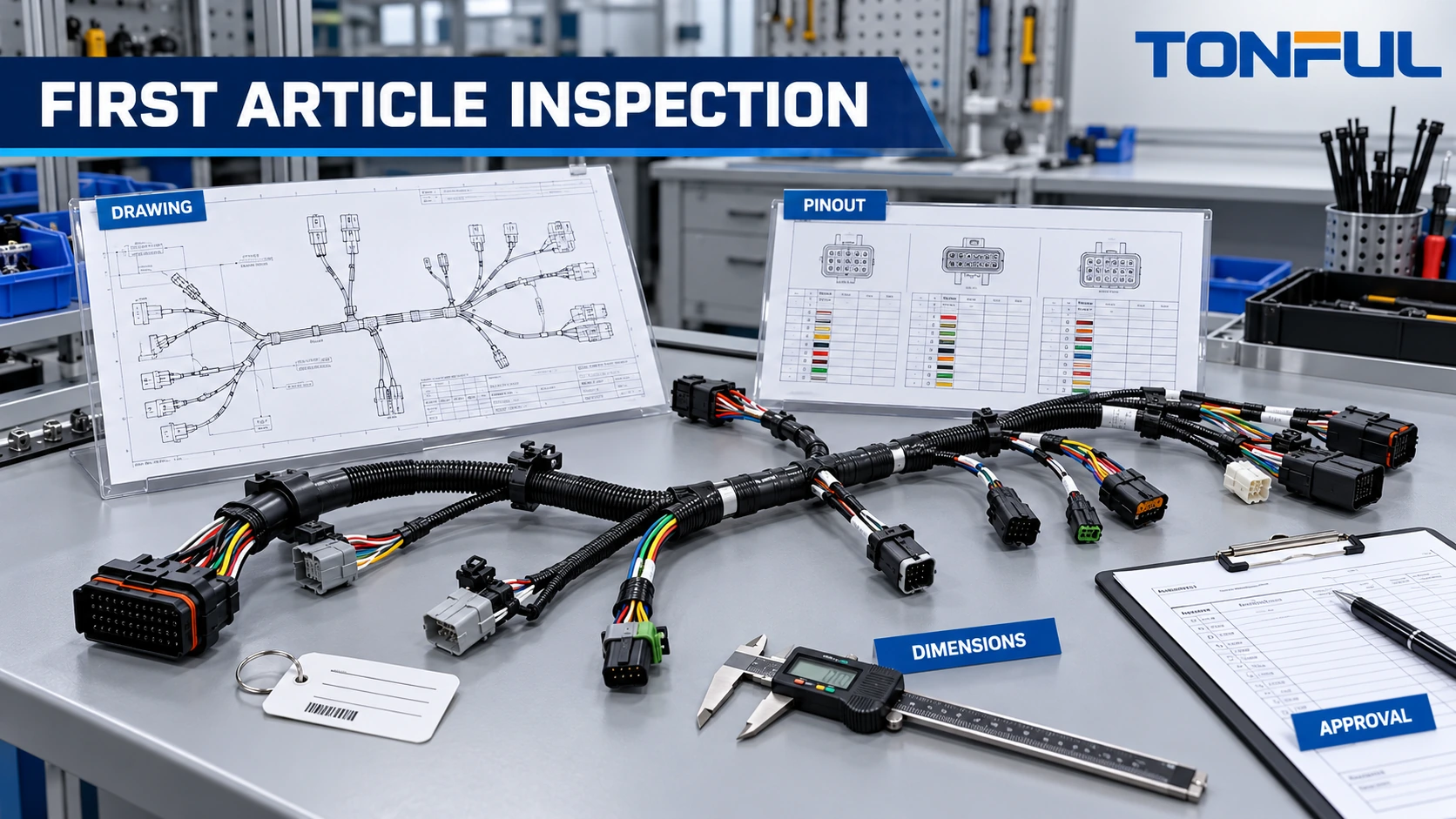
A passing electrical test does not prove that a delivered wire harness matches the released design. A tester may confirm continuity while missing the wrong wire specification, unapproved connector revision, incorrect branch length, damaged seal, weak crimp, misplaced label or undocumented substitution. First article inspection and incoming inspection address different parts of that risk.
First article inspection establishes whether a defined sample was built from the correct requirements and manufacturing route. Incoming inspection determines whether a delivered lot remains within the approved identity and acceptance controls. One cannot replace the other: a detailed first article does not release every future lot, while repeated receiving checks cannot compensate for an unapproved design or process.
This checklist helps buyers, engineers and quality teams build a controlled inspection plan. It does not prescribe a universal sample size, AQL, crimp height, pull force, resistance or dimensional tolerance. Those values must come from the contract, drawing, component documents, risk analysis and approved control plan.
First Article vs Incoming Inspection
| Area | First article inspection | Incoming inspection |
|---|---|---|
| Primary purpose | Prove that a defined configuration and process can produce the released harness | Confirm lot identity and screen delivered product against the approved baseline |
| Typical timing | New part, first production, major change or specified restart | Each receipt or frequency defined by the receiving plan |
| Evidence depth | Full drawing/BOM review, dimensional results, construction evidence and required tests | Lot documents, identity, workmanship, selected dimensions/tests and packaging |
| Sample basis | Approved project plan and risk | Contract, supplier performance and controlled sampling plan |
| Output | Approved, conditional or rejected first-article record | Accepted, contained, rejected or escalated lot |
| Key limitation | Does not approve uncontrolled future changes | Does not establish design/process qualification |

<figcaption><em>First article approval establishes the controlled baseline; incoming inspection protects that baseline at receipt.</em></figcaption>
Freeze the Inspection Baseline
Before touching the sample, identify the documents that define it. Record harness part number, drawing revision, bill-of-material revision, change notice, customer specification, applicable workmanship standard, approved deviation and purchase-order revision. If documents conflict, quarantine the decision rather than selecting the most convenient requirement.
The baseline should include the released drawing, connector and terminal documents, wire and cable specifications, splice details, label artwork, test specification, packing instruction and approved sample or photographs where contractually controlled. The TONFUL guide to reading harness drawings and pinouts explains how circuit tables, connector views and cavity definitions must remain aligned.
Assign an evidence identifier to each controlled file and record its revision/date. A supplier catalog page may help identify a component, but it is not automatically the released requirement. Likewise, a golden sample is useful only when its identity, approval status, storage and change relationship are controlled.
When a New First Article Is Required
Do not limit first article inspection to the first purchase order. Define re-approval triggers in the contract and change-control procedure. Typical triggers can include a new harness, drawing or BOM revision, new connector/terminal source, wire-construction change, tool or applicator change, process transfer, new manufacturing location, revised test software, long shutdown, major repair, customer complaint or corrective action.
Not every change requires the same scope. A label-artwork revision may need identity and marking checks without repeating environmental qualification. A terminal, seal or crimp-tool change may require dimensional, mechanical, electrical and environmental evidence. Record who determines the scope and why.
The first-article record must identify the exact production-intent route. A hand-built engineering prototype does not prove that automated cutting, crimping, ultrasonic splicing, overmolding or end-of-line testing is ready for serial production. Conditional approval should state the approved quantity, configuration, deviation, owner, expiry and closure evidence.
First Article Inspection Checklist
Identity, Material and Traceability
Verify sample ID, manufacturing date, work order, supplier site, wire lots, terminal lots, connector lots, seals, coverings and labels against the released BOM. Check wire markings and packaging labels without assuming that color proves construction. Confirm approved manufacturer and supplier part numbers, not just generic descriptions.
Trace a finished sample back to production records and selected incoming material, then select a material lot and trace it forward to affected finished harnesses. The record should expose gaps before volume release. The TONFUL UL AWM wire guide shows why style, manufacturer identity, use statement and lot evidence must remain connected where AWM is specified.
Dimensions and Branch Geometry
Measure overall length, branch lengths, breakout positions, connector orientation, clip locations, label positions and protective-covering limits from defined datums. Record actual values and instrument identity rather than writing “OK.” Clarify whether dimensions are free-state, fixture-held or under a specified load.
Check bend direction, breakout clocking and routing on the harness board or application fixture. A harness can meet individual lengths yet interfere during installation because branch orientation, clip rotation or connector exit direction is wrong. The TONFUL wire-harness DFM checklist provides related guidance on datums, tolerances and installation access.
Connector, Pinout and Secondary Locks
Verify housing part number, keying, color only where controlled, cavity count, populated and empty cavities, terminal orientation, cavity plugs, seals and secondary-lock position. Inspect from a documented connector-end view. A mating connector fitting physically does not prove that the pinout or electrical architecture is correct.
Compare every circuit against the cavity table: source, destination, wire ID, color, gauge or area, shield/drain treatment and intended function. For diode, resistor, sensor, twisted-pair or network branches, verify polarity, pairing and component orientation. Do not apply power to unidentified circuits.
Termination and Splice Evidence
Inspect strip condition, strand damage, conductor position, bellmouth, brush, insulation clearance, insulation support, cutoff tab and terminal retention according to the applicable termination documentation. Record measured crimp height or other controlled dimensions where specified. Visual appearance alone cannot establish internal strand compaction.
Review setup and destructive-test records for the actual wire/terminal/tool combination. The TONFUL crimp pull-force testing guide explains why fixture, pull rate, peak result and failure mode belong in the record. For ultrasonic or other splices, verify the approved process program, tooling, monitoring and covering.
Electrical and Functional Testing
Continuity testing should verify every intended connection and absence of prohibited shorts against the released netlist. Record tester program revision, adapter identity and result. Resistance, insulation resistance, dielectric withstand or functional loading should be added only when the approved plan defines method, limits and safety controls.
The TONFUL continuity, insulation-resistance and hi-pot guide separates these tests and their purposes. Never use resistance or continuity mode on an energized circuit. High-voltage testing requires controlled fixtures, guarding, discharge and trained personnel; a generic blog value is not an acceptance criterion.
Incoming Inspection Checklist
Incoming inspection begins with shipment identity. Match supplier, purchase order, part number, revision, quantity, lot/date code, certificate or test report, approved deviation and packaging label. Confirm that documents refer to the delivered lot rather than a generic sample or expired approval.
Inspect packaging for moisture, crushing, contamination, connector damage, bent clips and mixed labels. Verify protective caps, coil diameter, bag quantity and electrostatic controls where applicable. Packaging is part of product protection; a functionally correct harness can arrive unusable after uncontrolled transport.
Use a controlled sampling plan based on contract requirements, risk, lot size, supplier history and characteristic criticality. Do not choose a generic AQL merely because it is familiar. State the sampling unit, randomization method, acceptance/rejection number, treatment of mixed lots and response to one critical failure. Safety, wrong part, lost traceability or unauthorized change may require lot containment regardless of a calculated score.
Receiving Characteristics
At minimum, consider identity, revision, workmanship, connector condition, terminal backout, seals and cavity plugs, selected dimensions, labels, clips, covering, continuity sample and packaging. Increase depth for new suppliers, recent changes, previous escapes or high-risk characteristics. Reduce inspection only through an approved supplier-performance process, not informal confidence.
If a sample fails, stop release and define the suspect boundary. Do not sort only the visible symptom when the root cause may affect the full lot. Record defect, sample ID, photograph, measurement, requirement source, containment quantity and disposition. Supplier rework needs authorization, instructions, post-rework verification and updated traceability.

<figcaption><em>Receiving inspection should connect shipment identity, sampled evidence and lot disposition rather than rely on appearance alone.</em></figcaption>
Use IPC/WHMA-A-620 Within Its Proper Boundary
IPC explains that IPC/WHMA-A-620E prescribes practices and requirements for cable and harness manufacture and describes materials, methods, tests and acceptance criteria. The contract must identify the applicable revision, class and customer additions.
The standard does not replace the harness drawing, component application specification, sampling plan or product-specific electrical limits. It also does not decide which document wins when requirements conflict. Establish precedence in the purchase order or quality agreement and train inspectors to the controlled criteria they actually use.
Copyable First Article Record
| Record field | Required entry |
|---|---|
| Sample identity | Part, revision, serial/sample ID, work order and date |
| Requirement baseline | Drawing, BOM, specifications, deviations and change notice |
| Production route | Site, line, machine, tool/program revisions and operator/cell |
| Material trace | Wire, terminal, housing, seal, covering and component lots |
| Dimensions | Datum, nominal/tolerance, actual result and instrument |
| Pinout | Connector view, cavity map, circuit and result |
| Terminations | Visual criteria, controlled dimensions and destructive record |
| Electrical tests | Program, adapter, method, limit source and result |
| Packaging/labels | Revision, quantity, protection and result |
| Open items | Deviation, owner, due date and closure evidence |
| Approval | Status, scope, reviewer and date |
Copyable Incoming Lot Record
| Inspection field | Required entry |
|---|---|
| Receipt identity | Supplier, PO, part/revision, lot/date code and quantity |
| Document review | Certificate, report, deviation and change status |
| Sampling | Plan, lot size, sample IDs and randomization method |
| Visual/workmanship | Characteristics, criteria and defects found |
| Dimensional | Feature, actual result, instrument and calibration status |
| Electrical | Test/program/adapter and result where required |
| Packaging | Damage, labels, protection and mixed-lot check |
| Disposition | Accept, contain, reject or conditional release |
| Corrective action | NCR/SCAR reference, owner and closure evidence |
| Authorization | Inspector/reviewer and date |

<figcaption><em>Actual measurements, evidence IDs and disposition authority make the checklist usable during audits and corrective action.</em></figcaption>
Release Decisions and Change Control
Use clear statuses. Rejected means a mandatory requirement or evidence item failed and product cannot be released. Conditional means a defined deviation has an owner, quantity/scope and expiry; it is not silent approval. First article approved means the named sample and production route met the agreed review, not that future changes are accepted. Production lot accepted means the delivered lot passed its receiving plan within the existing approved scope.
High scores must not override critical failures, falsified records, wrong part identity, lost traceability or unauthorized changes. Not evaluated is not conforming. Mark N/A only with an approved applicability reason, and restrict approval when the inspection scope is incomplete.
After approval, maintain change notification for material, source, tooling, process, test program, site, packaging and sub-tier operations as contractually defined. Link complaints and receiving escapes back to the first-article baseline so the control plan evolves with real evidence.
Prepare Harness Inspection Evidence With TONFUL
For a custom harness quotation or sample build, provide TONFUL with the released drawing, BOM, pinout, controlled component list, inspection class, first-article format, receiving expectations, test specification and change-notification requirements. TONFUL can align sample and production records to the documented project scope. Final limits, sampling rules and approval authority remain subject to the customer’s controlled requirements.