
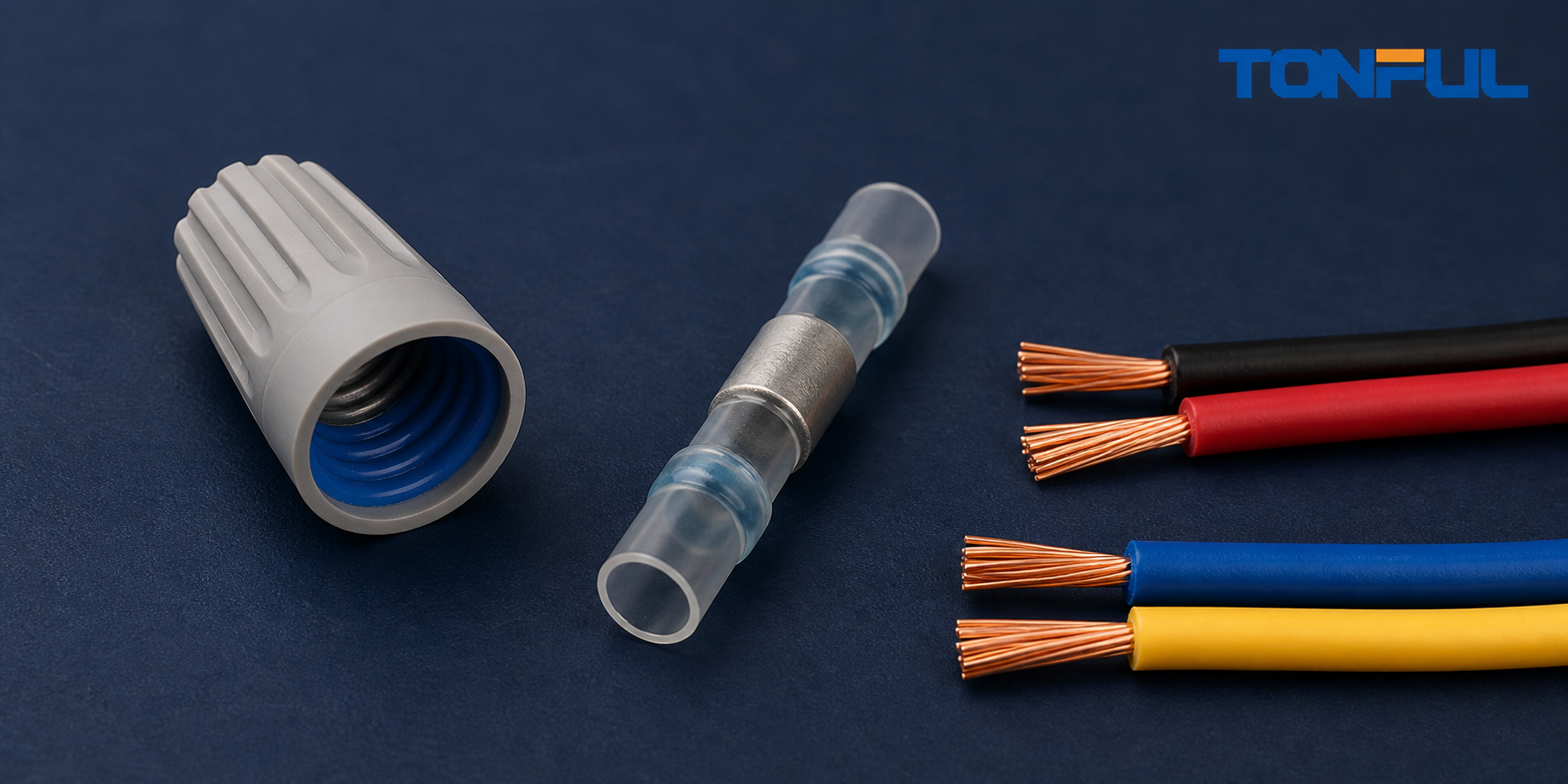

Waterproof wire nuts and heat-shrink butt connectors can both protect copper splices from moisture, but they solve different wiring problems. A waterproof wire nut usually joins two or more conductor ends inside a sealant-filled twist-on housing. A heat-shrink butt connector creates an inline crimp between two wire ends and seals around the insulation when heated.
The right choice depends on splice geometry, conductor count, installation tools, enclosure space, service conditions, and the product’s approved use. Neither connector type is universally better.
Quick Comparison
| Selection factor | Waterproof wire nut | Heat-shrink butt connector |
|---|---|---|
| Splice layout | End-to-end bundle entering one cap | Inline wire-to-wire splice |
| Typical conductor count | Two or more, within an approved combination | Usually one conductor per side unless specifically designed otherwise |
| Connection method | Twist-on spring or internal gripping element | Crimped metal barrel |
| Moisture barrier | Prefilled silicone or gel | Adhesive-lined heat-shrink sleeve |
| Main tools | Wire stripper; some designs require pliers | Wire stripper, matched crimp tool, controlled heat source |
| Space profile | Compact cap at one point | Longer but narrow inline profile |
| Rework | Replace the connector unless reuse is expressly allowed | Cut out and replace the splice |
| Best fit | Branch splices, valve boxes, landscape lighting | Harness repairs, automotive leads, marine wiring, inline extensions |
Start with the actual wire layout. If three fixture leads meet at one point, a model from TONFUL’s waterproof wire nut range may create the more direct assembly. If one damaged cable must be restored end to end, a matched heat-shrink terminal may produce a slimmer repair.
How Waterproof Wire Nuts Work

A waterproof wire nut combines mechanical conductor retention with a sealant-filled shell. As the connector is installed, its spring or gripping element holds the copper conductors while silicone or gel fills voids around the splice. The sealant limits the path available for water and contaminants.
The conductor combination matters more than the color or outside size. Verify:
- Number of conductors
- Solid or stranded construction
- AWG or mm2 size of every conductor
- Copper or other conductor material
- Strip length
- Required pre-twist instruction
- Voltage, temperature, and location rating
Use the manufacturer’s combination table rather than assuming every wire between the minimum and maximum gauge can be grouped together. TONFUL’s guide on choosing waterproof wire nuts explains why both wire size and installation environment belong in the selection process.
Strengths of waterproof wire nuts
- Efficient for branch splices with several conductors
- No heat source required for many designs
- Sealant is already present and distributed by installation
- Convenient in irrigation boxes and landscape-lighting junctions
- Product families can cover several approved conductor combinations
Limitations
- A cap-shaped connector can be difficult to package in a narrow harness
- It is unsuitable when the specification calls for an inline crimp
- Direct-burial approval cannot be inferred from the word “waterproof”
- Reuse can compromise spring grip or sealant distribution
How Heat-Shrink Butt Connectors Work
A heat-shrink butt connector uses a conductive barrel surrounded by an insulating sleeve. Each stripped wire is inserted into the correct side and crimped with the specified die. Controlled heating shrinks the tubing, while an adhesive lining flows around the wire insulation and barrel ends.
3M’s official description of its heat-shrink seamless butt connectors notes a copper barrel, tin plating, a transparent insulating sleeve, and sealing resistance against water, salt, and contaminants when properly crimped and shrunk. That description also reinforces an important point: the electrical joint comes from the crimp; heating finishes the environmental seal.
Review TONFUL’s guide to crimping heat-shrink terminals correctly before building a production process.
Strengths of heat-shrink butt connectors
- Straight inline profile
- Defined metal crimp for mechanical and electrical contact
- Adhesive-lined sleeve can provide strain relief and environmental sealing
- Useful for harness repair and wire extension
- Transparent tubing may allow visual inspection on some products
Limitations
- Requires the correct crimp tool and die
- Requires controlled heat without damaging nearby insulation
- Usually does not solve a multi-wire branch splice without a purpose-designed part
- A poor crimp remains poor even if the sleeve looks fully shrunk
Which Connector Fits Each Application?

Landscape lighting and irrigation
For several low-voltage leads meeting in a valve box or near a fixture, a listed sealant-filled wire nut is often easier to install and inspect. If the splice will be buried, confirm the exact product’s direct-burial scope. TONFUL’s UL 486D direct-burial guide explains why wet-location language alone is not enough.
Automotive and marine harness repair
An inline heat-shrink butt connector often fits harness routing better and adds strain relief around the repair. Match the barrel to the conductor, use a controlled crimp, and protect the joint from unsupported bending.
Outdoor signs and luminaires
Both approaches may appear in sign or lighting assemblies. Selection must follow the equipment instructions, wet-location marking, conductor combination, voltage, and available enclosure space. Do not substitute connector types solely because both publish a moisture claim.
Factory production
Choose the connector that can be installed and verified consistently. A wire nut process may emphasize strip length, conductor alignment, installation torque, and sealant coverage. A butt-splice process also requires crimp-height or tool-control checks and a repeatable heating profile.
A Five-Question Selection Checklist
- Is the splice a branch bundle or a straight inline joint?
- Does the exact product accept the complete conductor combination?
- Is it approved for the actual dry, damp, wet, or direct-burial location?
- Can the installer control all required steps with available tools?
- Can quality personnel inspect and test the finished splice?
Frequently Asked Questions
Can a waterproof wire nut replace a heat-shrink butt connector?
Only when the wiring layout, conductor combination, location rating, and equipment instructions permit a twist-on splice. It is not a direct substitute for an inline crimp by default.
Is a heat-shrink butt connector waterproof before heating?
No. The sleeve must be heated according to the product instructions so it recovers and the adhesive seals around the insulation. The connector also needs a correct crimp before heating.
Which option is faster?
A prefilled wire nut often uses fewer tools for a branch splice. A butt connector may be faster for a controlled inline repair when the crimp and heat process is already established.
Choose by Splice Function, Not Appearance
Waterproof wire nuts are strong candidates for compact multi-wire branch connections. Heat-shrink butt connectors are strong candidates for sealed inline repairs. The safest purchasing decision comes from the complete wire combination, application, approval, and installation process.
Send TONFUL your conductor sizes, splice layout, voltage, environment, and annual volume. The team can recommend a candidate waterproof wire nut or heat-shrink terminal and provide samples for validation.