
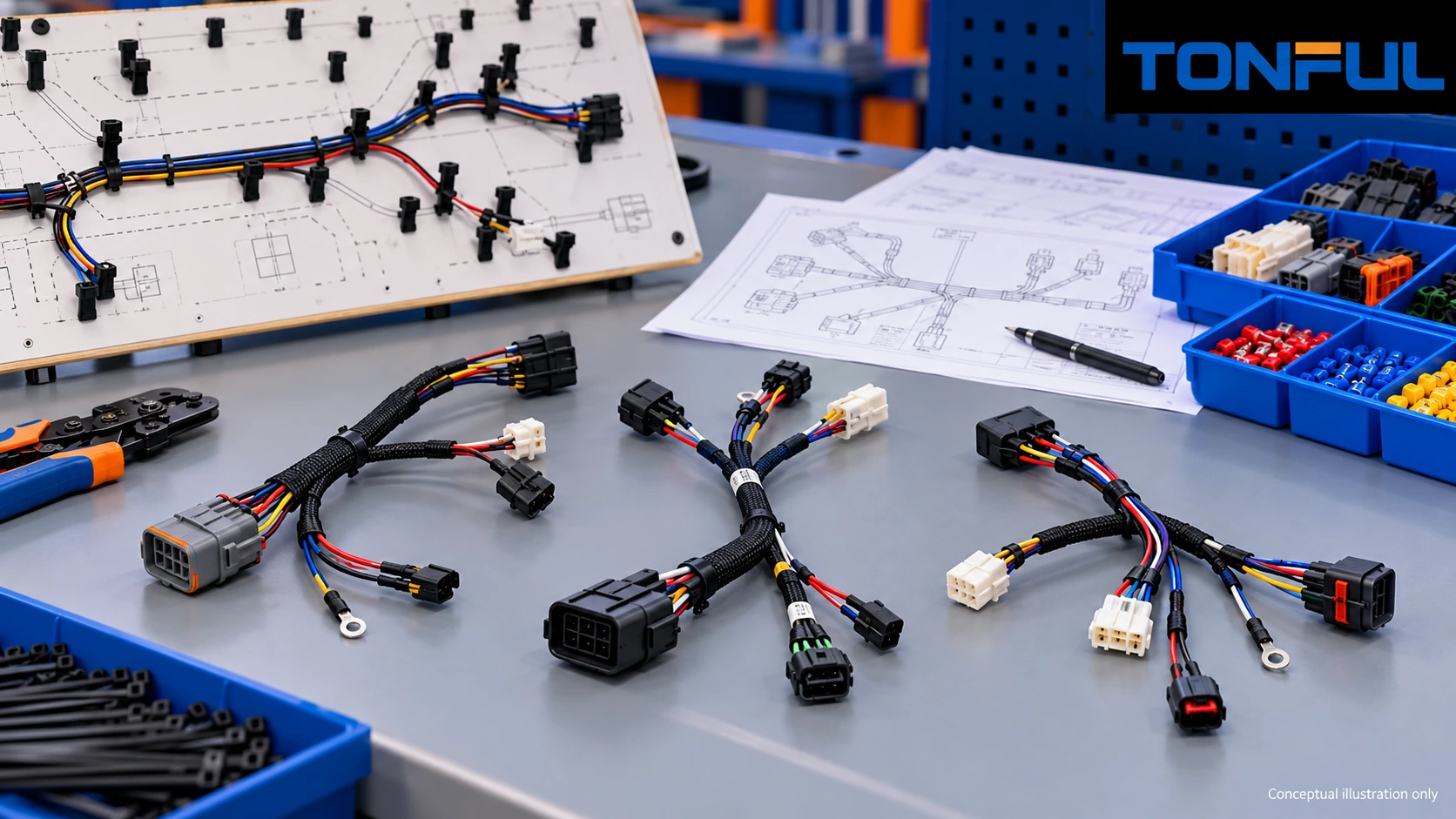
Prototype wire harnesses should answer specific engineering questions before a buyer authorizes repeat production. A sample can fit an enclosure and operate correctly while still leaving its material sources, crimp process, test program or drawing revision unresolved. Approval therefore needs to identify what was demonstrated, which configuration was tested and which conditions remain open.
The practical route is to define the sample purpose, freeze its build documents, inspect a production-intent first article, verify the installed assembly and authorize a bounded pilot lot. Quantity alone does not define these stages. A single carefully documented harness can provide better release evidence than a tray of samples assembled from uncontrolled substitutions.
Define What Each Prototype Build Must Prove
Engineering sample, first article and pilot lot
An engineering sample explores routing, connectivity or a component choice. Its approved deviations should be visible: a substitute terminal, temporary covering or hand-built fixture can affect what the result proves. Label the sample and record its as-built configuration so it cannot quietly become the production reference.
A first article demonstrates that the intended materials and manufacturing route produce an assembly meeting the released requirements. Define whether it represents final tooling, fixture, operators, site and test program. Where those differ from the proposed production state, document the gap and the additional evidence required.
A pilot lot checks repeated execution. It can expose setup variation, missing instructions, material identification errors, tester loading mistakes and packaging damage that one engineering sample would not reveal. Set the quantity and allocation from project risk, variant coverage and the approved plan; there is no universal pilot quantity.
| Stage | Main question | Record needed | Approval boundary |
|---|---|---|---|
| Engineering sample | Does the concept fit and function? | As-built drawing, deviations and observations | Named design questions |
| First article | Does the intended build meet requirements? | Characteristic inspection and test evidence | Defined configuration and process |
| Pilot lot | Can the build be repeated? | Lot, setup, inspection and individual test records | Specified quantity and release scope |

Put unresolved assumptions into a decision register
Before ordering samples, list missing inputs with an owner and decision date. Examples include connector viewing direction, branch datums, wire construction, grounding approach and test limits. Assign an authorized design owner to decisions affecting the circuit or installed behavior.
Avoid using a golden sample as the sole specification. It cannot reliably communicate internal splices, terminal identity, tolerances or acceptance criteria. Use it as a visual aid alongside controlled documents. The wire harness manufacturing process guide provides the wider production sequence around these sample gates.
Freeze the Build Package and Control Substitutions
The sample package should connect the drawing, BOM, wire list and circuit map under named revisions. Specify complete connector systems: housings, terminals, seals, plugs, locks and mating references where applicable. Record conductor construction, insulation, color and source rather than relying on a gauge and color alone.
Define branch lengths between identified datums and state the measurement condition. A dimension measured under tension can differ from one measured in the installed route. Identify connector orientation, breakout locations, protective coverings, labels and support interfaces. Capture routing inside the actual enclosure when a flat formboard cannot show clearance or bend constraints.
Evaluate the consequence of each substitute
A temporary substitute needs written approval for its particular use. Compare its termination compatibility, mating geometry, electrical behavior and environment. A housing that accepts the same mating plug may require a different terminal or seal. A wire with the same gauge may have different strand construction, outside diameter or stripping behavior.
Record each substitution against the BOM line, reason, sample IDs and affected tests. If production will use a different part, the sample cannot establish that part’s performance without additional evidence. Procurement should also identify minimum purchase quantities, obsolete inventory exposure and who pays for unused prototype materials.
Freeze the as-built state after each iteration. Redlines need incorporation into the next released revision, with a clear relationship between the old and new sample. Keep superseded samples identified so a technician cannot select an earlier unit during final installation review.
Inspect the First Article and Verify the Installed Harness
First article inspection should trace drawing characteristics to measured results. A report containing only photographs and a general pass statement cannot show whether every required feature was considered. Number characteristics and identify their method, limit source, actual result, sample and inspector.
Check geometry, terminals and protection
Measure overall and branch lengths from the agreed datums. Confirm connector orientation, populated and empty cavities, secondary locks, seal presence, labels and support locations. Inspect stripped conductor condition and termination workmanship before sleeves conceal the area.
Crimp validation must match the actual terminal, wire and approved tooling combination. Record tool or applicator identity, cavity, setup and the applicable acceptance document. Pull testing, crimp-height measurement and sectioning answer different questions; apply them according to the approved plan. A passing pull result alone does not demonstrate correct electrical performance or every internal crimp feature.
For workmanship scope, IPC’s official IPC/WHMA-A-620 overview describes the standard’s coverage of cable and harness interconnections and associated assembly activities. Specify the contractually agreed revision, class and applicable criteria. A reference to the standard does not demonstrate TONFUL certification or replace product-specific engineering requirements.
Test the actual electrical boundary
Approve the fixture map and test program against the released pinout. Check intended connections, unintended connections and polarity where relevant. A tester’s continuity threshold must be appropriate for the circuit and measurement boundary; a continuity indication does not establish a low-resistance power connection.
Specify resistance, insulation resistance, dielectric withstand or functional checks only where the project requires them. Electronics, suppression components and shields can change which points may be tested and at what conditions. Use qualified personnel and approved equipment. Never apply external power or a dielectric test to unidentified circuits.
Define conditioning, equipment range and accuracy, calibration, sample allocation, raw data and failure handling. Distinguish an invalid fixture event from a valid product failure. Any replacement sample or repeat test needs authorization and a retained explanation. The harness continuity testing guide explains the connectivity boundary in more detail.
Inspect installation and service access
Install the harness in representative equipment and exercise the specified operating states. Check connector access, bend direction, service loops, strain relief, abrasion zones and interaction with covers or moving parts. Repeat assembly and removal where serviceability matters. Record any interference that appears only after adjacent equipment is installed.

Release Low-Volume Production Through a Defined Pilot Gate
The pilot should use released instructions and production-intent components, tooling and fixtures. Record first-piece verification after setup and after relevant tooling, material or program changes. A prototype specialist’s memory should become an instruction that another authorized operator can follow.
Learn from variation between assemblies
Track defects by sample and operation. Repeated terminal seating problems may point to loading instructions, cavity identification or connector damage. Variable branch dimensions may indicate unclear datums or formboard restraint. Tester failures may originate in fixtures, program mapping or assemblies; preserve evidence before changing either the product or test setup.
Record process observations even when every finished harness passes. Excessive handling, forced connector insertion or difficult sleeve placement can reveal a repeatability problem. Resolve it through a controlled instruction, tooling or design change, followed by verification of the affected characteristics.
A conditional release must name the permitted product, revision, quantity, period, deviation and responsible approver. It cannot override a failed mandatory requirement. Keep unrelated variants outside the approved scope until their own evidence is reviewed.
Use a copyable release record
Before handing the pilot to routine production, compare the actual route with the quoted assumptions. Record manual adjustments, special handling, fixture access and inspection time that were necessary to complete the build. Assign an owner to each unresolved repeatability issue. Keep a retained reference assembly or an equivalent controlled evidence set where the project requires it, with its revision and limitations clearly identified. The reference should help explain construction, not override the drawing or authorize undocumented substitutions in later orders.

| Record field | Required entry |
|---|---|
| Sample identity | Harness number, sample ID and build stage |
| Baseline | Drawing, BOM, wire list and pinout revisions |
| As-built changes | Approved deviations and affected characteristics |
| Manufacturing route | Site, tooling, fixture and instruction revisions |
| Inspection evidence | Characteristic IDs, results and acceptance source |
| Electrical evidence | Program, fixture, conditions and raw result reference |
| Installed review | Equipment configuration, observations and reviewer |
| Open actions | Owner, deadline, affected scope and closure evidence |
| Disposition | Rejected, conditional, sample approved or production approved |
| Release scope | Product, revision, quantity, expiry and approver |
Sample approval authorizes the reviewed sample stage. Production approval requires the additional process and release evidence agreed for the project. Buyers can use the IPC/WHMA-A-620 buyer guide to clarify workmanship requirements within that package.
Preserve Approval in Repeat Orders and Work With TONFUL
Repeat orders should reference the released documents and prior approval, with an explicit change review. Connector, terminal, wire, material source, tooling, fixture, test-program or site changes can affect the evidence. Decide which inspections or tests must repeat before implementing each change.
Separate sample charges, tooling, test-fixture development, destructive validation, unit price and documentation in the quotation. Define ownership, storage, maintenance, reorder assumptions and change notification. Ask for a schedule based on component availability and open decisions rather than assuming a fixed prototype lead time.
TONFUL’s custom wire harness sourcing guide provides a starting point for supplier discussions. Send the drawing, BOM, pinout, installation context, sample purpose and validation responsibilities through TONFUL’s project enquiry channel. Request a quotation that identifies proposed components, unresolved assumptions and the evidence needed before a pilot lot or repeat production is approved.