
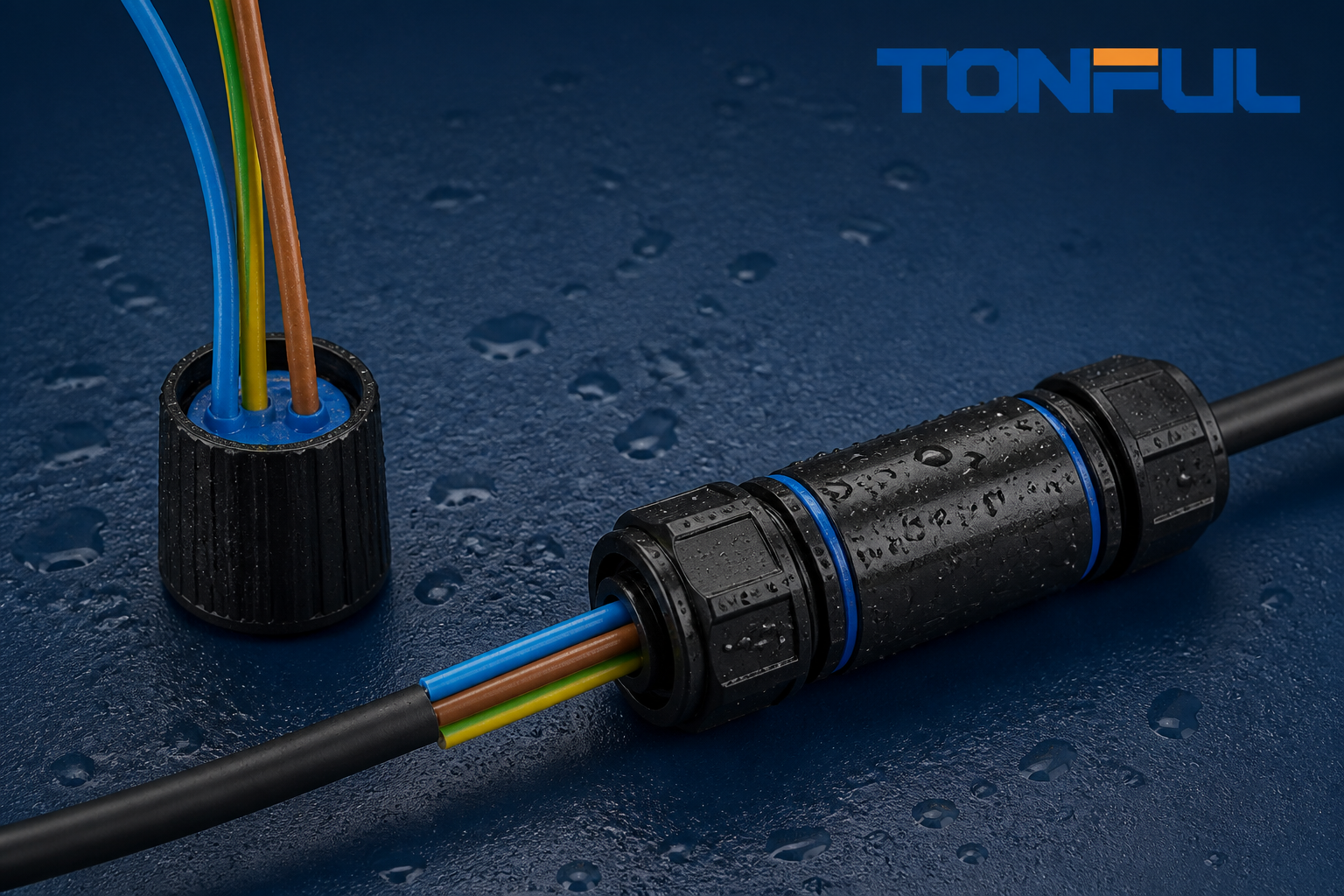

Silicone-filled and grease-filled waterproof wire connectors both use a nonconductive compound to limit moisture around a splice. The difference is not simply that one material is “better.” Product performance depends on the complete connector system: shell, spring or splice element, fill volume, wire entry, approved conductor combinations, location rating, and installation instructions.
In many compact waterproof wire nuts, a non-hardening silicone compound surrounds the twist-on splice. Some direct-bury kits use a separate tube prefilled with moisture-resistant grease and place a completed wire connector inside it. Buyers should compare the qualified assembly, not judge the sealant in isolation.
Quick Comparison
| Factor | Silicone-filled connector | Grease-filled connector or tube |
|---|---|---|
| Common construction | One-piece prefilled twist-on shell | Prefilled cap or protective tube around a splice |
| Moisture control | Silicone fills voids around conductors | Grease displaces air and forms a moisture barrier |
| Installation | Insert and twist according to instructions | May require completing a splice, then seating it inside a tube |
| Handling | Compound may transfer to wires and gloves | Grease may move as the connector is inserted |
| Temperature | Product-specific | Product-specific |
| Reuse | Do not assume reuse is allowed | Do not assume grease can be replenished in the field |
| Best selection basis | Certified assembly and conductor table | Certified assembly and conductor table |
TONFUL’s waterproof wire nuts use a prefilled construction intended to combine conductor retention and environmental protection in one installation step. A tube-style product can add physical coverage around a separate splice but needs more assembly space.
What the Filling Compound Actually Does

Water reaches a splice through openings, interfaces, damaged insulation, capillary paths, and changes caused by temperature or movement. A filling compound occupies voids and reduces the path available for water and contaminants. It does not compensate for an undersized connector, broken spring, poor strip length, damaged conductor, or unapproved wire combination.
The compound must also remain compatible with the shell, insulation, conductor plating, and operating environment. Published sealant temperature is not automatically the allowable operating temperature of the complete connector.
Silicone-filled designs
Non-hardening silicone is commonly used in prefilled twist-on connectors because it can surround irregular wire bundles and remain flexible. The integrated format can reduce installation steps in valve boxes, landscape lighting, and other repetitive wet-location splices.
Key checks include:
- Sufficient compound around all wire entries
- No hardened, contaminated, or missing fill
- Correct conductor insertion depth
- Shell and spring integrity
- Product approval for the intended location
Read TONFUL’s explanation of how waterproof wire nuts create a watertight seal for the interaction between housing, spring, and sealant.
Grease-filled designs
Grease-filled products include both compact connectors and larger protective tubes. In the 3M Direct Bury Splice Kit, the twist-on electrical connection is seated inside a UV-resistant polypropylene tube prefilled with moisture-resistant grease. The tube and grease are part of the qualified system.
This architecture can provide generous compound coverage around the splice, but installers must seat the connector fully and follow the specified wire preparation. Replacing the tube with loose grease and an unrelated connector does not reproduce the listed assembly.
Installation Differences
One-piece prefilled connector
- De-energize the circuit.
- Verify the complete conductor combination.
- Strip to the specified length.
- Align or pre-twist only as instructed.
- Insert conductors fully and tighten the connector.
- Inspect conductor retention and sealant coverage.
Grease-filled protective tube
- Prepare the conductors and complete the approved splice.
- Insert the finished connector into the tube in the specified orientation.
- Push it to the required depth without contaminating the compound.
- Confirm the tube closes or retains the splice as designed.
- Route the wires without pulling the splice out of position.
The installation sequence is part of the product. TONFUL’s waterproof connector selection guide helps buyers distinguish compact landscape-lighting connectors from other waterproof connection systems.
Performance Questions Buyers Should Ask

Is the connector approved for the exact location?
Wet, below-grade, direct-burial, and submersible claims are not interchangeable. Confirm the certification scope, system voltage, enclosure requirement, and any limit on submersion.
What wire combinations are approved?
Ask for the tested combinations, not only the minimum and maximum gauge. Compound cannot correct weak mechanical contact caused by an incorrect bundle.
How is fill consistency controlled?
For production purchasing, review fill mass or volume control, contamination prevention, shell closure, and lot traceability. TONFUL’s manufacturer audit checklist provides a broader supplier-review framework.
How will the splice be inspected?
Visual checks can identify cracked shells, missing compound, exposed copper, poor insertion, and contamination. Electrical or environmental tests may be required by the product standard or project qualification plan.
Can the product be reused?
Do not assume so. Removal changes compound distribution and may alter spring grip or introduce dirt. TONFUL’s article on the risks of reusing waterproof wire nuts explains why replacement is normally the safer maintenance policy unless instructions say otherwise.
Which Filling System Should You Choose?
Choose a silicone-filled one-piece connector when compact size, fast branch-splice installation, and a prefilled twist-on format match the application. Choose a grease-filled tube system when the specified product architecture, physical enclosure, or direct-bury approval requires that complete system.
Do not select by compound name alone. A properly qualified grease-filled system can outperform an unqualified silicone connector, and a correctly selected silicone-filled connector can be more practical than a bulky tube. The tested assembly and real installation decide the result.
Frequently Asked Questions
Is silicone more waterproof than grease?
Not as a general rule. Waterproof performance belongs to the complete connector design and its tested installation, not the material name by itself.
Can I add extra silicone or grease to a standard wire nut?
That field modification does not create a certified waterproof connector system and may interfere with conductor contact. Use a product evaluated for the required location.
Why does sealant sometimes squeeze out?
Some displacement can occur when wires enter a prefilled connector. Follow the product instructions; excessive loss, contamination, or an incompletely seated splice requires inspection and possible replacement.
Specify the Complete Connector System
Send TONFUL the wire sizes, conductor count, voltage, environment, installation space, target certification, and expected quantity. TONFUL can identify a candidate silicone-filled connector and provide samples and current product documents for validation.