
Introduction
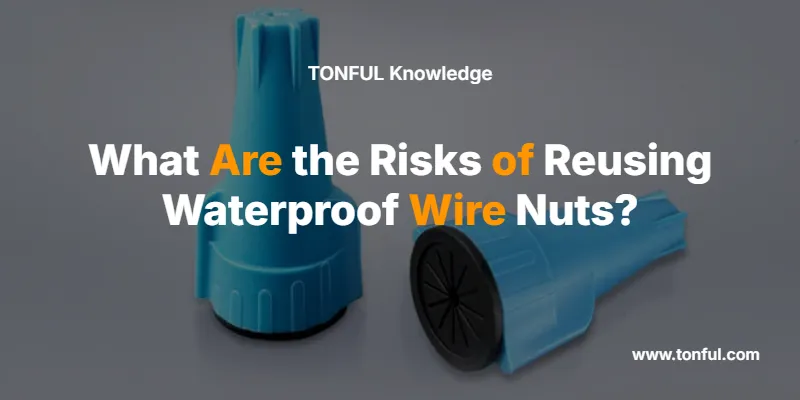
Waterproof wire nuts are the unsung sentinels of outdoor, underground, and marine electrical work. Filled with non-hardening silicone sealant and engineered to ANSI/UL 486D performance criteria, these specialized connectors protect splices from moisture, corrosion, and the slow oxidation that quietly destroys copper conductors. When a project changes direction mid-installation, or a technician needs to re-route a circuit, the temptation to unscrew a perfectly good-looking waterproof wire nut and thread it back onto a fresh splice is strong. The connector looks fine, so why waste it?
The answer, unfortunately, is that the very engineering that makes a waterproof wire nut effective also makes it a single-use device in the vast majority of field conditions. Removing it permanently deforms the sealant cavity, weakens the internal spring, and creates microscopic pathways for moisture that no amount of visual inspection can detect. This article unpacks the concrete risks of reusing waterproof wire nuts, quantifies the failure modes, and clarifies when — if ever — reuse is defensible.

The Core Engineering Problem: Why These Connectors Are Single-Use
A waterproof wire nut is not simply a standard twist-on connector with sealant added as an afterthought. It is a precision-engineered sealing system in which the shell, the internal spring, and the viscous sealant work as a unit. Understanding what happens during removal explains why reuse is so hazardous.
1. Sealant Displacement and Cavity Deformation
When a waterproof wire nut is first installed, the installer pushes the stripped conductors into the silicone gel and twists. The gel flows around the conductors, displaces air, and fills every microscopic void. This creates the hermetic seal that earns the connector its UL 486D wet-location rating. Once the conductors are withdrawn, the gel does not “reset.” It has been permanently deformed — channels remain where the conductors sat, the gel has been dragged outward, and the cavity’s internal geometry is distorted. Re-installing the nut on a new splice cannot reproduce the original flow pattern, leaving voids that capillary action will exploit.
2. Spring Tension Fatigue
The internal square-wire or conical spring provides the mechanical pressure that maintains metal-to-metal contact between conductors. Each installation cycle stretches and work-hardens this spring. Laboratory pull-force testing shows that tension drops measurably after just one removal-and-reinstall cycle, and a weakened spring translates directly into higher contact resistance. As resistance rises, so does Joule heating ($P = I^2R$), and the connection begins the slow march toward thermal runaway.
3. Shell and Skirt Distortion
The thermoplastic shell — particularly the flexible entry skirt that grips the wire insulation — is designed to expand once. Repeated stretching causes micro-cracking and permanent set, so the skirt no longer grips the new wire insulation with uniform pressure. The result is an inconsistent seal at the exact point where moisture is most likely to enter.

Quantified Risk Comparison: New vs. Reused Waterproof Wire Nuts
The following table synthesizes field data and standards-based testing to illustrate how each critical performance attribute degrades after a single reuse cycle.
| Performance Attribute | New Waterproof Wire Nut | Reused (1 cycle) | Reused (2+ cycles) | Failure Consequence |
|---|---|---|---|---|
| Sealant Integrity | Full hermetic fill, no voids | Channels and thinning at entry | Gel displaced, voids throughout | Moisture ingress, corrosion |
| Spring Tension (Pull Force) | 100% rated (e.g., 50–80 N) | ~70–80% rated | <50% rated | Wire pull-out, intermittent contact |
| Contact Resistance | <1 mΩ baseline | 1.5–3× baseline | 5–10× baseline | Joule heating, voltage drop |
| IP Rating Effective | IP67/IP68 as marked | Effectively IP54–IP65 | Effectively IP2X | Loss of wet-location rating |
| UV / Thermal Resistance | Full (UV-stabilized shell) | Micro-cracks initiated | Cracks propagate | Brittle fracture, shell split |
| Code Compliance (NEC 110.14) | Compliant | Questionable | Non-compliant | Inspection failure, liability |
| Expected Service Life | 20–30 years (burial) | 5–10 years | 1–3 years | Premature failure, rework cost |
| Fire Risk Index | Baseline | 2–3× elevated | 5–8× elevated | Arcing, insulation ignition |
This data underscores why the answer to whether waterproof wire nuts can be reused is “almost never” in permanent or wet-location installations. The cost of a new connector — typically $2–4 per unit — is negligible against the downstream cost of a failed splice.
Failure Modes: What Actually Goes Wrong
Moisture Intrusion and Electrochemical Corrosion
Once the seal is compromised, moisture enters as liquid or vapor and contacts the bare copper conductors. In the presence of oxygen and any dissolved salts, electrochemical corrosion begins. Greenish-blue copper oxide and carbonate deposits form at the splice, increasing contact resistance in a self-reinforcing feedback loop. In marine and coastal environments, salt spray accelerates this process dramatically — a compromised reused connector in a coastal installation may fail in months rather than years.
Loose Connection, Arcing, and Fire
A weakened spring cannot maintain the gas-tight metal-to-metal contact required to prevent arcing. As current cycles through the connection, thermal expansion and contraction further loosen the splice. Micro-arcs generate temperatures exceeding 3,000°C locally — hot enough to ignite thermoplastic insulation and adjacent materials. The signs a waterproof wire nut is compromised — discolored shells, burnt smell, warm-to-touch caps — often appear only after arcing has already begun. By the time these symptoms are visible, the connection is already a fire hazard.
Thermal Cycling Degradation
Even without moisture, a reused connector faces daily thermal cycling. As current flows, the splice heats; when current stops, it cools. Each cycle expands and contracts the conductors, and a weakened spring cannot maintain consistent pressure through these dimensional changes. Over thousands of cycles, the connection walks itself loose — a phenomenon well documented in receptacle and wire-nut failure analysis.

Application-Specific Risk Analysis
The severity of reuse risk varies sharply by application. The table below summarizes how reuse risk scales across common use cases.
| Application | Environment | Reuse Risk Level | Rationale |
|---|---|---|---|
| Direct burial (landscape, irrigation) | Underground, constant moisture | Critical — never reuse | NEC 300.5 / UL 486D requires new sealed connectors; failure is buried and uninspectable |
| Marine & boat wiring | Salt spray, humidity, flexure | Critical — never reuse | Salt accelerates corrosion; vibration accelerates spring fatigue |
| RV / trailer 12V systems | Road vibration, weather exposure | High — never reuse | Vibration works loose weakened springs rapidly |
| Outdoor junction box (above grade) | Damp but inspectable | High — strongly discourage | Accessible for inspection, but seal still compromised |
| HVAC condensate area | High humidity, temperature swings | High — never reuse | Condensation cycles test seal repeatedly |
| Indoor damp location (basement) | Occasional humidity | Moderate — avoid if possible | Lower moisture load, but still code-questionable |
| Protected indoor low-voltage | Dry, climate-controlled | Low — conditional only | Only if connector passes full inspection and is mechanical-seal type |
For deeper guidance on selecting the correct connector for each environment, see our guide to choosing waterproof wire nuts and our outdoor lighting installation guide.

Code and Compliance Implications
The National Electrical Code (NEC) Article 110.14(B) requires that all conductor connections maintain the full ampacity of the circuit. A reused waterproof connector with compromised sealant and weakened spring cannot guarantee this. Furthermore, UL 486D sealed wire connector systems are tested and listed as factory-sealed units — the listing assumes a single, proper installation. Reuse voids the basis of the listing, which means a reused connector in a wet or damp location is, strictly speaking, no longer a listed product. For contractors, this creates a liability exposure: an inspector who discovers reused connectors in a direct-burial installation can fail the job, and any downstream property damage may not be covered by insurance.
For a deeper comparison of how waterproof and standard connectors differ in code treatment, see our complete comparison guide and our breakdown of how waterproof wire nuts differ from standard wire nuts.

Best Practices: What to Do Instead of Reusing
- Always stock spares. Keep an assortment of waterproof wire nuts on hand so mid-project changes never tempt reuse.
- Inspect before installation. Learn how to visually inspect waterproof wire nuts for manufacturing defects or storage degradation before you ever twist one on.
- Use the right connector for the environment. Match the IP67 vs. IP68 rating to the application — direct burial, marine, or above-grade damp.
- Replace, don’t repair. If a splice must be reworked, cut the old connector off and install a new one. The $2–4 cost is trivial insurance.
- For repeated-access needs, switch technologies. If a junction will be serviced frequently, use a waterproof terminal block or heat-shrink connector designed for multiple cycles.
Short FAQ
Q: Can waterproof wire nuts ever be reused safely?
A: Only in very limited cases — protected indoor, low-voltage, dry locations where the connector uses a mechanical (non-gel) seal, passes full visual inspection, and is not in a critical or code-mandated wet location. Gel-filled connectors and direct-burial connectors should never be reused.
Q: What happens if I reuse a waterproof wire nut in a direct burial installation?
A: The compromised seal will allow moisture ingress, leading to corrosion, rising contact resistance, and eventual connection failure. This violates NEC 300.5 and UL 486D requirements, and the failure will be buried and difficult to locate or repair.
Q: How can I tell if a waterproof wire nut is already compromised?
A: Look for cracked or brittle shells, discolored or melted plastic, moisture inside the cap, corrosion on emerging wires, a loose or burnt smell, and any wire that pulls out with minimal force. See our signs a waterproof wire nut is compromised guide for the full inspection checklist.
Q: Is it cheaper to reuse waterproof wire nuts to save on project costs?
A: No. The marginal savings of $2–4 per connector evaporate against a single service call, inspection failure, or fire-damage liability. For procurement guidance, see our bulk purchasing guide and wholesale purchasing guide.
Q: Are there waterproof connectors designed for repeated reuse?
A: Yes — reusable sealed terminal blocks, lever-nut-style IP-rated connectors, and certain heat-shrink terminal systems are engineered for multiple cycles. Standard gel-filled twist-on waterproof wire nuts are not.
Conclusion
The risks of reusing waterproof wire nuts far outweigh the negligible cost savings. Each reuse permanently degrades the sealant cavity, weakens the spring, and distorts the shell — producing a connector that looks functional but has lost the very engineering that earned it a wet-location listing. In direct burial, marine, HVAC, and outdoor applications, reuse is not a defensible practice: it is a latent failure waiting for the next rainstorm, the next thermal cycle, or the next load spike to reveal itself. The professional standard is clear — cut, replace, and move on. For specifiers and contractors who want connectors engineered for reliability from the first twist, TONFUL Electric manufactures a full range of UL-listed waterproof wire nuts built for the environments where failure is not an option.