
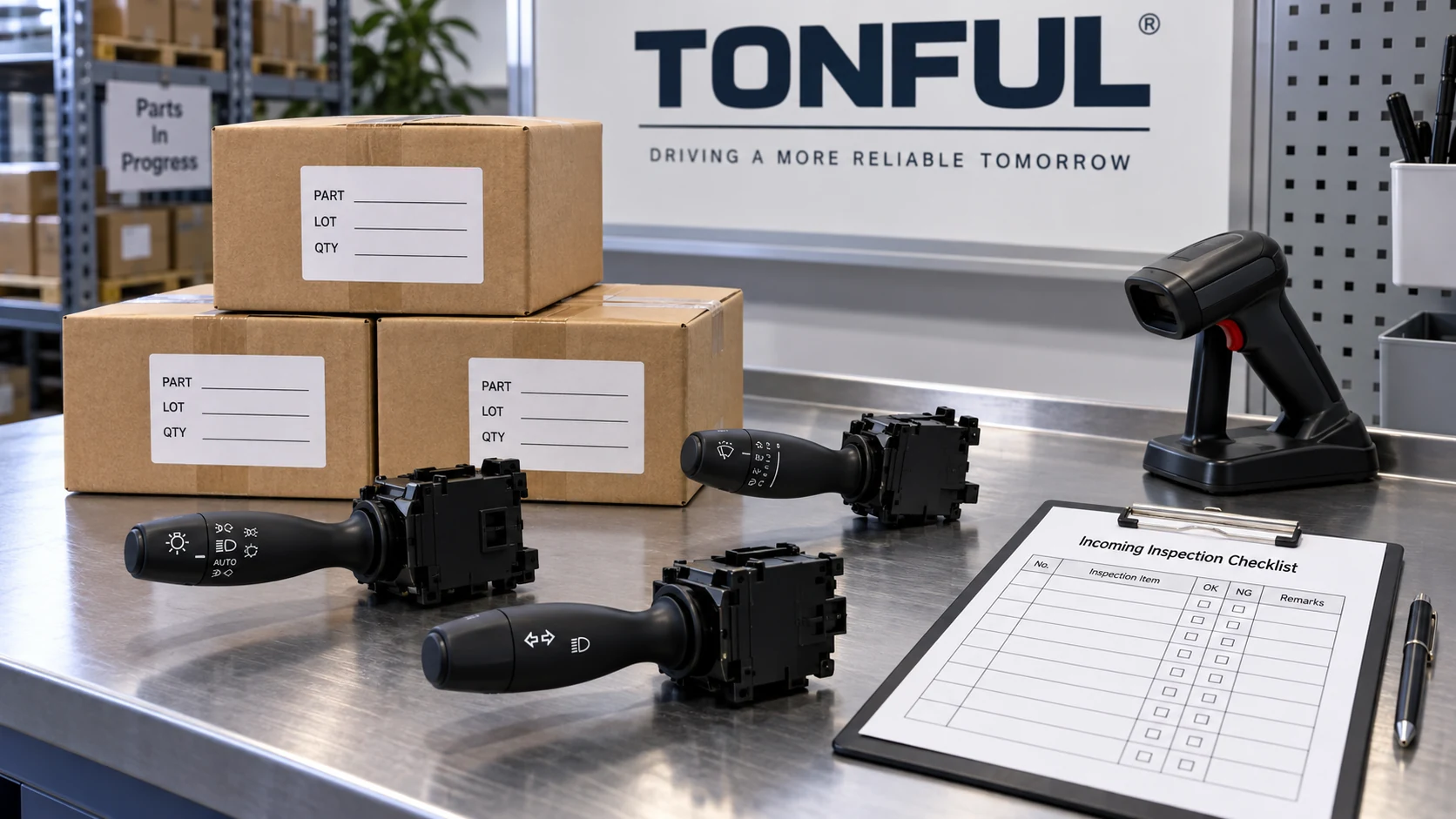
Incoming inspection should prevent the wrong combination switch, mixed revision or damaged lot from entering saleable stock. It should not attempt to repeat every supplier qualification test. A distributor needs a risk-based receiving plan that confirms identity, traceability, packaging, visible workmanship, connector/interface features, mechanical operation and a controlled electrical identity.
The inspection plan must be tied to the purchase order, approved sample and product specification. Generic checks such as “looks correct” or “plug fits” cannot distinguish variants with different pinouts, voltage domains, cruise controls, rear-wiper functions or software. Sampling also requires a defined statistical or contractual basis; this article does not invent a universal AQL.
On this page: Define the Lot | Inspect Product Evidence | Control Sampling and Decisions | Release Stock
Define the Lot
Verify Documents Before Opening Cartons
Compare purchase order, supplier shipment, packing list and approved product record. Confirm supplier, factory where required, TONFUL/customer part number, OE/reference number, revision, quantity, production date or lot, country/market labeling and change-notification status. Quarantine any unapproved substitution.
Define the inspection lot so samples represent one consistent population. Do not combine different part numbers, revisions, production lots, factories or receipt conditions merely because they arrived together. Record carton and pallet identity so a finding can be traced back to stock location.
| Receiving field | Required entry | Warning sign |
|---|---|---|
| Purchase order | Part/revision and approved supplier | Substitute or incomplete suffix |
| Shipment | Quantity, carton/pallet IDs | Mixed or relabeled cartons |
| Product label | Part, lot, date and barcode | Inconsistent print or duplicate IDs |
| Change status | Approved notice/deviation | Unannounced material or mark change |
| Approved reference | Drawing/catalog/sample revision | Obsolete comparison sample |
| Storage condition | Packaging damage/moisture/impact | Crushed, wet or opened carton |
The OE number cross-reference guide explains why molded numbers, supplier numbers and OE service numbers must not be treated as interchangeable.
Preserve Traceability
Photograph labels before repacking. Retain sample IDs, carton positions and inspection records. If individual units do not carry full lot identity, maintain container-level control through picking and repackaging. Do not mix accepted remainder with another lot until traceability rules allow it.
For private-label packaging, verify label revision, language, legal markings, product photo, barcode and application claims against approved artwork. A packaging mismatch can create an application warranty even when the switch itself is correct.
Inspect Product Evidence
Packaging and Visual Workmanship
Check protective caps, bags, trays, dividers and connector protection. Look for stalk deformation, impact, scratches, contamination, moisture, corrosion, loose parts, missing fasteners, molding damage and unreadable legends. Cosmetic criteria should come from the approved sample or specification, not inspector preference.
Compare symbols, colors, illumination windows, labels and date/lot marks. Confirm left/right stalk configuration and optional buttons. Similar appearance is not proof of the same function matrix.
Connector, Terminal and Mounting Features
Fix the connector viewing direction and compare housing, keying, latch, position count, populated cavities, terminals, seals, secondary locks and mounting points. Inspect for bent pins, backed-out terminals, plating damage and foreign material. The connector, terminal and harness checklist provides a copyable interface record.
Do not force-mate a sample with an unverified harness. Use an approved mating fixture and control its wear. A connector gauge or fixture should have calibration/verification status and a defined reaction when damaged.
Mechanical Operation
Operate every maintained, momentary and rotary control. Check detent sequence, return, cancel interface movement, button action, ring direction, abnormal noise and binding. Use an approved force/torque method only when the drawing requires quantitative checks. Manual feel comparisons need trained inspectors and an approved reference sample.
Do not repeatedly cycle all saleable units unless packaging and handling controls permit it. The inspection plan should define sample quantity and whether tested pieces can return to stock.
Electrical Identity
Receiving inspection can confirm that a lot matches the approved variant without performing full qualification. Use a protected fixture with controlled cavity mapping. For passive contacts, check the approved state/continuity matrix; for coded switches, measure specified states and tolerances; for electronic switches, verify supply, current, communication identity and required outputs using controlled software.
The analog, resistive, LIN and CAN stalk guide helps select the correct method. Never apply battery voltage to an unknown signal pin. The pinout and connector guide helps prevent mirrored cavity records.

Use the purchase order, approved reference and controlled fixture to confirm lot identity before stock release.
Control Sampling and Decisions
Choose a Sampling Plan Deliberately
ISO 28590:2017 introduces the ISO 2859 family of attribute-sampling systems and guidance for selecting an appropriate inspection system. The applicable sampling standard, edition, inspection level, quality index, switching rules and defect classes must be defined by contract or quality procedure.
Do not copy an AQL from another product. Acceptance sampling does not mean a lot contains no defects, and it does not replace supplier process control. Critical safety, legal, identity or counterfeit concerns may require different treatment, including 100% checks or automatic hold, as defined by the organization.
Sampling should be random across cartons and pallet positions. Avoid taking only convenient top-layer units. Record how samples were selected. New supplier, changed product, poor history or previous rejection may justify tightened inspection according to the approved procedure; sustained evidence may permit reduced inspection.
Define Defect Classes and Reactions
| Finding class | Examples | Typical controlled reaction |
|---|---|---|
| Critical/knockout | Wrong product identity, unsafe pinout, counterfeit evidence | Hold lot and escalate immediately |
| Major | Missing function, wrong connector population, broken mechanism | Reject/hold per plan; supplier response |
| Minor | Approved cosmetic issue outside limit | Decide by sampling plan |
| Documentation | Missing certificate, label or change record | Administrative hold until verified |
| Test-system issue | Fixture fault or expired verification | Invalidate affected check and contain |
These are framework examples; the organization must define classifications and acceptance numbers. Do not downgrade a functional mismatch because the sample still physically fits.
Record Inspection Results
| Record field | Required entry |
|---|---|
| Lot identity | Supplier, part/revision, lot, date and quantity |
| Sampling plan | Procedure, edition, level/index and sample size |
| Sample IDs | Carton/pallet position and unit ID |
| Documents/labels | Result and evidence reference |
| Packaging/visual | Defect type, location and photo |
| Connector/mechanics | Fixture/method and result |
| Electrical identity | Program revision, states and result |
| Equipment | ID and calibration/verification status |
| Decision | Accept, hold, reject or conditional |
| Disposition | Stock location, authorization and date |
Preserve raw results rather than only a pass checkbox. If a sample fails, stop uncontrolled repacking or distribution, identify potentially affected stock and follow the reaction plan.

Keep identity, product checks, sampling decision and stock disposition in one traceable receiving record.
Release Stock
Control Nonconforming Material
Physically and electronically quarantine held stock. Prevent picking, relabeling or blending. Send the supplier the exact part/lot, sample IDs, photographs, fixture/program revision and failure evidence. Request containment, affected-population assessment, root cause, permanent action and effectiveness evidence according to the agreement.
Rework requires written authorization, controlled instructions and reinspection. Do not allow terminal straightening, label replacement or switch disassembly as informal receiving repair. Scrap, return and concession decisions need named authority.
Maintain Catalog and Inventory Accuracy
Release the accepted lot to the correct SKU and application record. Keep visually similar LHD/RHD, cruise/non-cruise, 12/24 V and option variants separated. Barcode and location controls should prevent cross-picking. The 12 V versus 24 V guide explains why nominal voltage alone is not enough to merge inventory.
Trend supplier defects by part, lot, failure mode and inspection stage. Use data to adjust receiving controls and supplier development; do not hide repeat defects in a general “visual” category.
Periodically audit the inspection process itself. Confirm inspectors use the current drawing, approved sample and fixture program; challenge barcode and quarantine controls with known test cases; review false acceptance, false rejection and measurement variation. Obsolete instructions or worn mating fixtures can create misleading supplier trends and should trigger containment of affected decisions.
Final Release Checklist
- Purchase order, approved supplier, part and revision match.
- Lot boundary and traceability are preserved.
- Packaging and labels meet controlled requirements.
- Product legends, connector, terminals and mounting match.
- Every mechanical function is represented in the inspection plan.
- Electrical identity method matches the architecture.
- Sampling basis, defect classes and reactions are approved.
- Equipment and fixtures have valid status.
- Holds and nonconforming stock cannot be shipped.
- Release, concession, rework or rejection has named authorization.
Work With TONFUL
Use tightened or expanded inspection when a new supplier, engineering change, mixed-label event, transit damage or repeated defect increases risk. Return to the normal plan only after defined lots meet the closure rule. The reaction must specify which lots, warehouses and customer shipments are affected; do not isolate only the sample that revealed the problem.
Retain one controlled reference sample or approved image set for attributes that drawings do not communicate clearly, such as symbol appearance, stalk texture and connector-lock presentation. Reference samples need identity, revision, approval date, storage protection and replacement rules so aging or damage does not silently redefine acceptance.
TONFUL’s automotive combination switch range provides current references for sourcing discussions. Distributors can share the approved part/OE scope, receiving specification, label and packaging requirements, sampling procedure and electrical identity fixture needs. TONFUL can review product evidence and samples against those controlled requirements; inspection levels and acceptance values should be agreed for the specific supply program.