
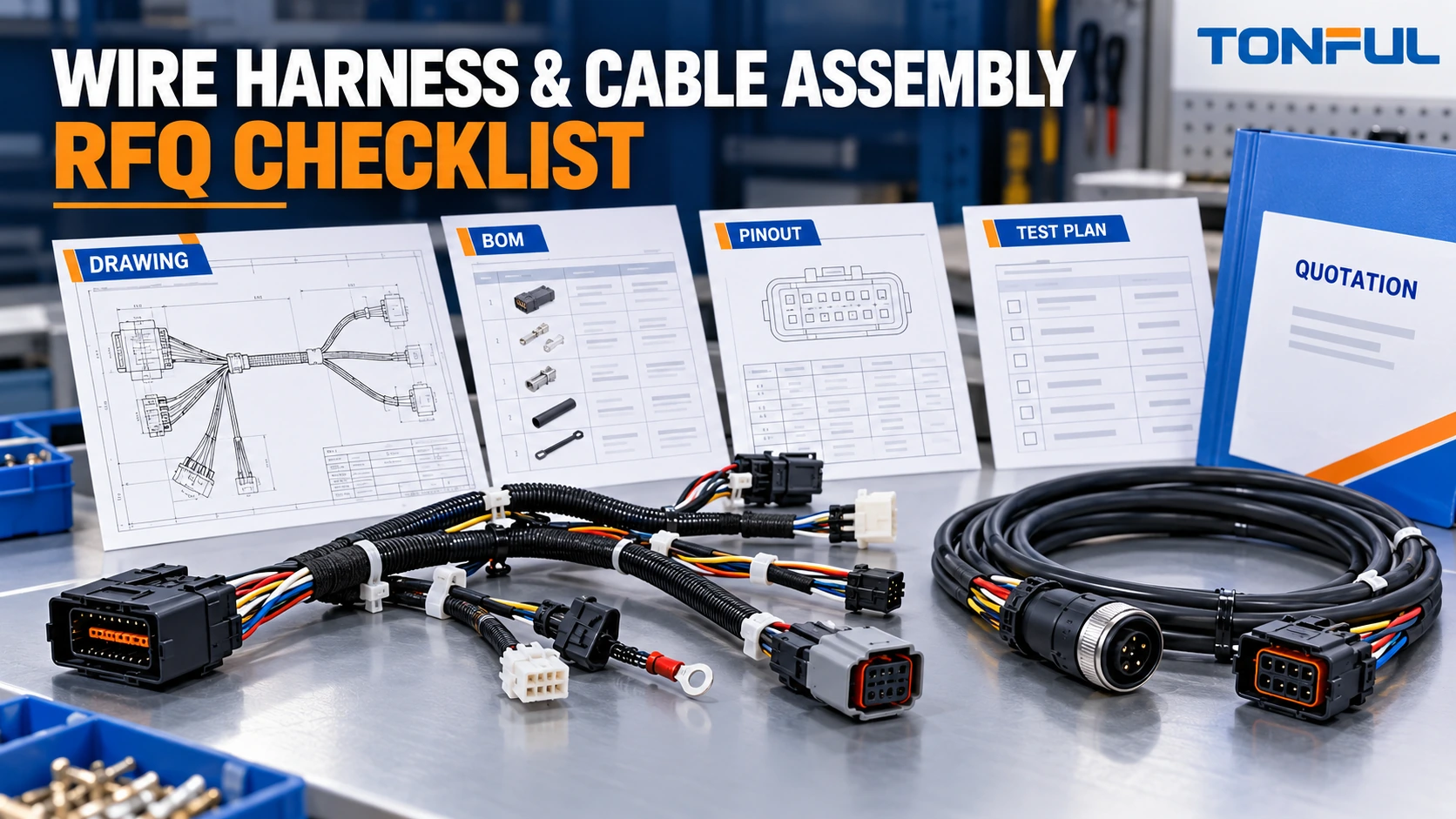
A wire harness or cable assembly RFQ should let a supplier quote the same product that engineering intends to approve. A photograph, sample and annual quantity are not enough. Without controlled drawings, a complete bill of materials, connector orientations, pin assignments, workmanship criteria and test requirements, suppliers must make assumptions. The resulting quotations may look comparable while describing different conductors, contacts, tooling, inspection coverage or performance evidence.
This checklist turns the RFQ into a controlled technical and commercial package. It works for branched discrete-wire harnesses, jacketed cable assemblies and hybrid products. Fields that do not apply should be marked N/A with a reason rather than deleted silently. Unknown requirements should remain open with an owner and due date; they should not be replaced by a supplier’s convenient default.
On this page: RFQ scope | Drawing | BOM | Pinout | Testing | Commercial terms | Copyable template
Define the RFQ Scope and Document Set
Identify the buyer, project, end equipment, assembly name and buyer part number. State whether the request is for prototype, engineering validation, pilot production, serial supply, service parts or a cost study. Record forecast, expected order pattern and destination, but distinguish forecasts from purchase commitments.
Create a document index before sending files. Every drawing, BOM, pin table, specification, CAD file, test plan and sample should have an identifier, revision, date and owner. Name the precedence rule when documents conflict. If the drawing controls dimensions but a separate circuit table controls connectivity, say so. Suppliers should acknowledge the exact package received and list missing or unreadable inputs in their response.
Align the requested evidence with the intended build sequence. The TONFUL wire harness manufacturing process guide shows where drawing, material, preparation, termination, assembly and final-test records enter production; use that sequence to identify which RFQ inputs must control each operation.
| Document | Minimum control fields | Supplier response |
|---|---|---|
| Assembly drawing | Number, revision, units, scale note and approval status | Received / exception |
| BOM | Item, approved manufacturer, full part number, quantity and substitution status | Quoted source / deviation |
| Pinout or circuit list | Connector ID, cavity, circuit, wire and destination | Testable / clarification |
| Specifications | Document, revision and applicable clauses | Comply / deviation |
| Test plan | Stage, method, sample or coverage and acceptance source | Included / optional |
| Reference sample | Sample ID, condition and controlling features | Received / not received |
A physical sample can clarify feel, routing and packaging, but it may contain undocumented repairs, substitutions or wear. State whether it is a visual reference, dimensional master, functional sample or approved golden sample. The controlled documents remain necessary for repeat production.
Make the Drawing Buildable and Inspectable
Dimension the assembly from declared datums. For a harness, identify connector faces, breakout points, ring-terminal centers, clips and branch ends. For a cable assembly, identify mating faces, backshell shoulders or cable exits. Define overall and branch-length tolerances and the measurement condition. Avoid chain dimensions that allow accumulated error to move the final connector outside the equipment envelope.
Show connector orientation, latch direction, keying, boot or overmold exit, labels, markers, protective coverings and clip clocking. Identify splice locations or permitted zones rather than leaving their position to production convenience. Where service loops are required, dimension or describe them without forcing an uncontrolled coil.
Add workmanship and inspection notes only when their source and applicability are clear. IPC identifies IPC-D-620 as a design and critical-process requirements standard for cable and wiring harnesses, while IPC/WHMA-A-620 addresses assembly requirements and acceptance. The RFQ must state the contract-required document, revision, class and any customer additions; naming “IPC” alone is incomplete. TONFUL’s IPC/WHMA-A-620 guide explains how acceptance criteria fit with drawings and customer requirements.

Conceptual RFQ drawing review; the approved customer drawing and revision define the production dimensions and acceptance criteria.
Control the BOM and Approved Alternatives
The BOM should identify each wire, cable, connector housing, contact, seal, terminal, splice, sleeve, tube, tape, label, clip, fastener, backshell and overmold material. Use complete manufacturer part numbers where a specific source is mandatory. For buyer-defined performance items, provide measurable requirements and a documented alternative-approval path.
Do not combine material identity and performance into vague descriptions such as “automotive wire,” “equivalent terminal” or “black heat shrink.” Record conductor size and construction, insulation or jacket family, color/marking, contact finish, connector keying, seal and accessory references. For custom cable, include the controlled construction or approved cable part number.
The supplier response should identify quoted manufacturer and part number, sourcing status, minimum buy, tooling or special-order exposure and every proposed deviation. An alternative must be reviewed for form, fit, function, processing, compliance evidence and validation impact. Lower piece price does not prove a lower total cost; the TONFUL wire-harness BOM optimization guide discusses cost boundaries and change risk.
Define Connectors, Pinout and Circuit Behavior
Give every connector and termination a unique ID. Record manufacturer, full part number, gender, keying, cavity count, populated cavities, contact, wire range, seals, secondary locks, mating reference and installed orientation. For customer-supplied or proprietary connectors, define supply responsibility and incoming evidence.
The pinout should show the declared connector end view and numbering orientation. For each cavity, list circuit name, source and destination, wire/cable element, color or ID, gauge/cross-section and special treatment. Record unused cavities, jumpers, shield/drain termination, twisted-pair identity, polarity and splice membership. A mating connector and matching cavity count do not prove correct wiring.

Conceptual pinout matrix—not a universal connector layout. Use the approved connector drawing and buyer circuit table.
Where the assembly carries power, state voltage, current profile and grounding boundary as project inputs. For signals, identify interface or protocol, pair assignment, shielding and any controlled-impedance or length-matching requirement. Never ask the supplier to infer electrical behavior from wire color. If energized functional testing is required, provide the circuit, protection, loads, fixtures and acceptance source.
Separate Qualification, First-Article and Production Testing
An RFQ should distinguish evidence that qualifies the design from checks applied to the first production build and tests performed on every unit or sampled lot.
| Stage | Purpose | Typical controlled records |
|---|---|---|
| Qualification | Demonstrate performance under defined conditions | Sample allocation, conditioning, parameters, results and report approval |
| First article | Confirm the production-intent configuration | Dimensions, BOM identity, pinout, workmanship and test-program revision |
| Production | Detect assembly errors and process drift | Unit/lot ID, fixture, program, result and reaction plan |
| Periodic/requalification | Monitor selected evidence or approve change | Trigger, interval, samples, acceptance and disposition |
Continuity and miswire testing should cover every intended circuit, prohibited short and required shield path. Define resistance threshold or measurement method only from the approved specification. The TONFUL continuity-testing guide explains why a simple audible check is not a complete production test.
Mechanical requirements may include crimp pull, terminal retention, connector retention, cable pull, flex or torque. Define sample identity, quantity, conditioning, equipment range and accuracy, fixture, rate or loading method, failure mode and acceptance document. The crimp pull-force testing guide provides a record framework without inventing universal values.
Electrical or environmental qualification may include contact/path resistance, voltage drop, insulation resistance, dielectric withstand, temperature rise, ingress, temperature, vibration, fluids, UV or signal-integrity tests. Apply only those required by the product specification or qualification plan. State whether tests use independent samples or a sequence on the same samples, preserve an unaged baseline when required, and define invalid-test and replacement-sample rules.

Conceptual test-stage matrix. Test parameters, sample sizes and pass criteria must come from the approved project documents.
Add Quality, Packaging and Release Requirements
Define lot traceability, retention period, inspection records, calibration status, nonconformance control and corrective-action expectations. State whether serialized traceability is needed or whether date/lot tracking is sufficient. Require approval before changing a controlled material, source, tool, process, test program, manufacturing site or sub-supplier when that change can affect the approved product.
Packaging must protect connector locks, terminals, seals, labels, bend limits and cosmetic surfaces. Specify unit quantity, bag or tray, coil diameter where relevant, moisture/ESD protection only when applicable, carton label fields and shipment documentation. Packaging should be validated against the real transport and storage route rather than copied from another project.
Define approval states. “Sample approved” means the named samples satisfied the stated review; it is not automatic approval of production tooling, all lots or every variant. Conditional approval should identify the deviation, quantity/scope, owner, closure evidence and expiry. Production release should reference the approved drawing, BOM, sample status, validation and commercial agreement.
Add Commercial, Supply and Change-Control Fields
Request unit pricing by defined quantity breaks, currency, Incoterm and delivery location. Separate recurring material/labor price from tooling, fixtures, test equipment, engineering, certification or other non-recurring expenses. State tooling ownership, maintenance responsibility, storage and transfer conditions. Ask for sample and production lead time assumptions, MOQ, minimum-buy exposure and quotation validity.
Include capacity assumptions, forecast flexibility, order cancellation rules, excess/obsolete inventory treatment, warranty and claim boundaries. If buyer-nominated components have long lead times, define who owns schedule and obsolescence risk. Ask the supplier to disclose unresolved assumptions; a quotation with hidden assumptions is not comparable with a fully compliant offer.
Copyable Wire Harness and Cable Assembly RFQ Template
| RFQ field | Buyer entry | Supplier response / evidence |
|---|---|---|
| Buyer / project / assembly | ||
| Buyer part number and revision | ||
| Program stage and intended application | ||
| Drawing and document index | ||
| Annual forecast / order quantities | ||
| Required delivery location and Incoterm | ||
| Complete BOM and approved sources | ||
| Connector IDs, mating parts and orientation | ||
| Pinout, circuits, pairs, shields and splices | ||
| Lengths, branches, tolerances and datums | ||
| Protection, labels, clips and packaging | ||
| Environment and service conditions | ||
| Qualification and sample allocation | ||
| First-article requirements | ||
| Production tests and coverage | ||
| Acceptance standards/documents and revisions | ||
| Traceability and record retention | ||
| Change-notification requirement | ||
| MOQ, price breaks and quotation validity | ||
| Tooling/NRE cost and ownership | ||
| Sample and production lead times | ||
| Deviations, assumptions and open actions | ||
| Buyer/supplier approver and date |
Request a Controlled Quotation From TONFUL
Send TONFUL the indexed drawing package, BOM, connector and pinout data, service environment, verification plan, volumes and commercial requirements. TONFUL can review manufacturability, termination, materials, tooling and test coverage against the defined project. The final quotation and approval scope should identify every assumption and remain tied to the agreed revision rather than a generic harness description.