
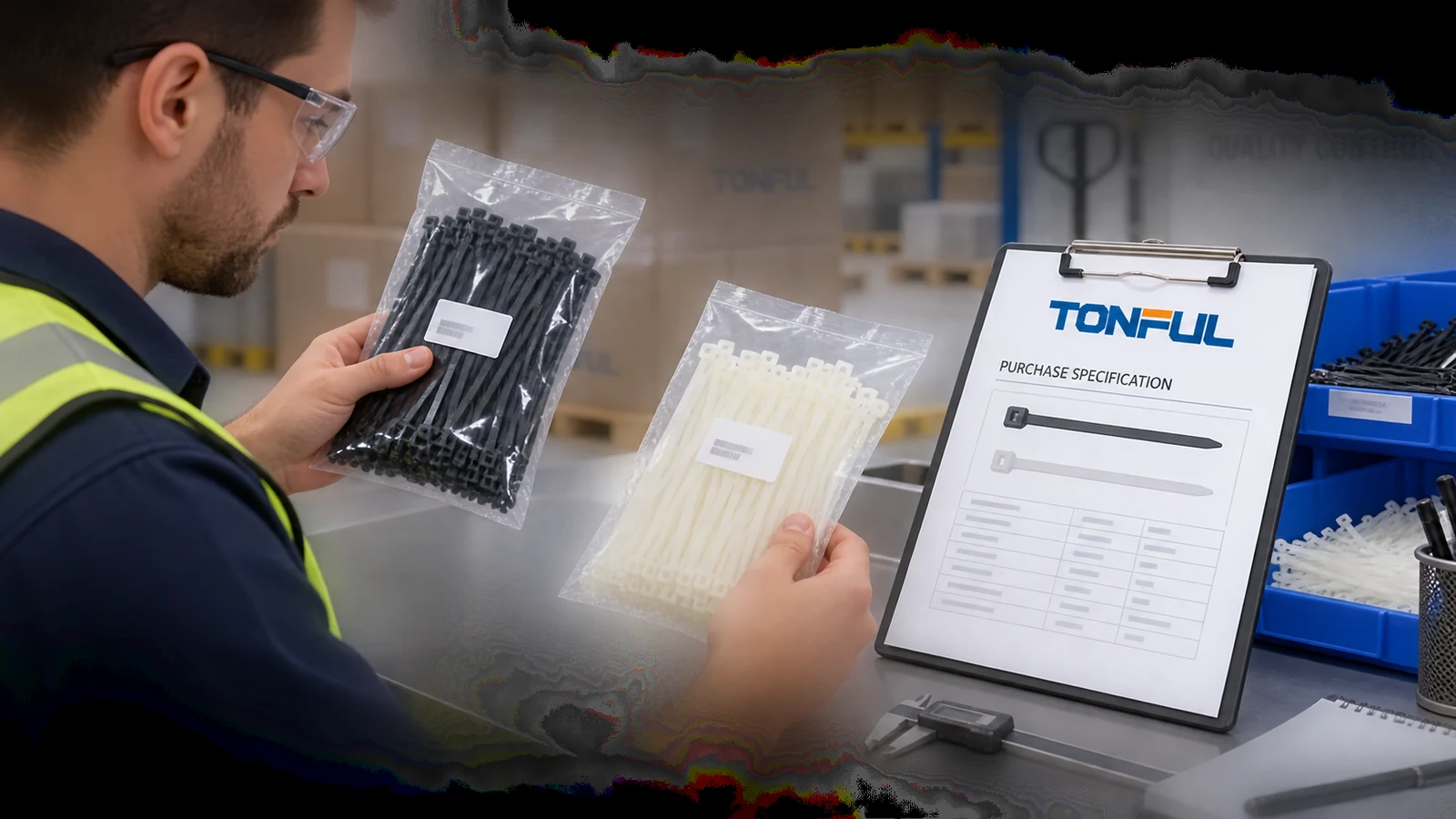
An unopened carton of cable ties is not an approved production lot. The labels may identify the wrong width, two manufacturing lots may be mixed, or an open bag may have changed the handling condition of nylon ties. Finding a mismatch before the parts reach a harness line is much cheaper than tracing it through finished assemblies. A useful incoming inspection plan checks identity, condition and the few characteristics that matter most to the intended use.
This checklist is for buyers, quality engineers and warehouse teams receiving polymer or metal cable ties in bulk. It provides a sequence and reusable record fields, not universal acceptance limits. The controlling purchase specification, part drawing, supplier agreement, certification scope and site sampling plan must define exact dimensions, test conditions, counts and dispositions. For choosing the part before ordering, start with the TONFUL cable ties buying guide; receiving inspection begins only after the approved part and revision are known.
Define the Lot Before Sampling
Identify what constitutes one inspection lot. A shipment may contain several supplier production lots, colors, mold cavities, resin batches or packaging dates. Do not combine them into one convenient carton-level sample unless the approved control plan explicitly allows that grouping. Record supplier name, purchase order, TONFUL or customer part number, drawing revision, declared material, lot code, bag count and received quantity. Photograph the original labels before cartons are opened.
The lot code should trace to a manufacturing interval and, where relevant, resin, tool or cavity records. Verify the certificate, packing list and labels carry the same part, revision and lot. A certificate for another revision does not cover the receipt.
Segregate materials with different handling requirements. Nylon 6.6, weather-resistant nylon, ETFE, stainless and metal-detectable ties are not interchangeable because they share color or head shape. The TONFUL types-of-cable-ties guide describes families; the BOM and drawing decide the approved type. Verify special ratings by exact model and document.
| Receiving identity field | Verify against |
|---|---|
| Supplier and purchase order | Approved supplier list and order |
| Part number and revision | Drawing, BOM and purchase specification |
| Material and color | Approved material declaration and visual standard |
| Manufacturing lot | Bag/carton label and supplier trace record |
| Quantity and pack size | Packing list and receiving count |
| Special claims | Exact part-specific certificate or approval scope |
If identity or traceability is missing, hold the affected material before sampling. Testing a few ties cannot prove that a carton contains the correct material or that a claimed certification belongs to the received SKU.
Write a Risk-Based Sampling Plan
The plan must state the lot definition, sample size, selection method, defect classes and acceptance/rejection rules before the shipment arrives. ASQ’s explanation of ANSI/ASQ Z1.4 describes attribute acceptance sampling with normal, tightened and reduced plans and switching rules for continuing lots. It does not assign one universal AQL or sample count for cable ties. A buyer must select the applicable plan and risk treatment, and maintain the switching history rather than choosing a convenient table row after seeing the defects.
Sample across cartons, bags and pallet positions; record the selection map. Label checks, visual/dimensional checks and destructive strength tests may need different allocations. Never return a destructively tested tie to stock. Document approval of heightened inspection for critical use or supplier corrective action.
Classify defects by consequence before counting them. A wrong material, missing certification evidence for a safety-relevant use or absent lot identity may be a release blocker. A head that fails to lock, cracked strap or grossly undersized width can be functionally serious. A minor cosmetic mark that does not violate the drawing may be managed differently. Do not label a defect “minor” merely because it is easy to see or repair. The customer specification defines the classification and whether any critical finding rejects the lot regardless of the calculated sample result.
| Planning field | Required decision |
|---|---|
| Lot boundary | Which supplier lots, revisions and packaging dates are separate? |
| Sampling standard | Which edition, plan type, inspection level and switching state apply? |
| Defect definitions | What is Critical, Major, Minor or Observation? |
| Selection | Which cartons and bags will provide samples? |
| Destructive allocation | Which samples are reserved for strength or conditioning tests? |
| Acceptance | What are Ac/Re rules and automatic hold conditions? |
| Escalation | Who authorizes tightened inspection, sorting or supplier return? |
Sampling is a decision tool, not proof that every untested tie is good. If a serious failure is found, investigate the whole lot and affected upstream/downstream stock instead of treating the sample result as a shield.
Inspect Packaging, Storage Condition and Appearance
Before opening bags, look for broken seals, moisture or water exposure, torn packaging, heat damage, fading, illegible labels and mixed product. Note storage temperature and time when the supply agreement requires them. For nylon 6.6, condition can matter: Panduit’s nylon 6.6 storage guidance explains that the material responds to atmospheric moisture and that moisture loss can contribute to brittle failures. Apply the supplier’s specific packaging and conditioning instructions; do not convert one vendor’s storage advice into a universal moisture percentage for all cable-tie materials.
Inspect color, flash, short shots, cracks, warpage, contamination, heads, strap edges and pawl/barb placement. The approved visual standard distinguishes cosmetic from rejectable marks. Sample across identifiable cavities when the plan requires it, and photograph disputed defects with scale and ID.
Do not perform a harsh manual bend on every tie as a substitute for a specified material test. Handling a sample at the wrong temperature or after opening a moisture-conditioned bag can alter the result. If ties feel unusually brittle or break during normal installation, quarantine the lot, capture the storage history and perform the agreed investigation. The TONFUL moisture-content and storage guide provides context for bulk-buyer handling, but the actual pass/fail rule belongs to the named material and supplier process.

Conceptual receiving workflow. The buyer’s controlled drawing and inspection plan set actual acceptance criteria.
Verify Dimensions and Locking Function
Measure the characteristics that determine fit: overall length, usable strap length, width, thickness, head dimensions and, when specified, minimum and maximum bundle diameter. Check measurement points against the drawing. A nominal label such as “200 x 4.8 mm” may not define every tolerance. Use an instrument with suitable resolution and current calibration, and record the actual readings rather than only ticking “within spec.” The TONFUL size-and-bundle guide explains why length, width and head geometry are separate fit decisions.
Form loops around the specified mandrel or bundle. Check insertion, engagement, seating, release where applicable, slipping and cracks. Use the approved production tool and setting. A hand-closed tie may not perform the same way at the bundle-range limit; finger-pulling does not replace a defined retention test.
Inspect mounting holes, push mounts, edge clips or marker panels with the specified gauge or mating part; loop strength will not reveal their defects. For metal ties, check edges, locking mechanism and coating. Magnet or color checks alone cannot prove stainless grade; use the documented material-verification method.

Illustrative dimensional check; record actual values against the approved drawing and lot identity.
Keep Strength and Environmental Claims in Scope
IEC 62275:2022 covers metallic, non-metallic and composite cable ties and associated fixing devices for electrical-installation cable management. The standard’s existence does not mean every shipment is IEC-certified or that a buyer must perform its full qualification sequence on each lot. UL Solutions’ application guide likewise directs attention to the exact certified product and its declared application, environmental and mechanical conditions. Check a certification directory or supplier certificate only when that claim is part of the order, and verify the model and scope.
If routine loop tensile testing is required, specify the governing method, sample conditioning, fixture or mandrel, pull direction, speed, equipment accuracy, sample count and acceptance value. Record individual results and failure mode. Do not compare numbers from different methods or convert a minimum loop tensile rating into an allowable hanging weight. The TONFUL loop-strength guide discusses that distinction. A failed test should trigger lot containment and method review, not an automatic retest until a passing number appears.
UV exposure, cold installation, heat aging, chemical resistance, flame behavior and support function are not established by a quick receiving appearance check. Such claims normally require supplier qualification evidence and change control, with periodic or event-driven verification when the agreement specifies it. Check the exact part, material and test version. If a buyer needs every-lot environmental testing, write that requirement and destructive-sample allocation into the contract; do not imply it is a default inspection duty for every carton.
Record Results and Decide the Lot
Use a record that connects each result to its sampled package. Avoid a form with a wide blank row of undifferentiated “pass” cells. A two-column field list is easier for technicians to complete and for managers to audit:
| Record field | Required entry |
|---|---|
| Receipt identity | Supplier, PO, part/revision, shipment and receipt date |
| Lot map | Supplier lot, carton/bag IDs, quantities and sample locations |
| Evidence | Drawing, specification, certificate and revision/date |
| Sampling plan | Standard/edition, level, state, Ac/Re and approver |
| Measurement | Instrument ID, calibration status, values and limits |
| Function and strength | Setup, conditioning, tool, results and failure modes |
| Defects | Class, photo ID, count and affected packages |
| Decision | Release, hold, sort, return or concession; owner/date |
| Closure | Supplier response, corrected evidence and retest authorization |
Use three decision states clearly. Release means the lot meets the approved receiving plan and all required identity evidence is present. Hold means the lot cannot enter production while a discrepancy or missing evidence is investigated. Conditional release requires an authorized deviation naming exact lot, application, quantity, expiry and extra controls; it is not a silent override of a failed inspection. Some critical findings may prohibit concession under customer rules. Record who made the decision and ensure warehouse stock status matches it.
For material already issued, trace the lot through work orders and finished assemblies. Segregate stock, notify production and assess stop-ship or customer notice under the contract. Request supplier containment, root cause and effective correction; a larger next-lot sample alone is not corrective action.
If retaining a reference sample, identify revision and storage condition. Trend defects by supplier and part; recurring flash, brittle breaks or labeling errors may warrant a process audit even when sampled lots pass.
Source With a Controlled TONFUL Specification
Send TONFUL the exact tie drawing, material and color definition, bundle range, package format, required markings, lot-trace fields, test method and customer-specific acceptance plan. Ask for a named sample and current supporting documentation. The TONFUL cable-tie range can start a sourcing discussion, but neither the product page nor this checklist proves that a particular shipment meets an unshared customer specification.
Agree on change notification for resin, mold, cavity, colorant, manufacturing location, packaging or test method when those changes affect the approved product. Once the first lot is accepted, keep the same definitions for later receipts so data is comparable. A good bulk-buying decision is not merely a low unit price; it is a clearly identified, inspectable and traceable part that the production line can release with confidence.
Technical Sources
- ASQ, Z1.4 and Z1.9 sampling standards: attribute and variable sampling plan scope, including switching rules.
- IEC 62275:2022: cable-tie and fixing-device standard scope.
- UL Solutions cable-tie application guide: part-specific certified characteristics and use conditions.
- Panduit nylon 6.6 storage guidance: manufacturer-specific moisture and packaging context.