
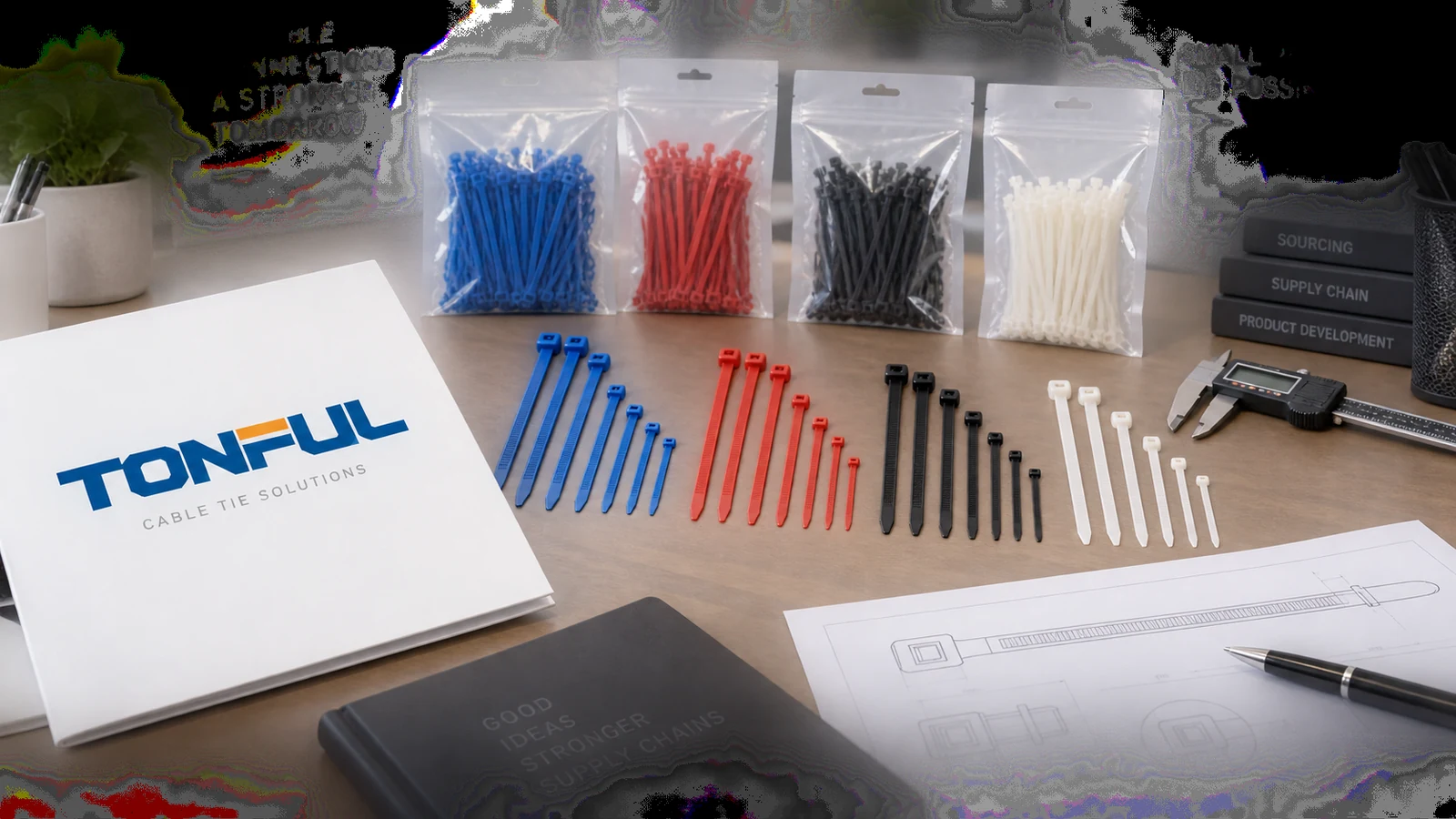
“Custom cable ties” can mean a new color in an existing mold, a different strap length, a molded mounting head, direct printing, or only a private-label bag. Those requests do not carry the same cost, tooling risk or validation burden. A buyer who sends a photograph and the phrase “make this in blue” may receive a visually similar sample that misses the intended bundle range, material condition or packaging traceability.
This guide turns a custom cable-tie request into an RFQ and approval plan. It covers color, dimensions, head design, marking and packaging as separate decisions, then reconnects them in a controlled drawing and sample release. It does not promise that any specific TONFUL mold, printing process, MOQ or lead time is available for every configuration. The live TONFUL cable-tie product page describes custom colors, lengths and branded packaging as commercial possibilities; confirm the exact project scope with a named sample and quotation.
Define the Application Before Customizing Appearance
Start with what the tie must do. Is it organizing a harness, securing a cable to a mounting surface, identifying an asset, offering tamper evidence or preparing a retail kit? Record cable or object materials, bundle diameter range, expected movement, installation tool, indoor or outdoor exposure, temperature, chemicals and service life expectations. If the tie is expected to support cable weight, distinguish that from simple bundling and request evidence for the complete fixing arrangement.
Name the applicable drawing, customer specification and any product approval. A familiar polymer such as PA66 is not automatically correct for UV, heat or chemical exposure, and a pigment may change more than appearance. For initial selection, the TONFUL cable ties buying guide separates material, size and tensile properties. Do not use a desired color as a substitute for a material grade or rating.
Define priorities: a warehouse may need coding, a harness line tool fit, and a distributor shelf-ready packs. Assign each change a controlled characteristic and validation method.
| Customization | Main question | Typical evidence |
|---|---|---|
| Color | Is it identification, appearance or environmental performance? | Color reference, material declaration, aged sample if required |
| Length and width | Does the part fit min/max bundle and route? | Drawing, measured samples, installed trial |
| Head design | Does it lock, mount and clear nearby parts? | Head drawing, mating trial, retention evidence |
| Printing or marking | Is it readable after installation and exposure? | Artwork, location drawing, legibility test |
| Packaging | Can stock be counted, traced and preserved? | Approved label, pack trial, transit/receiving check |
Specify Color Without Treating It as a Material Rating
Give the supplier a physical master chip, recognized color reference or approved target sample, plus an acceptable visual range under named lighting. “Blue” alone is not a manufacturing specification. Decide whether the color is needed on the strap, head, marker panel or packaging only. A critical identification scheme should also use part numbers or text; color-blind readers and faded parts may not reliably distinguish close shades.
Ask how the color is produced and whether masterbatch, pigment or stabilizer affects mechanical or aging requirements. An outdoor black tie may be formulated differently from an indoor black tie. A natural tie does not automatically share the same behavior as a pigmented version from the same mold. Require part-specific evidence for UV or other environmental claims; never infer performance from color alone.
Set first-article and production color tolerances before samples arrive. A pigment-source or concentration change should trigger an assessment of appearance, processing and performance.
Define Length, Width and Bundle Fit
Overall length is not the same as usable strap length after the tail passes through the head. Request the full drawing: overall length, strap width and thickness, head dimensions, tooth pitch if relevant, minimum and maximum bundle diameter and tolerances. A new length may be made by an existing mold or may require tooling changes; the supplier should identify which. A visually similar size may leave too few teeth engaged at the largest bundle or an excessive tail at the smallest.
Trial the proposed tie at both ends of the bundle range with the production installation tool. Inspect head seating, cable-jacket condition, tail cut and clearance to nearby components. The TONFUL size and bundle-diameter guide distinguishes dimensional fit from minimum loop tensile strength. A stronger tie is not automatically the correct length, and a longer tie can still have a head too large for a narrow routing slot.
If the project requires a custom width or strap profile, check that the specified tool nosepiece and tension setting remain compatible. Document which dimensions are function-critical, which may be controlled by normal molding tolerances and which require inspection by cavity. Do not invent a universal minimum engagement length; derive the release criterion from the product design and approved assembly trial.
Treat Head Design as an Engineering Change
The locking head is not decoration. Its geometry controls strap insertion direction, pawl engagement, installed height, cable contact and tool access. A low-profile head may improve clearance but change the locking mechanism. A releasable head adds a service action that could be useful in maintenance but inappropriate where tamper resistance is required. An edge clip, push mount, screw tab or marker flag adds another interface that must fit its mating surface.
Provide a drawing or physical mating part for every special head. Verify insertion and retention on the actual panel, stud, edge or hole, including the specified thickness and finish. For wiring, inspect the resulting bend and clearance. For a marker head, define usable marking area and installed viewing direction. The TONFUL types-of-cable-ties guide compares standard, releasable and mounting families; a custom design still needs project-specific function verification.
For new tooling, define ownership, cavities, maintenance, repair approval and drawing-change authority. If an existing tool is modified, confirm whether it still makes the previous approved version. Release the head only after an installed-assembly trial.

Conceptual head-family illustration, not a TONFUL tooling catalog or approval drawing. Confirm available geometries with project-specific samples.
Plan Printing, Marking and Identification
First decide what the marking must communicate: part number, asset ID, installation date, route, batch code, logo or instruction. Then decide whether it belongs on the tie, an integrated marker panel or the package. Printing a tiny code on a curved strap can be less practical than a larger flag or package label. In a dirty or outdoor location, legibility after exposure may matter more than initial contrast.
Supply final approved artwork with font, minimum character height, location, orientation, color contrast and variable-data rules. If a barcode or QR code is requested, define the encoded content, verifier method, reading distance and acceptance standard. A scanner reading one freshly printed sample does not establish performance after abrasion, cleaning or weathering. HellermannTyton’s custom-printing brochure demonstrates that printed tie and identification designs exist, but its processes and capabilities do not verify any TONFUL SKU. The TONFUL printed-ties article discusses marking use cases; this guide treats print as one component of a larger custom product.
Avoid printing a certification mark, voltage claim or “compliant” wording unless the exact product and intended use have supporting authorization. Distinguish the customer’s own brand from a third-party approval symbol. Request a production-intent print sample and assess adhesion, readability, smearing and placement after the tie is installed. If a production lot can have variable codes, define data ownership and controls against duplicates or skipped sequences.
Make Packaging Part of the Specification
Packaging affects count accuracy, material condition and traceability. Define units per bag, bags per carton, bag material, closure, dimensions, pallet configuration and shipping marks. The retail label may need a barcode, multilingual warning or country-specific information; the industrial label may prioritize part number, revision, lot, quantity and date. Avoid copying a competitor’s package artwork without a separate approval. For moisture-sensitive nylon, specify storage and resealing instructions agreed with the material supplier.
Private label is not only a logo. Confirm artwork approval, plate or die ownership, obsolete-label control and mixed-version prevention. The TONFUL moisture and storage guide adds bulk-pack handling context. Each bag should trace to a supplier lot and production record.
Test a production-intent pack for readability, seals, count, opening and storage protection. Record its revision separately from the tie revision. Define the response to mixed colors, revisions or unreadable lot codes.
Use an RFQ and Approval Matrix
Send the supplier one controlled RFQ rather than scattered messages about color, then length, then packaging. Include drawings, expected annual and order quantities, target markets, sample quantity, desired timing and any customer approval process. Ask the supplier to separate existing-tool options, tooling or artwork/NRE cost, sample fees, production lead-time assumptions, packaging cost, MOQ, price breaks and change-control terms. These are quotation fields, not fixed TONFUL promises.
| RFQ field | Required buyer entry | Supplier response |
|---|---|---|
| Application | Bundle, mount, environment and service life | Proposed tie family and material |
| Geometry | Length, width, head, bundle range and tolerances | Existing or new tooling; drawing revision |
| Color | Reference, viewing condition and allowed variation | Color method and sample plan |
| Marking | Artwork, location, variable-data and durability | Process, proof and validation plan |
| Packaging | Bag count, label, carton, storage and market | Pack drawing, traceability and trial |
| Validation | Strength, retention, aging, tool fit and inspection | Method, samples, limits and evidence |
| Commercial | Volumes, MOQ, NRE, lead times and terms | Itemized quote and assumptions |
| Change control | Notification and reapproval triggers | Written approval workflow |
Approve in stages. Concept sample proves a direction is feasible, not that production is released. Design-approved sample confirms named drawings and appearance targets. Production-intent sample should come from the intended materials, tooling, print and packaging route and meet the agreed validation plan. Production approval applies only to the named part, revision, plant/process and conditions. If customer PPAP or another formal approval is contractually required, define its submission level and evidence rather than claiming it is universal for all cable ties.

Illustrative approval review; actual material, print and package decisions must be documented against the buyer’s requirements.
Maintain a change log after launch. Resin grade, pigment source, cavity repair, printing method, artwork, packaging count and manufacturing location can each affect acceptance. Decide which changes require notice, which require a new sample and which require renewed testing. A sample that passed before a mold revision does not automatically approve the revised head. Keep incoming labels and test records linked to the approved revision so distribution stock can be separated if a change creates a complaint.
Work With TONFUL on a Controlled Custom Program
Provide TONFUL the application brief, drawings or reference samples, material and color definition, installation method, marking artwork, packaging specification, volumes and approval criteria. Ask the team to identify what can use an existing option and what needs tooling, print development or package validation. Confirm capabilities and commercial terms in the returned quotation rather than assuming every combination shown in a blog is immediately available.
The best custom tie fits, locks and installs consistently, remains traceable and arrives in a receivable package. Release the complete configuration before repeat orders.
Technical Sources
- TONFUL cable-tie product range: disclosed commercial custom-color, length and package options; each project still requires confirmation.
- HellermannTyton custom printing brochure: industry example of printed cable-tie and marker designs, not TONFUL capability evidence.
- UL Solutions cable-tie application guide: part-specific mechanical and environmental ratings must match intended use.