
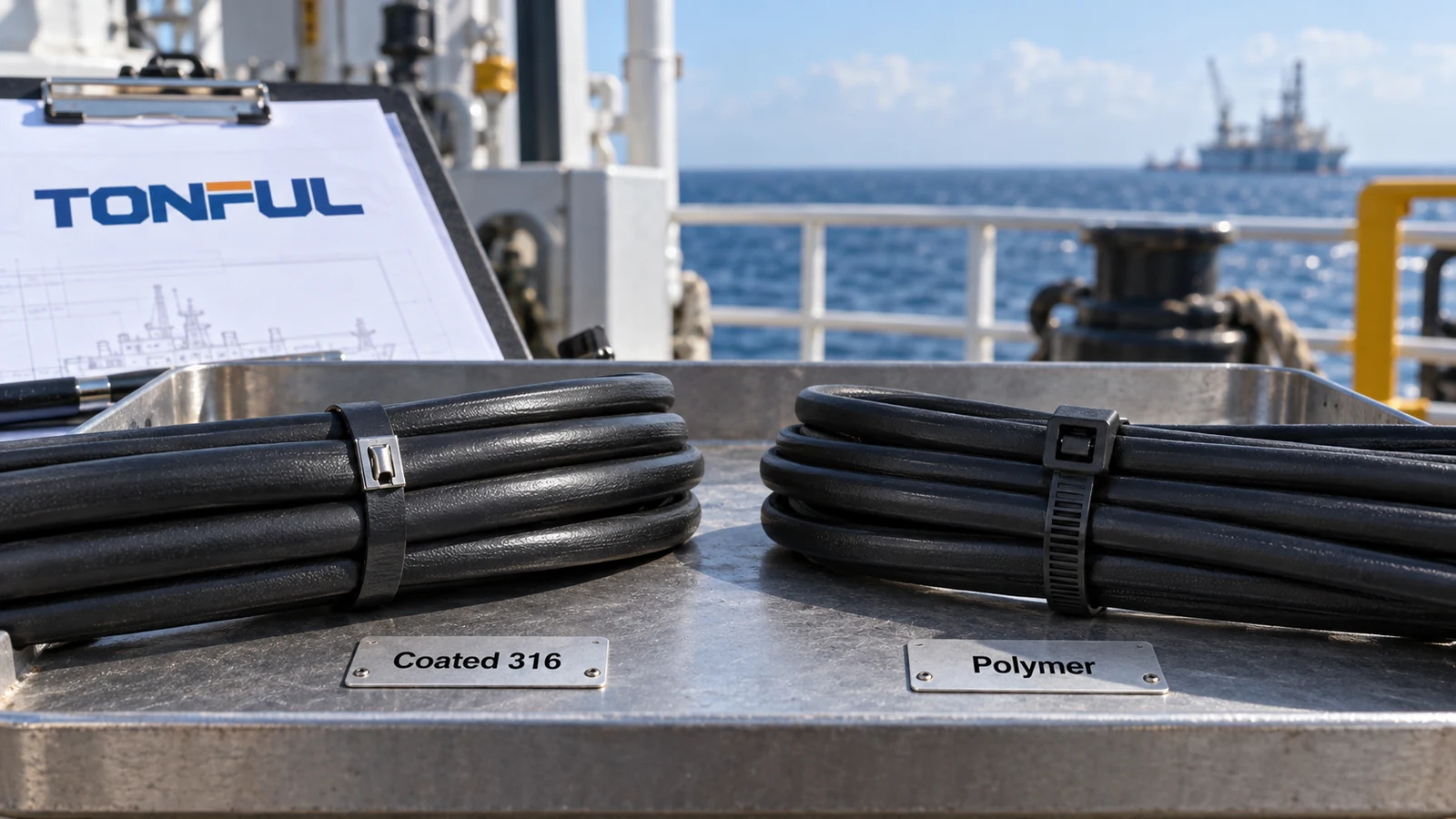
Salt-laden air does not affect every cable route in the same way. A control-panel bundle in a sealed cabin, a photovoltaic cable on a coastal roof and an exposed sensor cable on a vessel’s deck face different wetting, ultraviolet, vibration and service conditions. Choosing “marine grade” from a catalogue label can hide the actual failure mechanism: a polymer tie may embrittle, while an unprotected metal strap may damage the cable jacket or create a crevice against a wet bracket.
The useful comparison is not simply whether 316 stainless is stronger than nylon. It is which finished tie, head, coating, mount and installation method remain suitable for the defined route. This guide compares 316 stainless, coated 316 and selected polymer ties, then gives a practical qualification and inspection record. For the underlying alloy-only distinction, see the TONFUL 304 versus 316 guide.
Map the Marine Exposure Before Selecting Material
Define the installation zone first: dry interior, sheltered exterior, salt mist, direct splash, standing seawater or repeated immersion. Record whether wet salt can collect beneath the locking head, cable bundle or mounting hardware. The distance from shore alone is an incomplete predictor; wind direction, washdown, rain, temperature and drainage can change the chloride loading. A tie on a sunlit rail also faces UV and thermal cycling that an enclosed tie may never see.
List the supported cable’s jacket material, diameter, allowable bend radius, weight, expected movement and neighboring metals. Is the tie only bundling cables on a tray, or is it proposed as a load-bearing support? What happens if it fails: cosmetic disorder, intermittent signal loss, abrasion against machinery or loss of a safety-related route? High-consequence applications need a controlled engineering qualification rather than a material adjective.
Marine and offshore specifications may add fire, smoke, halogen, classification-society or vessel-owner requirements. Do not assume that a generic salt-spray result, a UL cable-tie listing or a steel grade makes a component acceptable under those project documents. Obtain the applicable drawing and approval list for the actual location, then specify the tie and fixing system against it.
What 316 Stainless Can and Cannot Solve
316 and 316L stainless steels contain molybdenum and often offer better resistance to chloride attack than 304. That makes 316 a common starting candidate for exposed coastal hardware, not a promise of immunity. Outokumpu’s corrosion guidance states that sufficiently high chlorides can still cause localized pitting and crevice corrosion. A tight head, folded strap, washer or poorly draining bracket can create a crevice where the visible surface looks sound while the contact area deteriorates.
Inspect the entire assembly, including the locking element. A supplier should identify the metal grade of strap and head, coating type and thickness if applicable, locking design, edge finish and part-specific mechanical ratings. A nominal “316 tie” with an unidentified lock or damaged coating is not the same as a controlled 316L assembly. The TONFUL stainless-tie technical guide explains lock and edge considerations in more detail.
Bare metal against an aluminum or galvanized structure can also contribute to contact corrosion in wet service. HellermannTyton’s cable-tie guidance describes coated 316L ties and protective channels as ways to reduce contact between dissimilar metals. The coating itself is a component with a temperature, UV, chemical and abrasion limit; damage at a cut edge or head may defeat the barrier. Do not treat coating as a universal solution without checking the installed interface.
When a Polymer Tie May Be Better
A polymer tie is electrically nonconductive and can avoid a direct metal-to-cable contact. It can be easier to handle near sensitive insulation and may simplify replacement. But “plastic” does not mean UV-stable or salt-proof. Compare the exact polymer grade, stabilizers, color, service temperature, hydrolysis or moisture behavior, chemical resistance and outdoor qualification. Standard indoor PA66, UV-stabilized PA66, PA12 and ETFE are different candidates, not interchangeable names.
For a sun-exposed coastal route, ask for outdoor/UV evidence for the exact finished tie and color. Black pigment by itself is not a guarantee of a particular lifetime. The TONFUL nylon 66 versus nylon 12 guide discusses how base-material choice interacts with exposed outdoor service; the final selection still needs a project-specific rating. Near hot engines, exhausts or chemical cleaning, an appropriate polymer may differ again. The TONFUL ETFE discussion is a material-evaluation route, not proof that every ETFE tie is released for marine use.
Check locking-head retention after wetting, heat, UV and vibration. A strap that survives a salt-spray cabinet but loses loop force after outdoor aging is not a good cable support. The same applies to a tie that remains strong but abrades its cable jacket when the route moves. Use spacing and independent supports to control motion; do not simply tighten the strap harder.
| Decision factor | Bare 316 stainless | Coated 316 stainless | Qualified polymer |
|---|---|---|---|
| Chloride exposure | Better candidate than 304, but pitting and crevices remain possible | Metal remains exposed at damaged coating or hardware interfaces | No metal corrosion, but polymer aging still requires evidence |
| Cable-jacket contact | Edge and tension control are critical | Coating may reduce direct metal contact if intact | Usually softer contact, yet overtension can still indent insulation |
| Dissimilar-metal structure | Evaluate galvanic/contact corrosion and isolation | Check coating continuity and fastener interfaces | Tie itself is nonmetallic; mounting hardware may not be |
| Heat and fire | Metal strap tolerates heat, but installed cable and any coating set limits | Coating can limit high-temperature use | Exact resin and project fire/smoke evidence needed |
| Inspection focus | Pitting, crevice deposits, lock slip and sharp edges | Coating wear, exposed edges, trapped moisture and lock | UV damage, cracking, creep and head engagement |
The table is a selection framework, not a ranking that declares one option best for every vessel. It also does not grant a service-life number. Compare candidates on the actual route and the same acceptance plan.

Conceptual illustration only—not an acceptance standard or laboratory micrograph. Inspect the actual head, coating, bracket and cable-jacket interfaces.
Validate the Complete Installation
Build test samples with production-intent cable, bracket, mounting hardware and tie tension. Define the tie’s function before setting the pull direction or acceptance criterion. A loop-tensile test compares a tie under a standard condition; it does not establish the allowed mass of an unsupported cable route. UL Solutions’ cable-tie application guide emphasizes matching declared ratings and fixing devices to the actual use. Do not cite a competitor’s certification as TONFUL evidence.
A qualification plan can include salt-fog or cyclic corrosion exposure, natural or accelerated UV, thermal cycling, wet/dry cycling, vibration and cable-jacket inspection when relevant. Define sample counts, initial condition, exposure sequence, inspection intervals and destructive-sample allocation. A single continuous salt-fog run may not reproduce the wet/dry cycles, deposits and crevices of a real coast, so interpret it as one controlled comparison rather than a guaranteed number of service years.
After exposure, document tie retention, lock slip, strap cracking, pitting, coating damage, bracket corrosion and cable-jacket indentation or cuts. Note failure location: strap, head, mounting point, cable or support. If a coated tie passes corrosion exposure but its cover splits at installation tension, the installed version is not qualified. If a polymer tie retains color but creeps under load, visual inspection alone is insufficient.
Use a test record that can support later substitution decisions:
| Record field | Required entry |
|---|---|
| Identity | Tie SKU/revision, material certificate, coating/color, lot and supplier |
| Route | Zone, cable jacket/bundle, bracket metal, support spacing and drainage |
| Installation | Tool, tension setting, tail cut, edge guard and first-piece photo |
| Exposure | Salt/wet-dry, UV, temperature, vibration, duration and sample sequence |
| Results | Initial and final retention, corrosion/damage location and failure mode |
| Release | Acceptance document, approved configuration, reviewer and date |
For safety-related systems, ask the vessel or facility engineer whether additional fire, smoke, shock or vibration evidence is required. Test conditions and limits must come from the project specification or approved qualification plan, not a generic blog number.
Installation and Maintenance Controls
For metal ties, use the specified tool and edge-protection method. Tightening by feel can leave a loose lock or cut into insulation. Position the head so it does not snag personnel and so water can drain. Avoid placing a sharp cut end against cable jackets or a service pathway. Inspect protective channel or coating after tensioning; a damaged barrier should not be accepted merely because the strap is still tight.
For polymer ties, verify full head engagement and cut the tail flush without nicking the strap. Keep the tie away from hot edges and moving mechanisms, and do not let it become the only support for a heavy span. On both materials, use corrosion-compatible brackets and fasteners. Replace a failed tie only after identifying why the bundle moved or the mounting surface trapped salt; repeating the same installation often repeats the defect.
Set inspection frequency by route criticality and observed exposure. Check sheltered and exposed zones separately. Look for brown staining, pits, white deposits, lifted coating, polymer chalking, cracks, lock looseness and cable scuffing. Record photos in the same viewing direction over time. If several adjacent ties fail, quarantine the affected material lot or maintenance practice and inspect the whole route rather than one visible location.

Illustrative field inspection; real acceptance depends on the approved part, route and maintenance criteria.
RFQ and Release With TONFUL
Send TONFUL the cable and bracket drawings, marine zone, salt exposure, temperature, UV, vibration, project approvals, desired inspection interval and required material/coating evidence. Ask for exact 316 or polymer part numbers, controlled drawings, production-intent samples, test reports and change-notification terms. The TONFUL stainless steel cable tie product page presents the range, but its broad corrosion and certification statements should be reconciled with exact-part evidence before they are repeated in a specification. Do not assume that “marine grade” means immunity to pitting or that one alloy choice covers every wet location.
Release the named tie, coating, tool, support and route as one configuration. If a substitution changes the lock, metal grade, resin, pigment or coating, re-evaluate the relevant interfaces. The lower-risk choice is the one with a controlled installation and verified performance in the site’s actual exposure, not the one with the most confident material adjective.
Technical Sources
- Outokumpu stainless corrosion basics: chloride-driven pitting and crevice caveat.
- HellermannTyton cable ties and fixings guidance: 316L coastal uses and coated/protected contact interfaces.
- UL Solutions cable-tie application guide: distinguishing product ratings, fixing devices and installed purpose.
Marine Cable Ties: 316 Stainless vs Polymer
Salt-laden air does not affect every cable route in the same way. A control-panel bundle in a sealed cabin, a photovoltaic cable on a coastal roof and an exposed sensor cable on a vessel’s deck face different wetting, ultraviolet, vibration and service conditions. Choosing “marine grade” from a catalogue label can hide the actual failure mechanism: a polymer tie may embrittle, while an unprotected metal strap may damage the cable jacket or create a crevice against a wet bracket.
The useful comparison is not simply whether 316 stainless is stronger than nylon. It is which finished tie, head, coating, mount and installation method remain suitable for the defined route. This guide compares 316 stainless, coated 316 and selected polymer ties, then gives a practical qualification and inspection record. For the underlying alloy-only distinction, see the TONFUL 304 versus 316 guide.
Map the Marine Exposure Before Selecting Material
Define the installation zone first: dry interior, sheltered exterior, salt mist, direct splash, standing seawater or repeated immersion. Record whether wet salt can collect beneath the locking head, cable bundle or mounting hardware. The distance from shore alone is an incomplete predictor; wind direction, washdown, rain, temperature and drainage can change the chloride loading. A tie on a sunlit rail also faces UV and thermal cycling that an enclosed tie may never see.
List the supported cable’s jacket material, diameter, allowable bend radius, weight, expected movement and neighboring metals. Is the tie only bundling cables on a tray, or is it proposed as a load-bearing support? What happens if it fails: cosmetic disorder, intermittent signal loss, abrasion against machinery or loss of a safety-related route? High-consequence applications need a controlled engineering qualification rather than a material adjective.
Marine and offshore specifications may add fire, smoke, halogen, classification-society or vessel-owner requirements. Do not assume that a generic salt-spray result, a UL cable-tie listing or a steel grade makes a component acceptable under those project documents. Obtain the applicable drawing and approval list for the actual location, then specify the tie and fixing system against it.
What 316 Stainless Can and Cannot Solve
316 and 316L stainless steels contain molybdenum and often offer better resistance to chloride attack than 304. That makes 316 a common starting candidate for exposed coastal hardware, not a promise of immunity. Outokumpu’s corrosion guidance states that sufficiently high chlorides can still cause localized pitting and crevice corrosion. A tight head, folded strap, washer or poorly draining bracket can create a crevice where the visible surface looks sound while the contact area deteriorates.
Inspect the entire assembly, including the locking element. A supplier should identify the metal grade of strap and head, coating type and thickness if applicable, locking design, edge finish and part-specific mechanical ratings. A nominal “316 tie” with an unidentified lock or damaged coating is not the same as a controlled 316L assembly. The TONFUL stainless-tie technical guide explains lock and edge considerations in more detail.
Bare metal against an aluminum or galvanized structure can also contribute to contact corrosion in wet service. HellermannTyton’s cable-tie guidance describes coated 316L ties and protective channels as ways to reduce contact between dissimilar metals. The coating itself is a component with a temperature, UV, chemical and abrasion limit; damage at a cut edge or head may defeat the barrier. Do not treat coating as a universal solution without checking the installed interface.
When a Polymer Tie May Be Better
A polymer tie is electrically nonconductive and can avoid a direct metal-to-cable contact. It can be easier to handle near sensitive insulation and may simplify replacement. But “plastic” does not mean UV-stable or salt-proof. Compare the exact polymer grade, stabilizers, color, service temperature, hydrolysis or moisture behavior, chemical resistance and outdoor qualification. Standard indoor PA66, UV-stabilized PA66, PA12 and ETFE are different candidates, not interchangeable names.
For a sun-exposed coastal route, ask for outdoor/UV evidence for the exact finished tie and color. Black pigment by itself is not a guarantee of a particular lifetime. The TONFUL nylon 66 versus nylon 12 guide discusses how base-material choice interacts with exposed outdoor service; the final selection still needs a project-specific rating. Near hot engines, exhausts or chemical cleaning, an appropriate polymer may differ again. The TONFUL ETFE discussion is a material-evaluation route, not proof that every ETFE tie is released for marine use.
Check locking-head retention after wetting, heat, UV and vibration. A strap that survives a salt-spray cabinet but loses loop force after outdoor aging is not a good cable support. The same applies to a tie that remains strong but abrades its cable jacket when the route moves. Use spacing and independent supports to control motion; do not simply tighten the strap harder.
| Decision factor | Bare 316 stainless | Coated 316 stainless | Qualified polymer |
|---|---|---|---|
| Chloride exposure | Better candidate than 304, but pitting and crevices remain possible | Metal remains exposed at damaged coating or hardware interfaces | No metal corrosion, but polymer aging still requires evidence |
| Cable-jacket contact | Edge and tension control are critical | Coating may reduce direct metal contact if intact | Usually softer contact, yet overtension can still indent insulation |
| Dissimilar-metal structure | Evaluate galvanic/contact corrosion and isolation | Check coating continuity and fastener interfaces | Tie itself is nonmetallic; mounting hardware may not be |
| Heat and fire | Metal strap tolerates heat, but installed cable and any coating set limits | Coating can limit high-temperature use | Exact resin and project fire/smoke evidence needed |
| Inspection focus | Pitting, crevice deposits, lock slip and sharp edges | Coating wear, exposed edges, trapped moisture and lock | UV damage, cracking, creep and head engagement |
The table is a selection framework, not a ranking that declares one option best for every vessel. It also does not grant a service-life number. Compare candidates on the actual route and the same acceptance plan.
Conceptual illustration only—not an acceptance standard or laboratory micrograph. Inspect the actual head, coating, bracket and cable-jacket interfaces.
Validate the Complete Installation
Build test samples with production-intent cable, bracket, mounting hardware and tie tension. Define the tie’s function before setting the pull direction or acceptance criterion. A loop-tensile test compares a tie under a standard condition; it does not establish the allowed mass of an unsupported cable route. UL Solutions’ cable-tie application guide emphasizes matching declared ratings and fixing devices to the actual use. Do not cite a competitor’s certification as TONFUL evidence.
A qualification plan can include salt-fog or cyclic corrosion exposure, natural or accelerated UV, thermal cycling, wet/dry cycling, vibration and cable-jacket inspection when relevant. Define sample counts, initial condition, exposure sequence, inspection intervals and destructive-sample allocation. A single continuous salt-fog run may not reproduce the wet/dry cycles, deposits and crevices of a real coast, so interpret it as one controlled comparison rather than a guaranteed number of service years.
After exposure, document tie retention, lock slip, strap cracking, pitting, coating damage, bracket corrosion and cable-jacket indentation or cuts. Note failure location: strap, head, mounting point, cable or support. If a coated tie passes corrosion exposure but its cover splits at installation tension, the installed version is not qualified. If a polymer tie retains color but creeps under load, visual inspection alone is insufficient.
Use a test record that can support later substitution decisions:
| Record field | Required entry |
|---|---|
| Identity | Tie SKU/revision, material certificate, coating/color, lot and supplier |
| Route | Zone, cable jacket/bundle, bracket metal, support spacing and drainage |
| Installation | Tool, tension setting, tail cut, edge guard and first-piece photo |
| Exposure | Salt/wet-dry, UV, temperature, vibration, duration and sample sequence |
| Results | Initial and final retention, corrosion/damage location and failure mode |
| Release | Acceptance document, approved configuration, reviewer and date |
For safety-related systems, ask the vessel or facility engineer whether additional fire, smoke, shock or vibration evidence is required. Test conditions and limits must come from the project specification or approved qualification plan, not a generic blog number.
Installation and Maintenance Controls
For metal ties, use the specified tool and edge-protection method. Tightening by feel can leave a loose lock or cut into insulation. Position the head so it does not snag personnel and so water can drain. Avoid placing a sharp cut end against cable jackets or a service pathway. Inspect protective channel or coating after tensioning; a damaged barrier should not be accepted merely because the strap is still tight.
For polymer ties, verify full head engagement and cut the tail flush without nicking the strap. Keep the tie away from hot edges and moving mechanisms, and do not let it become the only support for a heavy span. On both materials, use corrosion-compatible brackets and fasteners. Replace a failed tie only after identifying why the bundle moved or the mounting surface trapped salt; repeating the same installation often repeats the defect.
Set inspection frequency by route criticality and observed exposure. Check sheltered and exposed zones separately. Look for brown staining, pits, white deposits, lifted coating, polymer chalking, cracks, lock looseness and cable scuffing. Record photos in the same viewing direction over time. If several adjacent ties fail, quarantine the affected material lot or maintenance practice and inspect the whole route rather than one visible location.
Illustrative field inspection; real acceptance depends on the approved part, route and maintenance criteria.
RFQ and Release With TONFUL
Send TONFUL the cable and bracket drawings, marine zone, salt exposure, temperature, UV, vibration, project approvals, desired inspection interval and required material/coating evidence. Ask for exact 316 or polymer part numbers, controlled drawings, production-intent samples, test reports and change-notification terms. The TONFUL stainless steel cable tie product page presents the range, but its broad corrosion and certification statements should be reconciled with exact-part evidence before they are repeated in a specification. Do not assume that “marine grade” means immunity to pitting or that one alloy choice covers every wet location.
Release the named tie, coating, tool, support and route as one configuration. If a substitution changes the lock, metal grade, resin, pigment or coating, re-evaluate the relevant interfaces. The lower-risk choice is the one with a controlled installation and verified performance in the site’s actual exposure, not the one with the most confident material adjective.
Technical Sources
- Outokumpu stainless corrosion basics: chloride-driven pitting and crevice caveat.
- HellermannTyton cable ties and fixings guidance: 316L coastal uses and coated/protected contact interfaces.
- UL Solutions cable-tie application guide: distinguishing product ratings, fixing devices and installed purpose.