
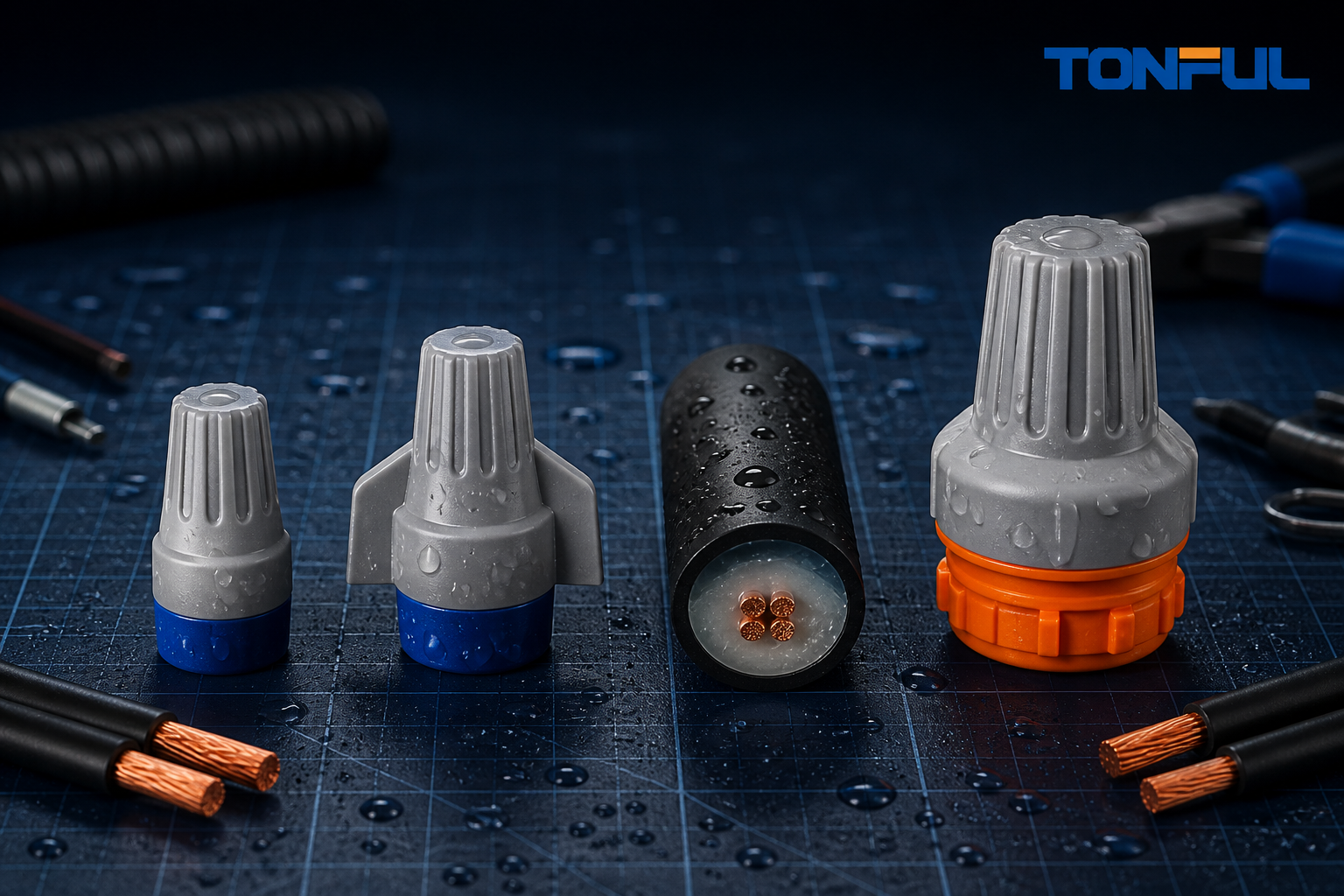

A waterproof wire connector cross-reference should not be treated as a list of parts that can be exchanged without verification. DryConn, 3M, IDEAL, and TONFUL all offer products for moisture-exposed splices, but their constructions, approved locations, wire combinations, voltage ratings, regional certifications, and installation methods can differ.
The practical approach is to identify the application first, then compare candidate products against the exact wire combination and approval requirements. This guide provides that framework and shows where TONFUL models may be considered as sourcing candidates. Final selection must be based on current datasheets, certification files, local electrical rules, and sample testing.
Quick Cross-Reference Summary
The table below is an application-level cross-reference, not a declaration of one-to-one interchangeability.
| Application need | DryConn family to investigate | 3M family to investigate | IDEAL family to investigate | TONFUL candidate family | Main verification point |
|---|---|---|---|---|---|
| Small outdoor lighting or control-wire splice | Small or medium waterproof twist-on connectors | Direct Bury Splice Kit in the required wire range | WeatherProof 61 or regional equivalent | JW1010 or JW1011 | Minimum conductor count, small-wire retention, approved location |
| General landscape lighting and irrigation splice | Medium waterproof or direct-bury connector | Direct Bury Splice Kit | WeatherProof 62 or regional equivalent | JW1020 or JW1030 | Wire combination, voltage, enclosure and burial requirements |
| Larger multi-conductor splice | Large waterproof or direct-bury family | Larger compatible Direct Bury Splice Kit | WeatherProof 63 or regional equivalent | JW1030, JW1040, or JW1050 | Maximum conductor bundle, torque, housing volume |
| Direct burial at building-wire voltage | A model specifically listed for the voltage and direct-bury condition | Direct Bury Splice Kit rated for the application | A region-specific direct-bury product, not assumed from WeatherProof branding | A TONFUL model supported by current direct-bury certification | Certification scope, voltage, enclosure, installation method |
| Private-label or distributor program | Standard branded product | Standard branded product | Standard branded product | TONFUL OEM/ODM waterproof connector program | Samples, documentation, packaging, MOQ, traceability |
For the current TONFUL product range, start with the waterproof wire nuts product page. The published range includes JW1010, JW1011, JW1020, JW1030, JW1040, and JW1050. Do not select a model from its size or color alone.
Why Cross-References Often Fail

Two connectors may look similar and still have different approved uses. The word “waterproof” is not enough to establish equivalence.
Location rating is product-specific
Above-ground wet-location use, below-grade use, direct burial, temporary submersion, and continuous submersion are different conditions. A connector approved for a wet enclosure is not automatically approved for direct burial. An IP rating also does not replace the certification or code requirement applicable to the installation.
King Innovation’s current specification for one DryConn medium waterproof connector describes wet-location use and allows direct-bury applications only at 30 volts or less for that product. DryConn also offers separate direct-bury families with different construction and listings. This is why a buyer must compare the exact catalog number rather than the brand name.
3M’s Direct Bury Splice Kit uses a twist-on connector together with a high-impact, UV-resistant tube prefilled with moisture-resistant grease. That two-part construction is not mechanically identical to a one-piece prefilled wire nut, even when both products serve landscape-lighting or irrigation applications.
IDEAL specifications vary by product and region. An EMEA WeatherProof brochure identifies models 61, 62, and 63 as IP55 connectors for damp or wet above-ground locations. A separate Australian document describes IP68 versions with a defined submersion test condition. Buyers should use the datasheet and certification applicable to the destination market.
Wire range is not the same as an approved wire combination
A label such as “#22 to #8 AWG” describes the overall range but does not prove that every number and combination of conductors inside that range is accepted. Three #12 conductors, one #10 plus two #14 conductors, and six #16 conductors load the spring and enclosure differently.
For a reliable cross-reference, compare:
- Conductor material
- Solid, stranded, or mixed construction
- Number of conductors
- Gauge or cross-sectional area of every conductor
- Approved combination table
- Strip length
- Required pre-twist or no-pre-twist method
- Minimum installation torque or other installation instruction
TONFUL’s waterproof wire nut selection guide provides a useful starting point for matching wire size and application, but the order specification should still state the complete conductor combination.
Voltage and temperature need context
A connector may publish one voltage for building wire and another condition for signs or luminaires. Temperature values may refer to the connector body, insulating shell, or sealant rather than the entire installed splice. Never transfer one component value to the finished assembly without checking the governing datasheet.
Brand-by-Brand Selection Notes
DryConn waterproof connectors
DryConn offers multiple waterproof and direct-bury constructions, including compact prefilled connectors, larger twist-on connectors, and tube-style systems. The medium waterproof specification reviewed for this article lists copper conductors, a broad AWG range, and selected combination tables, but its direct-bury allowance includes an important voltage condition.
DryConn is a logical reference point when a project already specifies a King Innovation catalog number. The correct purchasing workflow is to capture that full catalog number and obtain its latest specification sheet. Tonful’s existing DryConn-style waterproof wire nut alternative guide can then support a commercial comparison after the technical requirements are fixed.
3M Direct Bury Splice Kits
3M describes its Direct Bury Splice Kits as a twist-on wire connector combined with a grease-filled protective tube. Its official page identifies common uses including landscape lighting, irrigation, and direct burial, with product options selected for the required splice.
This construction may be preferable when a specification explicitly requires a protective tube around the splice. A compact one-piece connector should not be offered as a direct replacement unless the project engineer accepts the different construction and the alternative carries the necessary approvals.
IDEAL WeatherProof connectors
IDEAL WeatherProof connectors use a twist-on spring and non-hardening silicone-based sealant. Models and performance claims differ across regional catalogs. For that reason, “IDEAL 61,” “IDEAL 62,” or “IDEAL 63” should always be paired with the destination market, catalog number, and current regional document.
The connector size progression can help identify a preliminary TONFUL candidate, but it is not sufficient for approval. Confirm the conductor combinations, ingress claim, location limitation, voltage, temperature, and applicable standard.
TONFUL waterproof wire nuts
TONFUL’s current site publishes six main models from JW1010 through JW1050. The listed range spans small through larger conductor combinations, with published model-level dimensions, wire-range boundaries, strip-length guidance, and electrical ratings. The site positions these products for landscape lighting, irrigation, outdoor fixtures, and related wet-location applications.
For a cross-reference request, TONFUL should receive the incumbent part number plus the actual application data. The response should identify a candidate model and provide the current drawing, combination table, installation instructions, certification evidence, packaging information, and samples for validation.
Procurement teams evaluating a new factory can also use the waterproof wire nut manufacturer audit checklist to review process controls and documentation instead of comparing unit price alone.
How to Build a Defensible Cross-Reference

1. Record the incumbent product exactly
Provide the brand, complete catalog number, regional variant, package label, revision date, and current specification sheet. A family name without the catalog number is insufficient.
2. Define the electrical splice
List every conductor in the splice, including material, solid or stranded construction, AWG or mm2 size, and conductor count. State the system voltage and any current or temperature requirement that affects the termination.
3. Define the environment
Identify whether the splice is indoors, outdoors above grade, inside an enclosure, below grade, directly buried, exposed to spray, periodically submerged, or continuously submerged. Include chemicals, UV exposure, vibration, and expected temperature range where relevant.
For underground work, use Tonful’s UL 486D direct-burial wire connector guide to separate general moisture protection from a sealed connector system approved for the intended installation.
4. Compare documents, not marketing labels
The proposed replacement should be checked against the incumbent for:
| Verification item | Evidence to request |
|---|---|
| Wire compatibility | Approved conductor-combination table |
| Electrical rating | Current product datasheet and label artwork |
| Wet/direct-bury suitability | Certification scope and installation limitations |
| Temperature | Connector and sealant ratings with test context |
| Materials | Shell, spring, sealant, and conductor compatibility |
| Installation | Strip length, insertion, twisting, enclosure, and reuse instructions |
| Production control | Incoming inspection, process control, final inspection, lot traceability |
| Commercial fit | MOQ, pack count, private label, lead time, sample policy |
5. Validate samples in the real assembly
A paper comparison narrows the options; it does not finish qualification. Install samples using the production wire and tools. Check conductor retention, installation feel, sealant coverage, housing damage, exposed copper, and fit inside the intended enclosure.
The validation plan should reflect the project’s risk. It may include visual inspection, pull or retention checks, electrical resistance or continuity checks, moisture exposure, thermal cycling, vibration, or other application-specific tests. Acceptance limits should come from the product specification, applicable standard, or engineering plan rather than being invented during testing.
6. Lock the approved configuration
Document the accepted connector model, wire combinations, strip length, installation method, packaging label, certificate revision, and change-notification requirement. This prevents a general family approval from being applied to an untested size or regional version.
Cross-Reference by Application

Landscape lighting
Landscape lighting often uses small conductors, low-voltage circuits, wet soil, irrigation spray, and compact fixture boxes. Check the smallest approved conductor combination and whether the connector is approved for the actual below-grade or direct-bury condition. Do not assume that a low system voltage removes the location requirement.
Irrigation and valve wiring
Irrigation splices may remain in damp valve boxes or wet soil for long periods. Sealant distribution, conductor retention, and correct installation matter as much as the connector shell. Confirm whether the product must be enclosed and whether reuse is prohibited.
Outdoor signs and luminaires
Some connector datasheets distinguish building-wire voltage from signs and luminaires. Use the exact condition stated in the applicable document. Also verify conductor temperature, enclosure space, and local inspection requirements.
Direct-burial power splices
Direct-burial power circuits require more than visual similarity to a landscape-lighting connector. Confirm the voltage, conductor combinations, sealed-system listing, enclosure or tube construction, burial condition, and local code. Where the incumbent uses a tube or strain-relief system, include that mechanical function in the comparison.
Sourcing TONFUL as a Cross-Reference Candidate
For distributors and private-label programs, cross-referencing also includes commercial controls. A technically suitable connector can still fail the project if packaging, labeling, traceability, or change control does not meet the channel requirement.
Send TONFUL the following RFQ package:
- Incumbent brand and full part number
- Latest incumbent datasheet or a clear package-label photo
- Complete wire combinations
- Voltage, location, environment, and target market
- Required certification and document language
- Annual quantity, order quantity, and pack format
- Branding, barcode, carton, and instruction requirements
- Sample quantity and validation schedule
For branded distribution projects, review Tonful’s guide to private-label waterproof wire nuts before requesting samples and packaging quotations.
Frequently Asked Questions
Is a TONFUL connector a direct replacement for a DryConn, 3M, or IDEAL part?
Not automatically. TONFUL may offer a candidate with similar application coverage, but equivalence must be confirmed against the exact incumbent catalog number, conductor combination, voltage, approved location, installation method, certification, and validation results.
Can I cross-reference connectors by color?
No. Color is not a reliable industry-wide size or performance code. Different manufacturers may use similar colors for different wire ranges or product functions.
Does an IP68 rating prove that a connector is approved for direct burial?
No. An IP test describes ingress protection under defined test conditions. Direct-burial acceptance may also depend on a product standard, certification scope, voltage, enclosure, installation instructions, and local code.
Can waterproof twist-on connectors be reused?
Follow the exact manufacturer’s instructions. Reuse can disturb the spring, sealant distribution, conductor surfaces, and housing. If the documentation does not explicitly permit reuse, replace the connector.
What information produces the fastest TONFUL cross-reference?
Provide the incumbent part number, wire combinations, application location, voltage, target market, required certifications, annual volume, and packaging needs. Photos and the latest datasheet reduce ambiguity.
Request a TONFUL Cross-Reference Review
A useful cross-reference is a documented engineering and sourcing decision, not a visual guess. Send TONFUL your DryConn, 3M, or IDEAL catalog number together with the wire combination, voltage, installation environment, certification requirement, and order volume. TONFUL can recommend a candidate waterproof connector and prepare the drawings, samples, packaging options, and supporting documents needed for your qualification process.