
Every electrical failure tells a story, and in harsh environments, that story usually involves water. A single compromised connection in a marine engine bay, a solar junction box on a rain-soaked roof, or an underground irrigation splice can cascade into system downtime, equipment damage, and costly emergency repairs. Waterproof terminals exist to prevent that story from being written in the first place.
As a B2B manufacturer of electrical terminals and connectors, TONFUL Electric has seen firsthand how the right sealed connection can extend equipment lifespan by years. This guide breaks down what waterproof terminals are, how they work, the standards that govern them, and how to select the correct type for your application—whether you are specifying components for a marine wiring harness, an automotive engine compartment, or an outdoor lighting installation.
What Are Waterproof Terminals?
A waterproof terminal is an electrical connector engineered to prevent water, moisture, dust, and other contaminants from reaching the conductive contact area, ensuring reliable current transmission in environments where exposure is expected rather than accidental. Unlike standard wire terminals that rely solely on insulation for dielectric protection, waterproof terminals incorporate dedicated sealing components—elastomer gaskets, adhesive-lined tubing, silicone gel fills, or potting compounds—that create a physical barrier between the conductor and the surrounding environment.
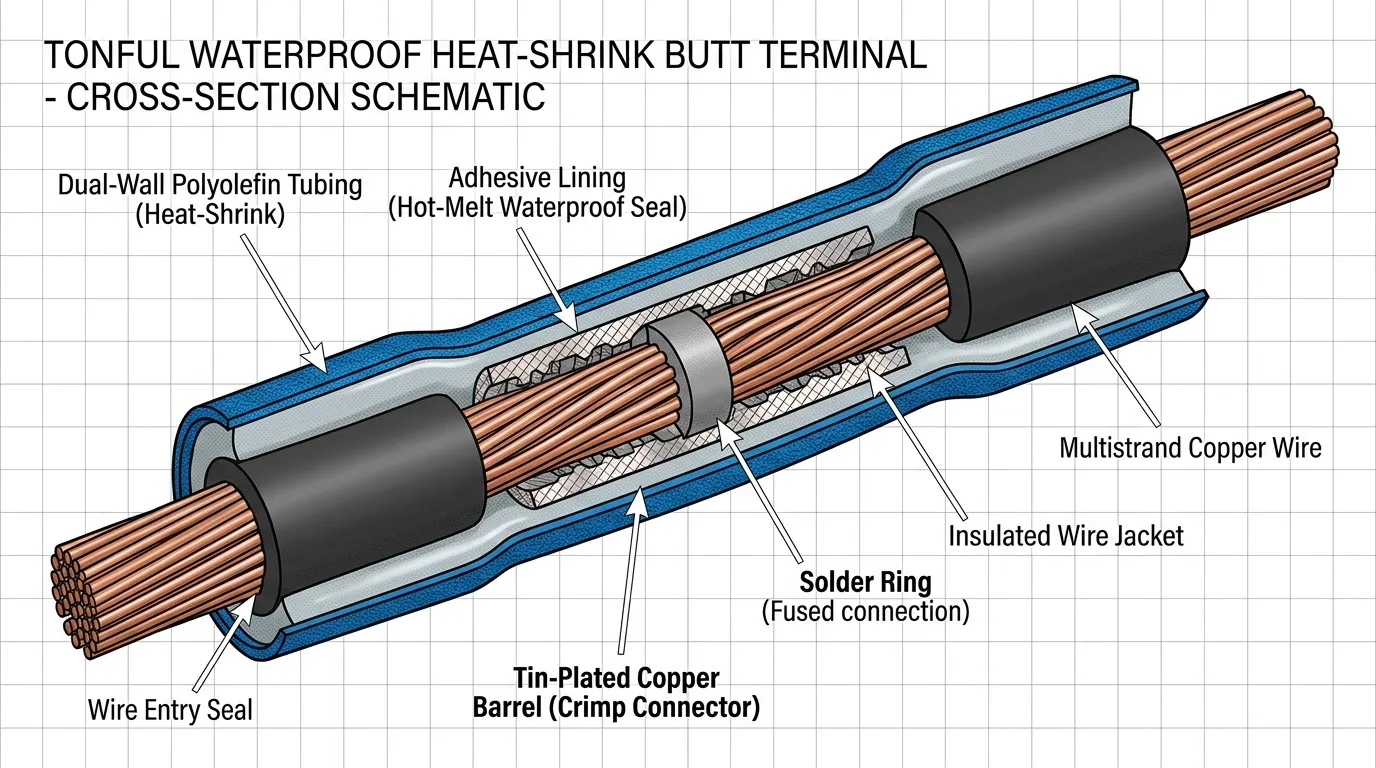
The internal structure typically combines a tin-plated copper or brass contact for corrosion resistance and conductivity, an insulating housing made from PA66, PVC, or polyolefin, and one or more sealing elements positioned at the wire entry point and the mating interface. When properly installed, these elements work together to maintain both electrical integrity and environmental isolation across thousands of thermal cycles and vibration events.

How Waterproof Terminals Work: Sealing Technologies
The effectiveness of a waterproof terminal depends entirely on its sealing mechanism. Three dominant technologies have emerged, each with distinct trade-offs in durability, installation method, and reworkability.
Adhesive-lined heat shrink is the most widely adopted approach for inline splices and butt connectors. A dual-wall polyolefin tube with an inner layer of hot-melt adhesive is positioned over the crimped joint. When heated with a heat gun, the outer wall shrinks to conform tightly around the wire while the inner adhesive melts, flows into voids, and bonds to the insulation—creating a permanent, void-free seal. Professional-grade heat shrink terminals can be fully sealed in 15–30 seconds and provide excellent resistance to vibration, moisture, and chemical exposure. For a detailed installation walkthrough, see our guide on how to crimp heat shrink terminals correctly.
Gel-filled connectors, such as waterproof wire nuts, use a pre-filled silicone or petroleum-based gel inside a plastic shell. When wires are twisted into the connector, the gel displaces around the conductors, displacing air and creating an environmental barrier. These are faster to install—no heat gun required—and excel in cold-weather applications and outdoor LED installations where reworkability matters. However, they generally offer lower mechanical strength than heat-shrink alternatives. For a deeper comparison, read our complete comparison of common vs. waterproof wire nuts.
O-ring and gasket-sealed connectors use precision-molded elastomer seals (silicone, EPDM, or nitrile rubber) at the cable entry and mating interface. This is the standard approach for multi-pin automotive electrical connectors and circular industrial connectors rated to IP67 and above. The seals compress when the connector halves mate, forming a labyrinth barrier that resists both splash and temporary immersion.

IP Ratings: The Universal Language of Waterproofing
In professional engineering, “waterproof” is not a precise term. What exists instead is a controlled probability of ingress under clearly defined conditions, quantified through the IP (Ingress Protection) rating system defined by IEC 60529. The code consists of the letters “IP” followed by two numerals: the first rates solid particle protection (0–6), the second rates liquid ingress protection (0–9K).
| IP Rating | Solid Protection | Liquid Protection | Test Condition | Typical Use Case |
|---|---|---|---|---|
| IP54 | Dust-protected | Splashing water | Water splashed from any direction | Indoor industrial, light outdoor |
| IP65 | Dust-tight | Low-pressure water jets (12.5 L/min, 30 kPa) | Water from 6.3mm nozzle, 3m distance | Outdoor enclosures, rain exposure |
| IP66 | Dust-tight | High-pressure water jets (100 L/min, 100 kPa) | Powerful jets from any direction | Marine deck, washdown areas |
| IP67 | Dust-tight | Temporary immersion (1m, 30 min) | Immersion in water tank | Engine bays, flooded environments |
| IP68 | Dust-tight | Continuous immersion (depth/time per mfr. spec) | Sustained submersion | Submersible pumps, underwater lighting |
| IP69K | Dust-tight | High-pressure, high-temp jets (80°C, 100 bar) | Close-range high-pressure spray | Food processing, heavy washdown |
A critical nuance: IP67 does not automatically cover IP66. IEC 60529 explicitly treats immersion testing (IPX7/IPX8) and water jet testing (IPX5/IPX6) as separate test categories. A connector rated IP67 may survive a 30-minute dunk but fail under directed high-pressure spray. Always verify that the rated protection matches your actual exposure scenario. For a vehicle-specific deep dive, see our IP67 vs. IP69K waterproof ratings guide for off-road vehicles.
Types of Waterproof Terminals: Comparison
Waterproof terminals span several form factors, each optimized for specific joint geometries and installation constraints.

| Terminal Type | Sealing Method | IP Rating | Wire Range (AWG) | Installation Tool | Best For | Reusable |
|---|---|---|---|---|---|---|
| Waterproof Wire Nut | Silicone gel fill | IP67–IP68 | 18–10 | Hand-twist | Splices, irrigation, lighting | No |
| Heat-Shrink Butt Connector | Adhesive-lined tubing | IP67–IP68 | 22–10 | Crimper + heat gun | Automotive, marine splices | No |
| Heat-Shrink Ring Terminal | Adhesive-lined tubing | IP67 | 16–8 | Crimper + heat gun | Grounding, battery lugs | No |
| Sealed Quick-Disconnect | O-ring + housing seal | IP65–IP67 | 18–14 | Crimper | Serviceable connections | Yes (mating) |
| Multi-Pin Sealed Connector | Silicone interface seal + grommets | IP67–IP69K | 20–16 | Crimper + insertion tool | Harness-to-harness, sensors | Yes (mating) |
| Waterproof Cold-Pressed Terminal | Potting / overmold | IP67–IP68 | 14–1/0 | Hydraulic crimpers | High-current, heavy duty | No |
For applications requiring ring-lug connections in wet environments, our heat-shrink ring terminals technical guide covers sizing and installation in detail.
Key Applications Across Industries
Waterproof terminals are not a niche product—they are mission-critical across a wide spectrum of industries where moisture exposure is continuous, not incidental.
Marine and boat wiring demands the highest sealing standard. Saltwater accelerates galvanic corrosion on exposed copper contacts at an alarming rate, making tin-plated terminals essential. IP67 or IP68 sealed connectors are specified for navigation systems, bilge pump wiring, and battery connections. Salt spray testing per ASTM B117 is the baseline qualification for marine-grade terminals. For vessel-specific guidance, see our IP ratings for boats and marine craft guide.
Automotive and off-road vehicles expose terminals to road spray, engine bay condensation, and high-pressure washing. Modern vehicles integrate hundreds of sealed connectors—from engine compartment sensors to EV battery management system connectors handling 800V+. Vibration resistance is equally critical; learn how to prevent vibration loosening in marine engines.
Solar and renewable energy installations require UV-resistant, weatherproof connections for panel junction boxes, combiner boxes, and solar wire connectors exposed to decades of sun, rain, and temperature cycling.
Outdoor lighting and irrigation benefit from gel-filled waterproof wire nuts, which simplify field installation for sprinkler systems and outdoor lighting. For underground splices, direct burial-rated connectors meeting UL 486D are mandatory.
Submersible pumps and underwater equipment require IP68-rated connections capable of continuous immersion. Our guide on submersible pump wiring with IP68 wire nuts covers depth ratings and seal selection.

Standards and Compliance
Specifying waterproof terminals without referencing standards is engineering malpractice. The following frameworks define what “waterproof” actually means in a testable, auditable context.
IEC 60529 defines the IP code and its test methods. It is a type test—validating the design of a new product under specific, short-term conditions. It does not account for material degradation over time due to UV exposure, ozone, chemical attack, or repeated thermal cycling. Engineers must complement IP ratings with material specifications and aging data.
UL 486D governs sealed wire connectors rated for direct burial in the United States. It tests for water resistance, dielectric integrity, and pull-out strength after environmental conditioning. Connectors lacking UL 486D listing should never be specified for underground applications. Compare this with UL 486 vs. UL 310 wire connector standards.
SAE J1742 and USCAR-21 define automotive terminal performance including current cycling, vibration, and fluid compatibility. For automotive-grade qualification, our USCAR-21 automotive terminal testing article details the test sequence.
IPC/WHMA-A-620 establishes acceptance criteria for wire harness assemblies, including sealed connections. Manufacturers adhering to this standard provide traceable quality—learn more in our IPC/WHMA-A-620 wire harness standard guide.

Selection Criteria: How to Choose the Right Waterproof Terminal
Selecting the correct waterproof terminal requires evaluating environmental, electrical, and mechanical factors simultaneously. The wrong choice is not merely suboptimal—it is a liability.
| Selection Factor | Key Questions | Decision Driver |
|---|---|---|
| Exposure type | Splash, immersion, or burial? | IP65 for splash; IP67 for temporary immersion; IP68/IP69K for continuous submersion or washdown |
| Wire gauge | What AWG range? | Match terminal barrel to wire OD; see our AWG to metric conversion chart |
| Current rating | What is the max continuous current? | Copper cross-section and plating thickness; copper vs. brass terminals trade-offs |
| Temperature range | Min/max operating temp? | Polyolefin (-55°C to 125°C); silicone (-60°C to 200°C); PA66 housing (-40°C to 125°C) |
| Chemical exposure | Saltwater, oils, fuels, solvents? | Tin plating for corrosion; Viton seals for chemical resistance |
| Vibration level | Continuous vibration or shock? | Heat-shrink for permanent joints; locked multi-pin connectors for serviceable harnesses |
| Installation environment | Field install or factory? | Gel-filled for tool-free field work; heat-shrink for factory-controlled quality |
| Serviceability | Will it need disconnection? | Sealed quick-disconnects or multi-pin connectors vs. permanent splices |
| Certification | What standard must it meet? | UL 486D for burial; IEC 60529 IP code; SAE for automotive; CE vs. UL for market access |
For a broader framework, our ultimate guide to selecting the best wire connectors for water applications walks through the full decision tree.
Why TONFUL?
TONFUL Electric is a specialized manufacturer of waterproof wire connectors and heat-shrink terminals serving B2B clients worldwide. Our waterproof terminals are manufactured from tin-plated copper, sealed with adhesive-lined polyolefin or silicone gel, and validated through IP-rating immersion tests, salt spray exposure, and crimp pull-force testing per IPC/WHMA-A-620. Whether you need wholesale waterproof wire nuts for irrigation projects, marine-grade connector kits for boat builders, or custom-sealed terminals for OEM harnesses, TONFUL delivers consistent quality at scale. Contact us to discuss your specification.
FAQ
What is the difference between waterproof and weatherproof terminals?
“Waterproof” is typically specified by a defined IP rating (e.g., IP67, IP68) based on standardized IEC 60529 test methods, indicating protection against specific water exposure conditions. “Weatherproof” is an informal term for outdoor exposure without a rigorous test basis. For engineering specifications, always rely on the published IP rating. See our NEMA vs. IP ratings guide for details.
Can waterproof wire nuts be used for direct burial?
Only connectors explicitly rated and listed for direct burial—typically meeting UL 486D—should be installed underground. Standard waterproof wire nuts rated IP67 may protect against temporary immersion but are not designed for continuous soil contact and moisture. Read our direct burial wiring guide and are waterproof wire nuts rated for direct burial? for specifics.
Are waterproof terminals reusable?
It depends on the type. Gel-filled wire nuts and heat-shrink connectors create permanent seals and cannot be reused once removed. Sealed quick-disconnect terminals and multi-pin connectors with O-ring seals can be mated and unmated multiple times, though the elastomer seals should be inspected for compression set after extended service. Learn more in can waterproof wire nuts be reused?.
What IP rating do I need for marine applications?
For above-deck marine wiring exposed to spray and rain, IP66 or IP67 is typically sufficient. For below-deck, bilge, or underwater connections, IP68 is the minimum. Saltwater environments additionally require tin-plated contacts and corrosion-resistant housings. See our complete guide to marine electrical wiring.
How do I test whether a waterproof terminal is still sealed?
Visual inspection for adhesive flow, gel displacement, and housing integrity is the first step. For critical applications, dielectric testing and immersion testing per IEC 60529 can verify seal integrity. Our article on how to visually inspect waterproof wire nuts for damage provides a practical checklist.