
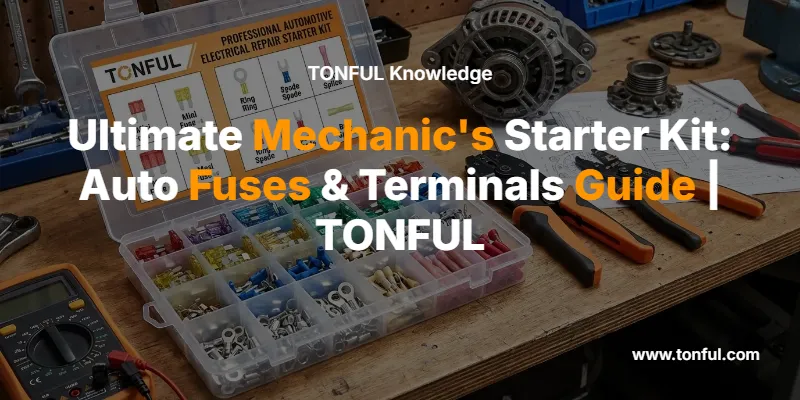
When building your first professional automotive repair toolkit, the difference between a frustrating diagnostic session and a swift, confident repair often comes down to having the right electrical components on hand. While socket sets and wrenches get most of the attention, experienced mechanics know that a comprehensive selection of automotive blade fuses and crimp terminals forms the backbone of efficient electrical repair work. This guide breaks down exactly which fuses and terminals belong in every mechanic’s starter kit, helping you build a foundation that handles 90% of common electrical repairs without unnecessary trips to the parts counter.
Why Electrical Components Matter in Your Starter Kit
Modern vehicles contain increasingly complex electrical systems, with the average car now featuring over 100 electrical circuits protected by various fuses. From diagnosing a non-functional power window to troubleshooting intermittent starting issues, electrical repairs account for approximately 30-40% of routine automotive service work. Having a well-organized assortment of fuses and terminals doesn’t just save time—it directly impacts your ability to complete repairs efficiently and professionally. A blown fuse that sidelines a vehicle for hours while waiting on parts represents lost productivity and frustrated customers, making a comprehensive electrical component kit as essential as your torque wrench.
The investment in quality electrical components pays immediate dividends. Professional-grade blade fuses and properly crimped terminals ensure repairs last, reducing comeback rates and building your reputation for reliable work. Moreover, understanding the specifications and proper application of these components elevates your diagnostic capabilities, allowing you to identify root causes rather than simply replacing blown fuses repeatedly.

Essential Blade Fuse Types for Your Starter Kit
Understanding the different blade fuse formats represents foundational knowledge for any automotive technician. The automotive industry has evolved through several fuse generations, each designed to meet specific space and current requirements. Your starter kit should include a strategic selection across these categories to handle the majority of vehicle electrical systems you’ll encounter.
Standard ATO/ATC Blade Fuses
The workhorse of automotive electrical protection, standard blade fuses (also called ATO or ATC fuses) measure 19mm in width and remain the most common format in vehicles manufactured from the mid-1980s through the early 2000s. These fuses typically protect higher-amperage circuits including cooling fans, fuel pumps, and power accessories. For your starter kit, stock amperage ratings of 5A, 7.5A, 10A, 15A, 20A, 25A, and 30A—these seven ratings cover approximately 85% of standard blade fuse applications. The color-coding system makes identification straightforward: tan (5A), brown (7.5A), red (10A), blue (15A), yellow (20A), clear (25A), and green (30A).
Mini Blade Fuses
Introduced in the 1990s to accommodate increasingly dense fuse panels, mini blade fuses measure just 10.9mm wide—nearly half the width of standard fuses. Today’s vehicles predominantly use mini fuses for most circuits, making them the highest-priority component in your starter kit. Stock the same amperage range as standard fuses (5A through 30A), with particular emphasis on 10A, 15A, and 20A ratings, which represent the most frequently encountered values. Mini fuses follow the same color-coding convention as their standard counterparts, simplifying identification during repairs.
Maxi Blade Fuses
For high-current applications exceeding 30 amperes, maxi blade fuses provide protection for primary power distribution circuits, including main battery feeds, alternator outputs, and electric power steering systems. Measuring 29mm wide, these larger fuses handle currents from 20A up to 80A. Your starter kit should include at least 30A, 40A, 50A, 60A, and 80A ratings. While less frequently replaced than mini or standard fuses, having maxi fuses available prevents extended vehicle downtime when these critical circuits fail.
Micro Fuses
The newest addition to the blade fuse family, micro fuses (both Micro2 and Micro3 variants) appear primarily in vehicles manufactured after 2010. These ultra-compact fuses measure just 9mm wide, enabling manufacturers to pack more circuits into limited fuse panel space. While not as universally necessary as mini and standard fuses, including a selection of micro fuses (5A, 7.5A, 10A, 15A, 20A, 25A) ensures you’re prepared for late-model vehicle repairs.

Blade Fuse Amperage Quick Reference
| Amperage | Color Code | Common Applications | Priority Level |
|---|---|---|---|
| 5A | Tan | Dashboard lights, instrument cluster, radio memory | Medium |
| 7.5A | Brown | Interior lights, license plate lights, clock | Medium |
| 10A | Red | Power windows, power locks, turn signals | High |
| 15A | Blue | Cigarette lighter, horn, windshield wipers | High |
| 20A | Yellow | Fuel pump, cooling fans (low speed), heated seats | High |
| 25A | Clear/Natural | Power seats, sunroof, rear defroster | Medium |
| 30A | Green | Cooling fans (high speed), ABS pump, starter relay | High |
| 40A | Amber | Electric power steering, HVAC blower motor | Medium |
| 50A | Red (Maxi) | Main power distribution, alternator output | Medium |
| 60A | Yellow (Maxi) | Battery feed, primary power circuits | Low |
| 80A | Clear (Maxi) | High-output alternators, electric vehicle systems | Low |
Understanding blade fuse amp ratings and color codes prevents misapplication and ensures proper circuit protection during repairs.

Essential Crimp Terminal Types
While fuses protect circuits, terminals create the connections that make those circuits function. A comprehensive selection of crimp terminals enables you to repair damaged wiring harnesses, install aftermarket accessories, and restore corroded connections without resorting to unreliable twist-and-tape methods. Quality crimped connections, when properly executed, provide superior mechanical strength and electrical conductivity compared to soldered joints in automotive applications, particularly in high-vibration environments.
Ring Terminals
Ring terminals feature a complete circular opening that slides over a stud or bolt, providing the most secure mechanical connection available. These terminals excel in applications requiring vibration resistance, such as battery cable connections, ground points, and starter motor wiring. Your starter kit should include both insulated and non-insulated varieties in wire gauges from 22 AWG through 10 AWG, with stud sizes ranging from #6 (3.5mm) through 1/4″ (6.35mm). The insulated versions, color-coded by wire gauge (red for 22-18 AWG, blue for 16-14 AWG, yellow for 12-10 AWG), provide strain relief and prevent short circuits in tight spaces.
Spade Terminals (Quick Disconnects)
Also known as quick disconnect terminals, spade terminals enable tool-free connections and disconnections, making them ideal for accessory wiring, relay connections, and switch installations. Available in male (tab) and female (receptacle) configurations, these terminals come in three standard widths: 0.187″ (4.8mm), 0.25″ (6.3mm), and 0.110″ (2.8mm). Stock your kit with insulated female spade terminals in all three sizes, covering wire gauges from 22 AWG to 10 AWG. The ability to quickly disconnect components for testing or replacement makes spade terminals invaluable for diagnostic work.
Butt Connectors
When splicing wires or extending circuits, butt splice connectors provide a reliable, professional alternative to twist connections. These tubular terminals accept wire from both ends, creating a secure crimp connection that maintains circuit integrity. Include both standard insulated butt connectors and heat shrink butt connectors in your kit. The heat shrink versions incorporate adhesive-lined tubing that creates a waterproof seal when heated, making them essential for underbody repairs and exterior lighting circuits exposed to moisture.
Pin Terminals
For connector repairs and custom harness fabrication, pin terminals mate with corresponding socket terminals inside multi-pin connectors. These terminals require specific crimping tools and techniques but enable professional-quality repairs to damaged connector pins. Start with a basic assortment of common automotive connector pins compatible with popular connector families like Weather Pack and Metri-Pack systems.

Terminal Selection by Wire Gauge
| Wire Gauge (AWG) | Insulation Color | Typical Applications | Recommended Terminal Types |
|---|---|---|---|
| 22-18 AWG | Red | Interior lighting, sensors, signal circuits | Ring, spade, butt, pin |
| 16-14 AWG | Blue | Power windows, door locks, horn, wipers | Ring, spade, butt, pin |
| 12-10 AWG | Yellow | Fuel pumps, cooling fans, power seats | Ring, spade, butt |
| 8 AWG | Red (non-insulated) | Starter circuits, alternator output | Ring, lug |
| 6 AWG | Red (non-insulated) | Battery cables, high-current accessories | Ring, lug |
| 4 AWG | Red (non-insulated) | Main battery cables, inverter connections | Ring, lug |
Matching terminal size to wire gauge ensures proper crimp compression and prevents connection failures. Using the crimp terminal color code chart simplifies selection and reduces installation errors.
Specialized Components for Professional Results
Beyond basic fuses and terminals, several specialized components elevate your starter kit from adequate to professional-grade, enabling you to handle a broader range of repairs with improved quality and durability.
Heat Shrink Terminals
Heat shrink terminals combine the mechanical strength of crimped connections with the environmental protection of heat-activated adhesive tubing. When heated with a heat gun, the dual-wall tubing shrinks tightly around the connection while internal adhesive melts to create a waterproof, corrosion-resistant seal. These terminals prove indispensable for marine applications, trailer wiring, and any exterior lighting repairs where moisture exposure poses a concern. Stock heat shrink versions of ring terminals, spade terminals, and butt connectors in the three standard color codes (red, blue, yellow).
Waterproof Wire Connectors
For ultimate environmental protection, waterproof wire connectors featuring silicone-filled chambers or gel-sealed designs provide IP67 or IP68-rated protection against water intrusion. These connectors excel in applications like trailer lighting, marine electrical systems, and off-road vehicle accessories where traditional terminals would corrode rapidly. While more expensive than standard terminals, including a small selection prevents callbacks on exterior electrical repairs.
Wire Ferrules
Often overlooked in automotive applications but increasingly relevant for modern vehicles, wire ferrules (also called cord end terminals) provide a professional termination for stranded wire inserted into screw terminals or spring-cage connectors. European vehicles and certain control modules use these connections extensively. A basic ferrule assortment covering 22 AWG through 10 AWG adds versatility to your kit for minimal investment.

Essential Tools for Your Electrical Kit
Having the right components means nothing without proper tools to install them. Your electrical starter kit requires several specialized tools beyond standard hand tools to ensure professional-quality connections.
Crimping Tool
A quality ratcheting crimping tool represents the single most important investment for electrical work. Ratcheting designs prevent incomplete crimps by requiring full compression before releasing, ensuring consistent connection quality. Look for tools with interchangeable dies covering insulated terminals (22-10 AWG), non-insulated terminals, and weatherproof connectors. Professional-grade crimpers from manufacturers like TONFUL provide precise compression that creates gas-tight connections without damaging wire strands.
Wire Strippers
Automatic wire strippers that adjust to wire gauge eliminate the risk of nicking conductor strands during insulation removal—a common cause of premature wire failure. Quality strippers handle the full range from 10 AWG through 22 AWG and include integrated cutting jaws for trimming wires to length.
Multimeter
No electrical toolkit is complete without a digital multimeter capable of measuring voltage, current, resistance, and continuity. When diagnosing blown fuses, a multimeter helps identify the root cause by measuring circuit loads and detecting short circuits before installing replacement fuses.
Fuse Puller
While often included in vehicle fuse panels, a dedicated fuse puller tool prevents damage to fuse terminals and surrounding components during removal. The small investment prevents frustration and potential damage to fuse panels.
Heat Gun
For activating heat shrink terminals and tubing, a quality heat gun with temperature control prevents overheating that can damage wire insulation or melt connector housings. Compact models designed for electrical work provide sufficient heat output without the bulk of industrial heat guns.
Starter Kit Recommendations by Experience Level
Entry-Level Mechanic Kit ($75-150)
For technicians just beginning their careers or DIY enthusiasts building their first comprehensive toolkit, focus on the most commonly encountered components. This kit should include 10-15 each of mini blade fuses in 10A, 15A, 20A, and 30A ratings; 5-10 each of standard blade fuses in the same ratings; 25-50 each of insulated ring and spade terminals in red, blue, and yellow sizes; 25-50 insulated butt connectors; a basic ratcheting crimping tool; automatic wire strippers; and a digital multimeter. This selection handles approximately 70% of routine electrical repairs while maintaining a reasonable initial investment.
Professional Mechanic Kit ($200-400)
Professional technicians requiring broader coverage should expand to comprehensive automotive electrical connector kits including all blade fuse types (standard, mini, maxi, and micro) in complete amperage ranges; extensive terminal assortments including heat shrink and waterproof variants; specialized connector pins for common automotive connector families; professional-grade crimping tools with multiple die sets; heat gun; and advanced diagnostic tools. This investment level supports high-volume repair work without frequent parts ordering delays.
Specialty/Fleet Kit ($500+)
Fleet maintenance facilities and specialty shops benefit from organized assortment boxes featuring hundreds of components in systematic storage. These kits include every fuse type and amperage, comprehensive terminal selections, specialty connectors for specific vehicle makes, and premium tools including hydraulic crimpers for heavy-gauge cables. The upfront investment pays dividends through reduced downtime and improved repair efficiency across diverse vehicle populations.
Fuse vs. Terminal Comparison
| Component | Primary Function | Replacement Frequency | Skill Level Required | Average Cost |
|---|---|---|---|---|
| Blade Fuses | Circuit protection | High (consumable) | Beginner | $0.25-1.00 each |
| Crimp Terminals | Electrical connections | Low (permanent) | Intermediate | $0.10-0.50 each |
| Heat Shrink Terminals | Protected connections | Low (permanent) | Intermediate | $0.25-0.75 each |
| Waterproof Connectors | Sealed connections | Very Low (permanent) | Advanced | $1.00-3.00 each |
Understanding the distinction between blade fuse types and proper terminal selection prevents misapplication and ensures long-lasting repairs.
Storage and Organization Best Practices
The most comprehensive component collection becomes useless if you cannot quickly locate the right part during repairs. Invest in transparent storage cases with adjustable dividers, allowing you to organize fuses by type and amperage, and terminals by gauge and style. Label each compartment clearly, and maintain inventory by replenishing commonly used items before depletion. Many professional mechanics use color-coded storage systems matching terminal insulation colors for instant visual identification. Portable storage cases enable you to bring essential components to the vehicle rather than making repeated trips to a central storage location.
Consider organizing your kit by repair scenario rather than component type—for example, creating a “lighting repair” section containing the fuses, terminals, and connectors most commonly needed for exterior lighting work. This approach reduces diagnostic time and ensures you have all necessary components for complete repairs.
Quality Considerations When Purchasing Components
Not all fuses and terminals are created equal. Professional-grade components from established manufacturers like TONFUL Electric undergo rigorous testing to ensure they meet or exceed OEM specifications. Cheap imported fuses may use inferior fuse elements that blow prematurely or fail to interrupt current properly during overload conditions, creating safety hazards. Similarly, low-quality terminals often feature inadequate plating that corrodes rapidly, or improperly sized crimp barrels that create high-resistance connections leading to voltage drops and heat generation.
When evaluating suppliers, look for components meeting relevant industry standards such as SAE J1284 for blade fuses and UL 486 for crimp terminals. Quality manufacturers provide detailed specifications including current ratings, voltage ratings, temperature ranges, and material compositions. The modest price premium for professional-grade components pays dividends through reduced failure rates and improved customer satisfaction.
Common Mistakes to Avoid
Even experienced mechanics occasionally make errors when working with electrical components. Using incorrect amperage fuses represents the most common and dangerous mistake—installing a higher-rated fuse to prevent repeated blowing ignores the underlying circuit problem and creates fire hazards. Always replace fuses with identical amperage ratings and investigate the root cause of repeated failures.
Improper crimping technique causes numerous connection failures. Over-crimping crushes wire strands, reducing current-carrying capacity and creating brittle connections prone to vibration failure. Under-crimping creates high-resistance connections that generate heat and eventually fail. Using the correct crimping tool with appropriate dies and following proper crimping procedures ensures reliable connections.
Mixing terminal types within a circuit creates compatibility issues. For example, using standard insulated terminals where heat shrink terminals are specified eliminates environmental protection, leading to premature corrosion in moisture-prone locations. Similarly, attempting to use automotive terminals in marine applications without proper waterproofing invites rapid failure.
Maintenance and Inspection
Your electrical component kit requires periodic maintenance to ensure reliability when needed. Inspect stored fuses for corrosion on blade terminals, particularly in humid environments—corroded fuses create poor connections even when electrically intact. Check terminal crimp barrels for corrosion or damage, and discard any questionable components. Verify that heat shrink terminals and waterproof connectors remain sealed in their packaging, as exposure to moisture can compromise adhesive properties.
Periodically inventory your kit and replenish depleted items before they run out completely. Track which components you use most frequently and adjust your stock levels accordingly—there’s no benefit to carrying 50 rarely-used 7.5A fuses while constantly running out of 20A fuses. Many professional mechanics maintain a simple log noting which components they use during each repair, providing data to optimize their kit composition over time.
Building Your Kit Strategically
Rather than purchasing a pre-made kit that may contain unnecessary items, consider building your collection strategically based on the vehicles you service most frequently. Shops specializing in domestic vehicles may need different component mixes than those focusing on European or Asian imports. Fleet maintenance facilities serving commercial trucks require more heavy-duty components than shops primarily servicing passenger cars.
Start with a core selection of the most universal components—mini blade fuses in common amperages, insulated terminals in all three color codes, and basic butt connectors. As you encounter specific repair scenarios, add specialized components to fill gaps in your coverage. This approach minimizes initial investment while ensuring you acquire components you’ll actually use rather than items that sit unused for years.
FAQ Section
Q: Can I use a higher amperage fuse if I don’t have the correct rating?
A: Never install a higher-rated fuse than specified. Fuses protect wiring from overcurrent damage—using a higher rating eliminates this protection and creates fire hazards. If a fuse blows repeatedly, diagnose and repair the underlying circuit problem rather than installing a larger fuse.
Q: What’s the difference between crimping and soldering terminals?
A: Crimping creates a cold mechanical connection that’s faster, more consistent, and better suited for automotive vibration environments. Soldering creates a metallurgical bond with slightly better conductivity but requires more skill and time. For professional automotive repair, crimping is preferred for reliability and efficiency.
Q: How do I know which wire gauge I’m working with?
A: Use a wire gauge tool or refer to the AWG to metric conversion chart. Most automotive wire is marked with gauge information on the insulation. When in doubt, measure the conductor diameter and reference a gauge chart.
Q: Are heat shrink terminals worth the extra cost?
A: For exterior applications, underbody repairs, or any location exposed to moisture, heat shrink terminals provide superior long-term reliability. The modest additional cost prevents corrosion-related failures and reduces comeback repairs.
Q: How long do crimped connections last?
A: Properly crimped connections using quality terminals can last the lifetime of the vehicle when protected from environmental factors. Poor crimps or low-quality terminals may fail within months, emphasizing the importance of proper technique and quality components.
Q: Can I reuse terminals or fuses?
A: Never reuse blown fuses—they’re designed as one-time protective devices. Terminals can sometimes be reused if carefully removed and undamaged, but new terminals are inexpensive enough that reuse is rarely worthwhile given the risk of compromised connections.
Conclusion
Building a comprehensive mechanic’s starter kit centered around essential fuses and terminals represents a fundamental investment in your professional capabilities. The components outlined in this guide—spanning blade fuses from micro to maxi sizes, crimp terminals in various configurations, and specialized waterproof connectors—provide the foundation for handling the vast majority of automotive electrical repairs efficiently and professionally. By selecting quality components from trusted manufacturers like TONFUL Electric, maintaining organized storage systems, and continuously expanding your kit based on actual repair experience, you create a resource that pays dividends through reduced downtime, improved repair quality, and enhanced diagnostic capabilities.
The electrical systems in modern vehicles will only continue to grow in complexity, making comprehensive electrical component knowledge and well-stocked repair kits increasingly valuable. Whether you’re a technician just beginning your career or an experienced mechanic upgrading your toolkit, the strategic approach outlined here ensures you’re prepared for the electrical challenges that define contemporary automotive repair work.
For more technical guidance on electrical components and professional repair techniques, explore TONFUL’s comprehensive resources on automotive electrical connectors, terminals and connectors, and electrical tools.