
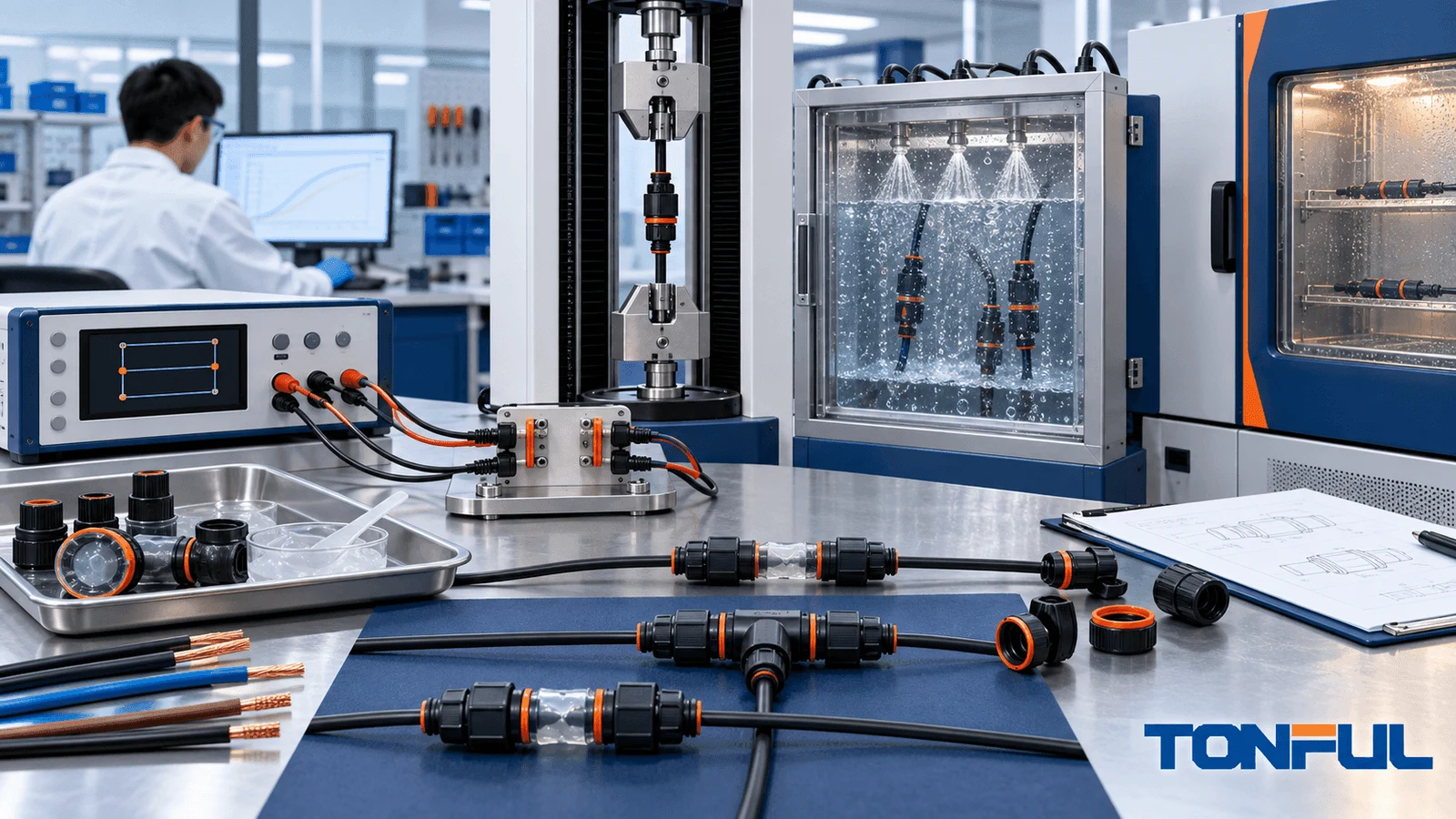
Waterproof wire connector testing must prove two functions: the conductors remain electrically and mechanically connected, and the connector limits moisture under its specified conditions. A connector that survives a water test but has weak conductor retention is not acceptable. A strong splice with an incomplete seal is also not acceptable.
The exact test plan depends on the product standard, certification scope, conductor combinations, voltage, materials, and intended location. This guide explains the main test categories without inventing universal limits.
Test Plan Overview
| Test group | What it evaluates | Typical evidence |
|---|---|---|
| Construction review | Materials, dimensions, fill, assembly | Drawings, material records, dimensional data |
| Electrical testing | Contact stability and insulation | Resistance, continuity, dielectric or leakage results |
| Mechanical testing | Conductor retention and housing integrity | Pull or retention data, torque observations |
| Environmental testing | Moisture, temperature, corrosion, UV or cycling | Conditioned sample results and inspection |
| Production control | Lot-to-lot consistency | Incoming, in-process, and final inspection records |
UL Solutions identifies UL 486D and UL 486G for sealed wire connector systems and sealed twist-on connecting devices. A certification program uses the applicable standard and product construction; a factory should not create acceptance numbers from a general blog article.
1. Construction and Material Verification

Testing begins before electrical power or water is applied. Inspectors confirm that samples match the documented construction.
Common checks include:
- Shell dimensions and wall condition
- Spring or conductor-gripping component
- Conductor material compatibility
- Sealant type and fill consistency
- Wire-entry geometry
- Strip length and insertion depth
- Lot identification and label information
Sealant quantity should be controlled, but fill mass by itself does not prove sealing. Distribution around the installed conductor bundle matters. A connector with the correct fill weight can still trap a void if the wires are misaligned or the housing is damaged.
TONFUL’s manufacturer audit checklist helps buyers examine material control, traceability, and inspection records around these tests.
2. Electrical Contact Testing
The connector must maintain a stable conductive path through the splice. Depending on the product and qualification plan, testing may assess continuity, connection resistance, temperature rise, dielectric strength, or leakage after conditioning.
Important controls include:
- Use the specified conductor material and wire combination
- Prepare wires with controlled strip length
- Install samples with the required method
- Record ambient and sample conditions
- Measure before and after environmental conditioning when required
- Inspect the failure mode rather than reporting only pass or fail
Do not confuse low-voltage continuity checking with a complete connector qualification. Continuity can confirm that a path exists, but it does not prove long-term contact stability, insulation performance, or environmental sealing.
3. Mechanical Retention Testing

Mechanical testing checks whether conductors remain secured during handling and service. A controlled pull or retention test applies force in a defined direction and records movement or separation according to the applicable method.
The test setup should document:
- Connector model and lot
- Complete wire combination
- Solid or stranded construction
- Installation tool or torque method
- Conditioning before the test
- Pull direction and rate
- Result and failure location
For twist-on connectors, weak retention can indicate an incorrect combination, insufficient installation, damaged spring, poor strip length, or conductor contamination. For a sealed system, mechanical movement can also disturb the moisture barrier.
4. Moisture and Ingress Testing
Water testing must represent a defined requirement. Spraying, immersion, pressure, duration, water depth, sample orientation, and post-test inspection can all change the meaning of the result.
A typical evaluation may include:
- Install connectors on specified wire combinations.
- Condition samples as required.
- Expose them to the defined moisture procedure.
- Perform required electrical checks during or after exposure.
- Open or section samples when the method calls for internal inspection.
- Record water paths, corrosion, sealant displacement, and electrical changes.
An internal demonstration tank is useful for process monitoring but does not replace third-party certification. TONFUL’s guide to waterproof connector standards explains why IP claims and sealed-connector listings must be interpreted separately.
5. Temperature and Environmental Conditioning
Outdoor connectors can experience heat, cold, condensation, UV exposure, soil chemistry, fertilizer, salt, and movement. Qualification may therefore include thermal aging, temperature cycling, corrosion exposure, UV conditioning, or other product-specific procedures.
Conditioning is most useful when followed by electrical, mechanical, and visual checks. A housing that still looks normal may hide reduced spring force or conductor corrosion. A compound that remains soft may still have moved away from a wire entry.
For direct-burial applications, review TONFUL’s UL 486D silicone-filled wire nut guide and verify the product’s exact approved location.
6. Wire-Combination Testing
A model range such as #22 to #8 AWG does not mean every bundle between those values has been tested. Qualification should cover the combinations defined by the product program, including difficult minimum-fill and maximum-fill conditions.
Buyers should ask for:
- Approved combination table
- Worst-case rationale
- Solid and stranded coverage
- Mixed-gauge coverage
- Strip-length tolerance
- Installation instructions used for testing
TONFUL’s waterproof wire nut selection guide can help convert an application into a combination request.
7. Production Quality Checks
Certification testing qualifies a construction; production control helps keep shipped parts consistent with it. Useful factory checks may include dimensions, shell appearance, spring presence, sealant fill, lot marking, packaging, and periodic functional verification.
The control plan should define sampling frequency, acceptance criteria, reaction plan, equipment calibration, nonconforming-product control, and traceability. Claims such as “100% tested” should identify what is actually checked on every unit.
Questions to Ask a Supplier
- Which standard and exact model scope apply?
- Can you provide the current certification record?
- Which conductor combinations are approved?
- Which tests are third-party certification tests and which are internal controls?
- What changes require customer notification?
- How are sealant and spring lots traced?
- Can samples be supplied with the same construction as production parts?
Build a Controlled Qualification Matrix
A useful qualification matrix links every test to a defined risk, sample condition, measurement method, and acceptance source. “Waterproof test passed” is not a sufficient record because it does not identify the exposure, the electrical state during exposure, or what was inspected afterward. Assign each sample a unique ID and retain the connector model, revision, lot, conductor manufacturer, gauge, construction, insulation, strip length, installer, and installation date.
| Record field | Required entry |
|---|---|
| Sample identity | Connector part number, revision, lot, and sample ID |
| Wire configuration | Quantity, gauge, solid/stranded construction, conductor and insulation |
| Installation | Strip length, preparation method, tool or torque instruction, installer |
| Conditioning | Temperature, moisture, corrosion, UV, or aging sequence and duration |
| Measurement | Instrument, range, resolution, accuracy, calibration status, and test points |
| Result | Initial value, conditioned value, change, observations, and failure mode |
| Acceptance | Drawing, certification file, standard clause, or customer specification |
| Disposition | Pass/fail, reviewer, date, retained sample, and corrective-action reference |
The sample quantity must come from the applicable certification program, qualification plan, or customer requirement. Record how samples were allocated among destructive and nondestructive tests. If a specimen is damaged by fixture slip, incorrect preparation, equipment interruption, or an unauthorized test deviation, classify it as invalid, preserve the evidence, and apply the preapproved retest rule. Never discard an inconvenient result and simply test another sample.
Measure Resistance and Temperature Correctly
Low resistance requires more control than a continuity buzzer. Define the current, polarity, stabilization time, ambient temperature, and exact Force and Sense locations. A four-wire Kelvin method minimizes current-lead resistance, but everything between the Sense points remains part of the reported path. If forward/reverse measurement or offset compensation is used to reduce thermal EMF, document the calculation and instrument mode. State whether equal lengths of unspliced reference wire are measured and subtracted.
Temperature-rise testing must use the specified conductor bundle, loading sequence, mounting orientation, enclosure condition, and thermocouple location. The connector may be one source of heat, but conductor size, nearby components, and enclosure airflow also influence temperature. Record the stabilized load and temperature data rather than describing the sample as merely “warm” or “cool.” Acceptance limits must be taken from the governing document.
Correlate Sealing with Electrical and Mechanical Results
Environmental exposures should not be reviewed in isolation. After moisture, cycling, or corrosion conditioning, repeat the electrical measurement and required retention test, then compare each sample with its own initial data. Photograph wire entries and any water path before disassembly. If sectioning is required, preserve the cut location and sample identity.
| Observation | Evidence to collect | Possible confirmation path |
|---|---|---|
| Resistance increase | Raw readings, reference wire, Sense locations, teardown | Contact movement, corrosion, contamination, or conductor damage |
| Reduced retention | Force curve, failure location, wire condition | Wrong combination, poor installation, spring damage, or material change |
| Moisture beyond seal | Orientation, exposure record, entry photographs | Fill void, damaged housing, capillary path, or incorrect wire bundle |
| Housing crack | Lot, dimensions, conditioning history | Molding defect, chemical incompatibility, impact, or thermal stress |
| Sealant displacement | Fill mass, installation photos, aging sequence | Underfill, overfill, migration, or wire movement |
One result may have several plausible causes. Quarantine the affected lot, review traceability, compare retained samples, and confirm the mechanism before changing material, tooling, or work instructions.
Frequently Asked Questions
Does an immersion test prove direct-burial suitability?
No. A demonstration may show short-term sealing under one condition. Direct-burial approval depends on the applicable product standard, certification scope, voltage, installation, and location requirements.
Should every connector be pull-tested?
Pull testing may be destructive or impractical for every shipped part. The applicable control plan determines qualification, periodic, and production checks.
Can buyers use supplier test reports instead of certificates?
Internal reports are useful evidence but do not replace required third-party certification. Match the report, certificate, drawing, and shipped model.
Build a Test Plan Around the Application
TONFUL supplies waterproof wire connectors for B2B and OEM/ODM programs. Share the wire combinations, environment, voltage, target market, and approval requirements so the team can provide a candidate product, current documents, and samples for your qualification plan. Review the current TONFUL waterproof wire nut range before requesting samples.