
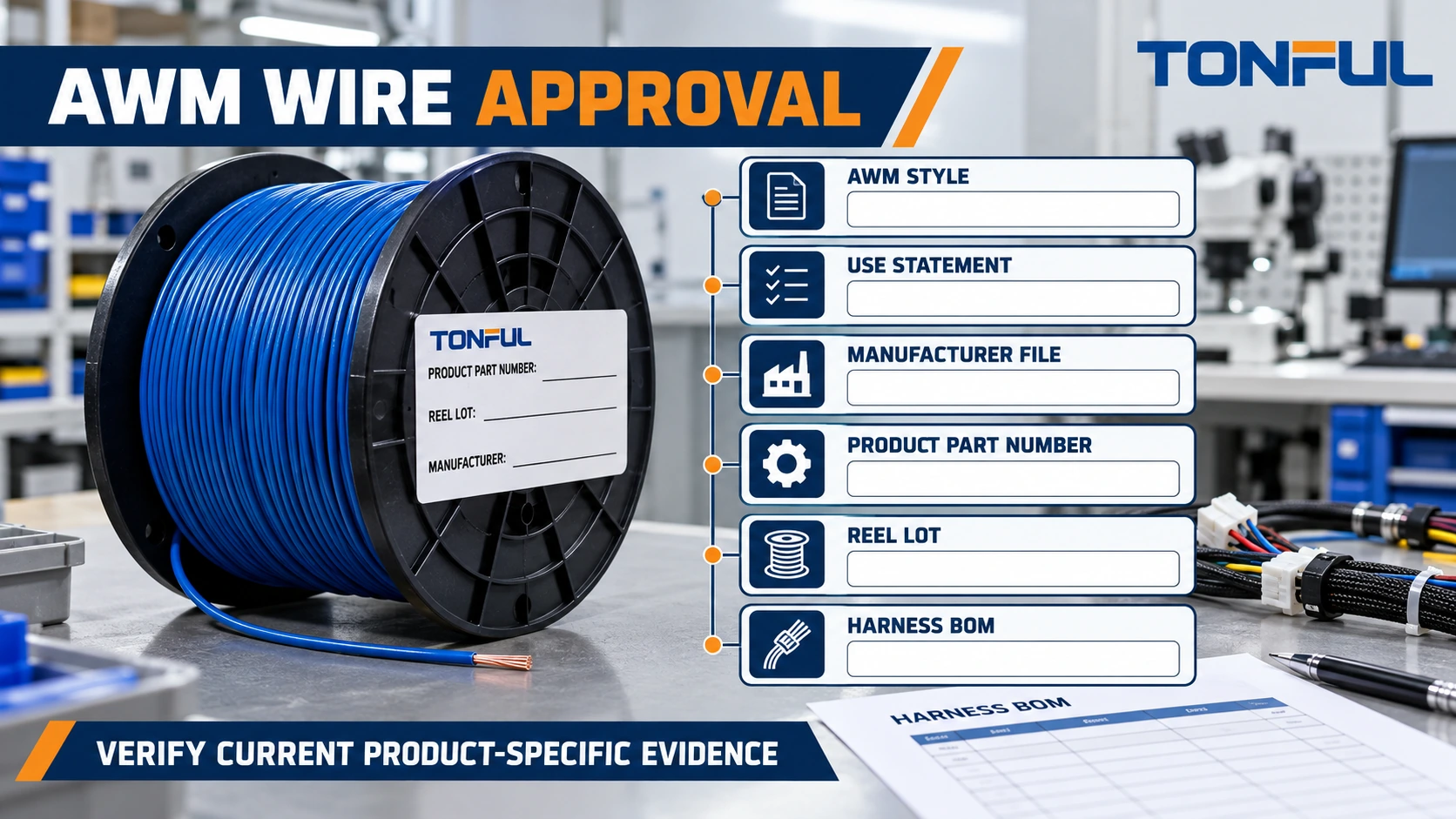
An AWM style number is not a complete custom-harness wire specification. Appliance Wiring Material (AWM) is a UL Recognized Component category used for factory-installed wiring under defined conditions. The applicable style page describes a construction and scope, but the harness buyer must still verify the actual manufacturer, product, file, conductor, insulation, ratings, use statement, markings and end-product requirements.
This distinction prevents two common errors. First, a style number found on a marketplace listing is not proof that the supplied reel is authorized under that style. Second, AWM recognition does not automatically make a conductor suitable for field wiring, a branch circuit or every listed end product. Approval remains connected to the exact wire and the conditions under which the completed equipment is evaluated.
For a custom harness, the practical task is to convert “use UL wire” into a controlled purchasing and production record. That record must survive quotation, incoming inspection, cutting, stripping, termination, assembly, final test and future repeat orders.
What UL AWM Means and What It Does Not Mean
UL’s Wire and Cable Application Guide explains that Component-Appliance Wiring Material is factory-installed component wiring and does not carry an NEC wire Type designation simply because it is AWM. Component wire is generally not evaluated for field installation unless it is used within the scope of a complete listed product or system. Therefore, “UL AWM” should not be rewritten as “UL Listed building wire.”
The AWM style describes an evaluated construction framework. Depending on the style, it can address single or multiple conductors, insulation or jacket construction, conductor range, temperature, voltage, flame performance, internal or external wiring use, and special conditions. The use statement matters as much as the headline rating. Two styles with similar voltage and temperature fields can have different intended uses.
AWM recognition also does not approve the finished harness for every application. A harness may include terminals, connectors, seals, splices, tubing, braid and labels that require separate evaluation. The end-product manufacturer or certifying body decides whether the complete construction is acceptable for the equipment.
Read an AWM Style Page in the Correct Order
Use the current UL Product iQ record or other controlled UL source rather than an archived screenshot. Historical style pages may help research, but their own notices can direct users to the current database. Record the access date and retain the applicable evidence with the project file.
| Style-page field | What to record | Why it matters |
|---|---|---|
| Style number | Full number and current source | Prevents substitution by a similar-looking style |
| Construction | Single/multiple conductor, jacket, shield and optional layers | Defines what the style actually covers |
| Conductor | Size range, material and solid/stranded conditions | Must include the purchased construction |
| Insulation/jacket | Material and controlled construction reference | Polymer name alone is insufficient |
| Rating | Temperature, voltage and stated flame or exposure classifications | Limits must remain tied to the style and product |
| Use statement | Internal, external, interconnection or special-use scope | Prevents use outside the evaluated purpose |
| Marking | Required surface, tag, carton or procedure marking | Supports receiving verification |
| Manufacturer procedure | File/facing-page information where applicable | Connects the style to the authorized producer and construction |
Do not combine favorable fields from different styles. A temperature from one style, sunlight claim from another and preferred wall thickness from a third do not create a valid hybrid wire. TONFUL’s wire AWG and insulation guide explains how current, conductor construction, insulation and route conditions should be specified together.
Distinguish Style, Manufacturer File and Product Part Number
Three identifiers answer different questions. The AWM style identifies a UL construction category and use scope. The manufacturer file or certification record identifies the organization authorized for the covered construction. The supplier’s product part number identifies the specific commercial wire ordered. A controlled BOM should preserve all three when they are applicable.
The same style may be produced by multiple authorized manufacturers, but their wire products are not automatically interchangeable in a released harness. Outside diameter, strand count, nominal wall, color availability, surface print, strip behavior and terminal compatibility may differ while remaining within their respective controlled constructions. Engineering must approve alternatives rather than allowing purchasing to substitute by style alone.
Likewise, a catalog description that says “meets Style XXXX” should be checked against the current certification record and manufacturer documentation. Save the source, revision or access date, exact part number and reel/lot evidence. Do not use a reseller’s generic photo as the primary approval record.

Translate the Style Into a Harness Drawing and BOM
The harness drawing should state enough information to prevent silent material changes. At minimum, define conductor size and material, strand construction where important, insulation or cable construction, color, approved manufacturer and part number, AWM style or other governing specification, and applicable rating or use constraints. Add outside diameter when connector seals, grommets or routing space depend on it.
The BOM should identify approved alternatives separately. Each alternate needs evidence that its wire construction fits the same terminal, seal, connector, routing and validation boundary. “Equivalent UL wire” is not a sufficient alternate description.
For every circuit, check electrical and thermal design independently. AWM voltage and temperature markings do not select conductor size, establish circuit protection or calculate current capacity for the installed harness. Route temperature, bundle heating, duty cycle and end-product requirements still apply. The TONFUL automotive harness heat-and-space guide shows why local routing conditions can be more important than a broad catalog label.
Verify Incoming Reels and Packaging
Receiving inspection should compare the purchase order, approved BOM and physical delivery. Do not cut the wire first and investigate the evidence later. Quarantine discrepancies before the reel enters production.
| Receiving field | Required evidence |
|---|---|
| Supplier and manufacturer | Purchase record and manufacturer identity |
| Product part number | Reel, spool, tag or package label |
| AWM style and file | Applicable print/label plus current certification record |
| Conductor | AWG/mm², material and strand construction as specified |
| Insulation | Color, OD and construction-relevant checks |
| Quantity | Reel length/weight or controlled receiving quantity |
| Lot/date code | Manufacturer lot, production code or traceable batch identifier |
| Documentation | Certificate/report required by the contract |
| Disposition | Accepted, quarantined or approved deviation with authority |
Surface printing can support identification, but absence or format must be judged against the applicable marking rules and manufacturer procedure. A short cut length may not retain every repeated legend. Preserve reel labels and packaging records so finished harness lots remain connected to the source even when individual wires no longer show a complete marking.
Photographs should capture the full label and context, not only the style number. Record who inspected it and when. If the label, certificate and purchase record conflict, quarantine the material; do not choose the most convenient source.
Maintain Lot Traceability Through Production
Wire traceability can be lost when a large reel is divided among cutting machines, partial reels and work orders. Define the smallest production unit that must retain identity. A typical controlled chain is receiving lot → internal material lot → reel or partial reel → cutting job → harness work order → finished lot or serial record.
Transfer the approved identifiers whenever material is rewound or moved. Avoid handwritten shorthand that omits the manufacturer or lot. Control remnants and returns to stock so two lots are not merged under one label. If traceability is required at serial level, the manufacturing record must associate each completed unit with the consumed wire lot; if lot-level traceability is sufficient, define the lot boundary and segregation rule.
UL traceability guidance illustrates why component identity and authorized markings matter through off-site harness assembly. Apply the current project, certification and factory procedures rather than treating historical guidance as a universal label template.

Control Cutting, Stripping and Termination by Exact Wire
Changing wire product can change manufacturing even when style and AWG remain the same. Strand diameter and count affect compression. Insulation OD, hardness and wall affect stripping, insulation support and connector seals. Surface characteristics can affect feeding, printing and overmolding.
Approve strip tools, blade or program, strip length and inspection criteria for the actual wire. Check for nicked or missing strands, stretched insulation, residue and unacceptable insulation edges. For crimped contacts, use the terminal manufacturer’s application specification to set conductor and insulation crimp requirements. Record the applicator or hand tool, setup, crimp-height evidence where specified, pull-test result and failure mode. The TONFUL crimp pull-force guide explains why sample preparation, rate, grips and acceptance source belong in the record.
If a wire alternate is introduced, re-evaluate the affected tooling and connector interfaces. A supplier declaration of the same style cannot replace a production-intent crimp and seal review.
Local protection also needs its own controlled construction. If tubing is added over a termination or branch, use the TONFUL heat-shrink material guide to compare recovery process, installed wall and insulation compatibility; an approved AWM wire does not automatically qualify the added tubing or heating process.
Separate Recognition Evidence From Harness Tests
AWM evidence and harness production tests answer different questions. Recognition supports the covered wire construction under its evaluated scope. Continuity verifies that the finished assembly follows the approved circuit matrix. Pull or retention tests evaluate terminations under defined conditions. Insulation-resistance, dielectric, sealing or environmental tests may be required by the end product or customer.
The TONFUL continuity-testing guide explains how cavity maps, opens, shorts and cross-connections are controlled. A passing continuity test cannot prove that the correct wire style or lot was used. Conversely, a correct reel label cannot prove that the harness was wired correctly. Both material identity and assembly verification are necessary.

Manage Alternatives and Engineering Changes
Require formal review before changing manufacturer, part number, construction, source, color, stranding, OD or marking. The review should identify affected drawings, terminals, seals, tooling, route space, tests, certifications and customer approvals. Define whether existing inventory can be consumed and how mixed lots will be prevented.
An approved alternate should have its own evidence set, not a note saying “same as original.” Record the style, file, manufacturer, product data, sample results and approval date. If a certification status changes, quarantine new receipts until the released BOM and end-product impact are reviewed.
Audit traceability in both directions. Select a finished harness and trace it back to the wire lot and receiving evidence. Then select a wire lot and identify every affected finished lot or serial number. A failed exercise reveals recall and containment risk even when the wire itself is conforming.
Copyable AWM Wire Approval Record
| Record field | Required entry |
|---|---|
| Project and harness drawing | Number, revision and customer scope |
| Circuit(s) | Wire IDs and locations using this product |
| Wire manufacturer/product | Legal manufacturer and exact part number |
| AWM evidence | Style, file/category, current source and access date |
| Use statement | Internal/external/special scope and application fit |
| Ratings/classifications | Only the fields supported by the controlled record |
| Physical construction | Conductor, strands, insulation, OD, wall and color |
| Terminal/seal compatibility | Application specification and sample evidence |
| Manufacturing controls | Cut/strip setup, crimp tool and inspection plan |
| Incoming traceability | Label, lot/date code and retained documents |
| Harness tests | Continuity and other project-required verification |
| Alternate/change status | Approved list, deviation or unresolved issue |
| Approval | Engineer, quality reviewer and date |
Specify Traceable Harness Wire With TONFUL
Send TONFUL the released wire and harness specifications, required AWM style and use scope, approved manufacturer/part number list, connector and terminal requirements, incoming-document expectations, lot-traceability level and production test plan. TONFUL can align purchasing, receiving, cutting, termination and harness records to the defined project. Final end-product suitability and certification remain governed by the applicable equipment requirements and controlled approval evidence.