
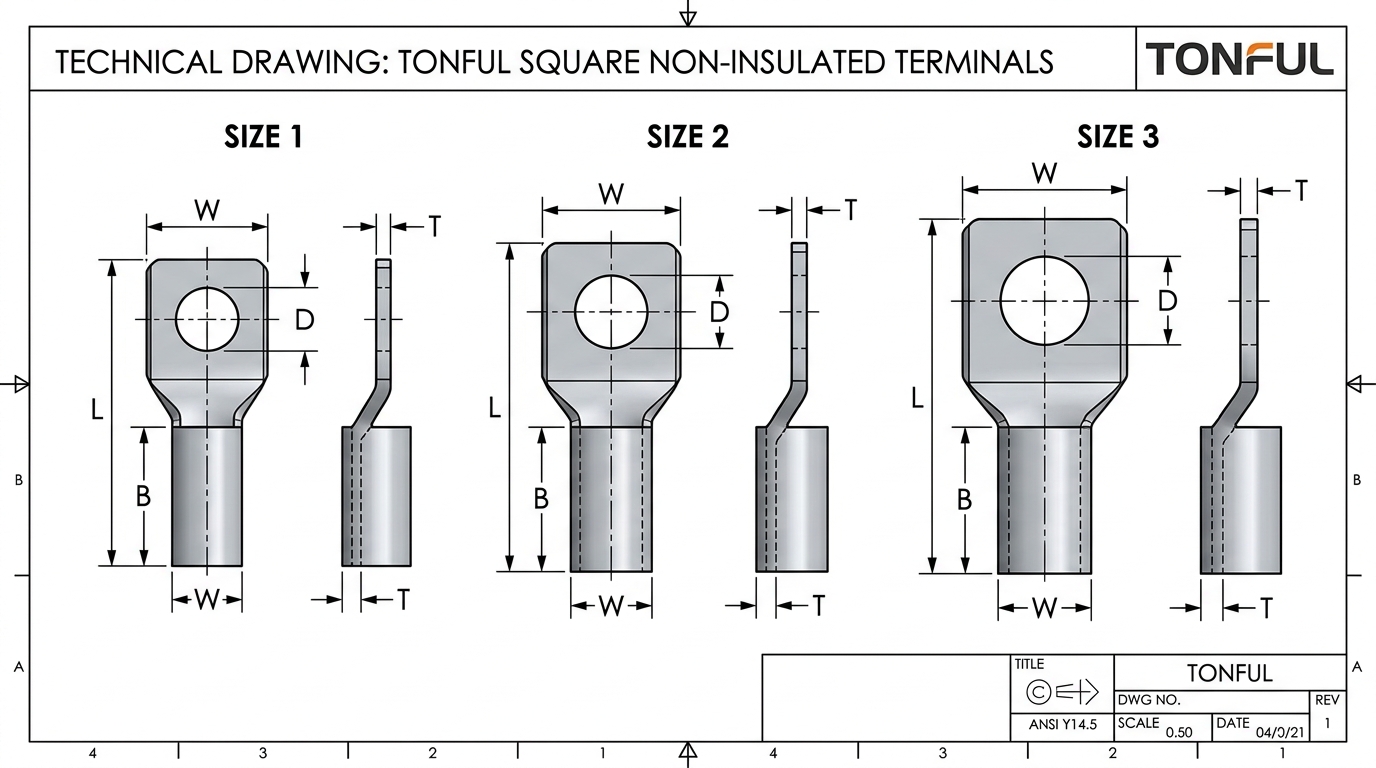
A square non-insulated terminal is a bare-metal crimp connector whose flat, four-sided barrel is engineered to lock into barrier strips, busbar blocks, and terminal boards without rotating under torque. Unlike its insulated counterpart, it carries no nylon or vinyl sleeve, which exposes the crimp for visual inspection and lets the terminal accept higher continuous currents in confined, controlled enclosures. For OEMs building wire harness assemblies, distribution panels, and battery banks, that combination of anti-rotation geometry and inspectable bare copper is the reason the square non-insulated terminal remains a workhorse in high-reliability power distribution. This article walks through its structure, material standards, field applications, and the selection criteria that separate a compliant joint from a latent failure point.
What Is a Square Non-Insulated Terminal?
At its core, the square non-insulated terminal is a stamped, tin-plated copper or brass lug formed into a closed-barrel sleeve with a flattened, four-edges profile and a mounting tongue terminated in a stud hole. The square geometry is not cosmetic. When the terminal seats into a barrier strip or a slotted busbar, those four flat edges act as mechanical keys that resist the rotational force a screw or set-screw applies during tightening. A round barrel, by contrast, can spin under vibration or torque, slowly work-hardening the contact zone until resistance climbs and heat builds.
The non-insulated design strips away the polymer sleeve for three functional reasons. First, it lets the technician see the crimp—every strand engaged, no stray wires bridging to an adjacent terminal. Second, it allows the terminal to be paired with heat shrink tubing chosen specifically for the environment, whether that is adhesive-lined polyolefin for marine duty or high-temperature fluoropolymer for engine bays. Third, bare copper and tin-plated brass sustain higher operating temperatures than PVC or nylon sleeves, which typically degrade above 105°C. Tin-plated versions run to +150°C; bare copper can serve continuously up to +340°C in non-oxidizing enclosures.

Material and Plating Standards
The performance ceiling of a square non-insulated terminal is set first by its base alloy and second by its surface plating. TONFUL manufactures these terminals from high-purity electrolytic copper or brass, with electro-tin plating as the standard finish and bare copper or silver plating available for custom orders. Tin plating serves two jobs: it suppresses oxidation of the copper substrate, and it lowers contact resistance by forming a soft, conformable oxide layer that deforms under mating pressure to enlarge the true contact area. For a deeper comparison of base metals, see copper vs. brass terminals.
Plating thickness matters as much as plating chemistry. Industry benchmarks such as MIL-T-10727C Type 1 and ASTM B545 specify tin plating between 0.0001″ and 0.00025″ (2.5–6 µm). Below that range, the copper diffuses through the tin and oxidizes at the interface; above it, the plating becomes brittle and prone to whiskering under thermal cycling. The tin-plated copper terminal corrosion standards article covers the salt-spray and humidity-cycling protocols used to qualify a plating line. For applications where the terminal sees engine-bay temperatures or EV battery pack duty, silver plating is sometimes specified for its superior conductivity and high-temperature stability.
The barrel itself is formed with a brazed or butted seam. A brazed seam is preferred for heavy-current lugs because the joint is fused and cannot split open under an indent-crimp die. A butted seam is acceptable for lighter-gauge work and accepts any standard low-cost crimper, but it demands a properly sized die to avoid splaying the seam. Internal barrel serrations—small longitudinal grooves pressed into the bore—grip the wire strands during crimping and reduce pull-out force variability.

Core Applications Across Industries
The square non-insulated terminal earns its place wherever a conductor must terminate at a fixed stud, busbar, or barrier strip with mechanical security and high current density. The table below maps the dominant application sectors against the demands that drive terminal selection in each.
| Application Sector | Typical Current Range | Key Driver for Square Non-Insulated | Recommended Plating |
|---|---|---|---|
| Switchgear & distribution panels | 60–300 A | Anti-rotation lock into barrier strips; visual crimp inspection | Tin-plated copper |
| EV battery packs & BMS modules | 100–470 A | High current density, compact envelope, heat-shrink pairing | Tin or silver-plated |
| Industrial control panels | 15–115 A | DIN-rail terminal block engagement; maintenance re-termination | Tin-plated brass |
| Marine & off-road battery banks | 50–255 A | Vibration resistance; heat-shrink seal against moisture | Tin-plated copper |
| Renewable energy (solar inverters, wind junction boxes) | 115–470 A | Long-term thermal cycling; UV-resistant enclosure | Tin or silver-plated |
| Heavy-duty truck & fleet harnesses | 60–215 A | Engine-bay temperature tolerance; harness assembly density | Tin-plated copper |
| Power tools & appliances | 15–60 A | Cost-sensitive high-volume crimp; automated termination | Tin-plated brass |
In switchgear and distribution panels, the square barrel seats into slotted barrier strips where a set-screw bears down on two of the four flat faces. The geometry prevents the terminal from rotating as the screw torques down, which keeps the conductor aligned and the contact pressure even. For panel builders integrating automotive terminals and connectors into mixed-power enclosures, that anti-rotation behavior is what separates a terminal that survives a seismic or short-circuit event from one that backs out.
In EV battery packs, the terminal links cell modules to busbars and BMS sense lines. Currents of 200–470 A are routine during regenerative braking or fast-charge events, and the terminal must dissipate that heat without a polymer sleeve softening at the crimp. Pairing a bare tin-plated terminal with adhesive-lined heat shrink gives the assembly both the thermal headroom of bare copper and the environmental seal of an insulated joint. The cold-pressed terminals in EV battery packs article details the pull-force and micro-ohm resistance targets these joints must hit.
In marine and off-road installations, vibration and moisture are the twin enemies of any termination. The square non-insulated terminal, crimped with the correct die and sealed with heat shrink, resists both—provided the base material is genuine copper and not a copper-clad aluminum substitute. For high-current marine grounding, the heavy-duty copper lugs sizing guide walks through the AWG-to-stud matching that prevents hot joints at the battery post.
Insulated vs. Non-Insulated: When to Choose Bare
The choice between an insulated and a non-insulated terminal is a choice about where the insulation lives. A pre-insulated terminal fixes the insulation at the factory: a nylon or vinyl sleeve covers the crimp zone, protecting against incidental contact and mild moisture. A non-insulated terminal defers that decision to the installer, who can specify heat shrink tubing rated for the actual environment—or leave the joint bare inside a sealed, controlled enclosure. The insulated vs. non-insulated wire connectors guide covers the trade-offs in depth.
| Attribute | Square Non-Insulated Terminal | Pre-Insulated Terminal |
|---|---|---|
| Crimp inspectability | Fully visible | Hidden under sleeve |
| Max operating temperature | +150°C (tin) / +340°C (bare Cu) | +105°C (PVC) / +125°C (nylon) |
| Current density | Higher (no sleeve mass) | Lower (sleeve limits heat dissipation) |
| Anti-rotation in barrier strips | Square edges lock in | Round barrel, no keying |
| Environmental sealing | Requires heat shrink | Built-in (basic) |
| Tooling | Standard non-insulated crimper | Insulated-crimp die with color nest |
| Cost per termination | Lower | Higher |
| Best use case | Panels, battery banks, harnesses in controlled enclosures | Field service, exposed terminations, quick-disconnect work |
Non-insulated terminals are the right call when the enclosure already provides the isolation—a busbar chamber, a sealed battery box, a DIN-rail terminal block row. They are the wrong call when the termination sits exposed to touch, to weather, or to adjacent conductors that could short to the bare barrel. In those cases, a pre-insulated terminal or a heat-shrink-sealed non-insulated terminal is the compliant path. The cold-press terminal vs. soldering comparison extends this logic to the termination method itself.

Crimping and Installation Best Practices
A square non-insulated terminal fails far more often from a bad crimp than from a bad alloy. The crimp is a cold weld: the die compresses the barrel and the wire strands into a single, gas-tight mass with no air gaps where oxidation could take hold. Achieving that requires the right die profile, the right strip length, and the right pull-force verification.
Strip length must match the barrel length so that the wire fills the barrel completely with a small portion of strand visible at the inspection hole. Too short and the crimp bites empty barrel; too long and stray strands protrude past the shoulder, risking a short to the adjacent terminal. Die selection follows the terminal’s seam type and wire gauge: a butted-seam terminal takes an indent or dimple die that compresses without splaying, while a brazed-seam lug accepts a hex or square die for maximum contact area. The F-crimp vs. O-crimp terminal profiles article breaks down which die geometry suits which terminal family.
Pull-force verification is the non-negotiable quality gate. After crimping, the joint must survive a tensile pull test calibrated to the wire gauge—typically 35–40 lbf for 12 AWG, scaling up to several hundred pounds for 2/0 AWG lugs. A joint that pulls out below spec indicates either an under-crimp, a mismatched die, or a wire that was not fully inserted. The crimp pull-force testing guide and the tensile test and metallographic analysis of cold-pressed terminals articles specify the test fixtures and pass criteria. For production lines, crimping tool maintenance and calibration is what keeps the die within spec across thousands of cycles—a ratcheting crimper that drifts out of calibration will produce visually identical but electrically weaker joints.
Compliance adds a second layer. CE-marked terminals destined for the European market and UL-listed terminals for North America carry different test sequences, and a terminal qualified to one standard is not automatically qualified to the other. The CE vs. UL certification for electrical terminals comparison maps the overlap and the gaps.

Selection Guide: Matching Terminal to Load
Selecting the right square non-insulated terminal starts with three numbers: the wire cross-section, the stud size, and the continuous current. TONFUL’s product line spans 22 AWG (0.5 mm²) up to 2/0 AWG (70 mm²) with stud holes from #10 (5.3 mm) through 1/2″ (13 mm), supporting continuous currents up to 470 A. The abbreviated selection table below maps the mid- to high-current range; the full square non-insulated terminals product page carries the complete dimension chart.
| Item No. | Cable Size (AWG) | Cable Size (mm²) | Max Current | Stud Size | Thickness (mm) |
|---|---|---|---|---|---|
| CB 22-5 | 4 | 16–25 | 115 A | #10 (5.3 mm) | 1.7 |
| CB 38-5 | 2 | 35–50 | 160 A | #10 (5.3 mm) | 1.8 |
| CB 60-8 | 1/0 | 50–70 | 215 A | 5/16″ (8.4 mm) | 1.7 |
| CB 80-10 | 1/0 | 95–120 | 255 A | 3/8″ (10.5 mm) | 2.2 |
| CB 100-10 | 4/0 | 120–150 | 300 A | 3/8″ (10.5 mm) | 2.6 |
| CB 150-12 | 250 kcmil | 150–185 | 395 A | 1/2″ (13 mm) | 3.2 |
| CB 200-12 | 400 kcmil | 240–300 | 470 A | 1/2″ (13 mm) | 4.0 |
Three rules govern selection. Derate for ambient temperature: a 300 A terminal in a 70°C enclosure carries less than its nameplate. Match the stud, not the wire: a terminal sized for the wire but drilled for a smaller stud will trap the conductor off-center and concentrate contact pressure on one edge. Verify the plating against the environment: tin-plated terminals survive most industrial enclosures, but marine engine rooms and chemical plants often demand silver or a sealed heat-shrink overlay. For OEMs specifying custom stud holes, metal thicknesses, or bend angles, TONFUL offers custom tooling—the terminals and connectors manufacturer page outlines the OEM customization workflow.

Short FAQ
Q: Can a square non-insulated terminal be used outdoors? Only if it is sealed after crimping with adhesive-lined heat shrink tubing or installed inside a rated enclosure. The bare barrel has no inherent moisture protection. For direct burial or exposed outdoor work, follow the how to choose waterproof wire connectors guidance.
Q: What is the difference between a square and a round non-insulated terminal? The square barrel has four flat edges that lock into barrier strips and resist rotation under screw torque; a round barrel can spin and is better suited to free-standing stud connections. Both are non-insulated; only the barrel profile differs.
Q: Do I need a special crimping tool for non-insulated terminals? Yes. Non-insulated terminals require a non-insulated crimp die (indent, dimple, or hex profile)—not the color-nested die used for PVC or nylon sleeves. Using the wrong die under-compresses the barrel and produces a joint that fails pull-force testing. See how to crimp a terminal.
Q: Are square non-insulated terminals rated for EV battery packs? They are widely used in EV packs when paired with the correct plating and heat shrink. Currents up to 470 A are within the range of the CB 200 series. Verify against the BMS specification and the cold-pressed terminals in EV battery packs qualification protocol.
Q: Tin-plated or bare copper—which should I choose? Tin-plated is the default for most industrial and automotive work because it resists oxidation and is easier to solder. Bare copper is reserved for high-temperature applications (up to +340°C) where the tin plating would melt, or where solderability is not required. The why are cold-pressed terminals plated with tin or silver article covers the metallurgy.
Conclusion
The square non-insulated terminal occupies a narrow but critical niche: the termination that must carry high current, lock against rotation, and survive inspection in a controlled enclosure. Its value is not in any single attribute but in the combination of square-barrel geometry, bare-metal inspectability, and the freedom to pair it with whatever insulation the environment demands. Specified correctly, crimped with the right die, and verified by pull-force testing, it is one of the most reliable joints in power distribution. Specified casually, it becomes the weak link that turns a 470 A busbar into a failure point. For OEMs and panel builders sourcing at scale, the wire terminal manufacturer and TONFUL Electric pages are the starting point for qualified, RoHS- and CE-compliant supply.